
by
The right solar battery in Victoria matches how your home uses electricity, your backup needs, and the tariff you pay, not the one with the biggest capacity or the loudest sales pitch.
For most homeowners, the decision comes down to four things:
However, in 2026, the federal Cheaper Home Batteries Program can reduce eligible upfront costs through Small-scale Technology Certificates (STCs), while Victoria’s old interest-free battery loan is closed to new applications.
This guide shows what to compare, what current incentives mean, where payback can work, and the questions to ask before you sign.
Every Victorian household buys batteries for different reasons, so there isn’t one best battery that works perfectly for every household.
It’s better to first start with the outcome, then choose the system.
Start by deciding what you want the battery to achieve.
A battery stores electricity that would otherwise be exported or purchased later, then supplies it when your household needs it.
For a home with rooftop solar, adding a battery normally means storing surplus daytime generation and using it in the evening instead of buying electricity from the grid at a high price.
If blackout protection matters, say so before the system is designed.
A battery on the wall does not automatically mean your fridge, lights and internet will stay on when the grid fails.
So, make sure your installer knows what you want the battery to achieve so they can design the system with the right equipment.
An EV, induction cooking, heat-pump hot water and electric heating can significantly change when your home uses electricity.
A good battery recommendation from any expert should consider what your household may look like in five years, not simply last quarter’s bill.
Some homeowners want to use more of their own solar power instead of buying electricity from the grid.
This can be a worthwhile goal, even if the fastest payback isn’t the main priority.
Just make sure the quote clearly separates the lifestyle and backup benefits from the actual financial savings you can expect.
Yes, a solar battery can be a great addition for many Victorian households, but the actual answer depends much more on your household data than on Victorian averages.
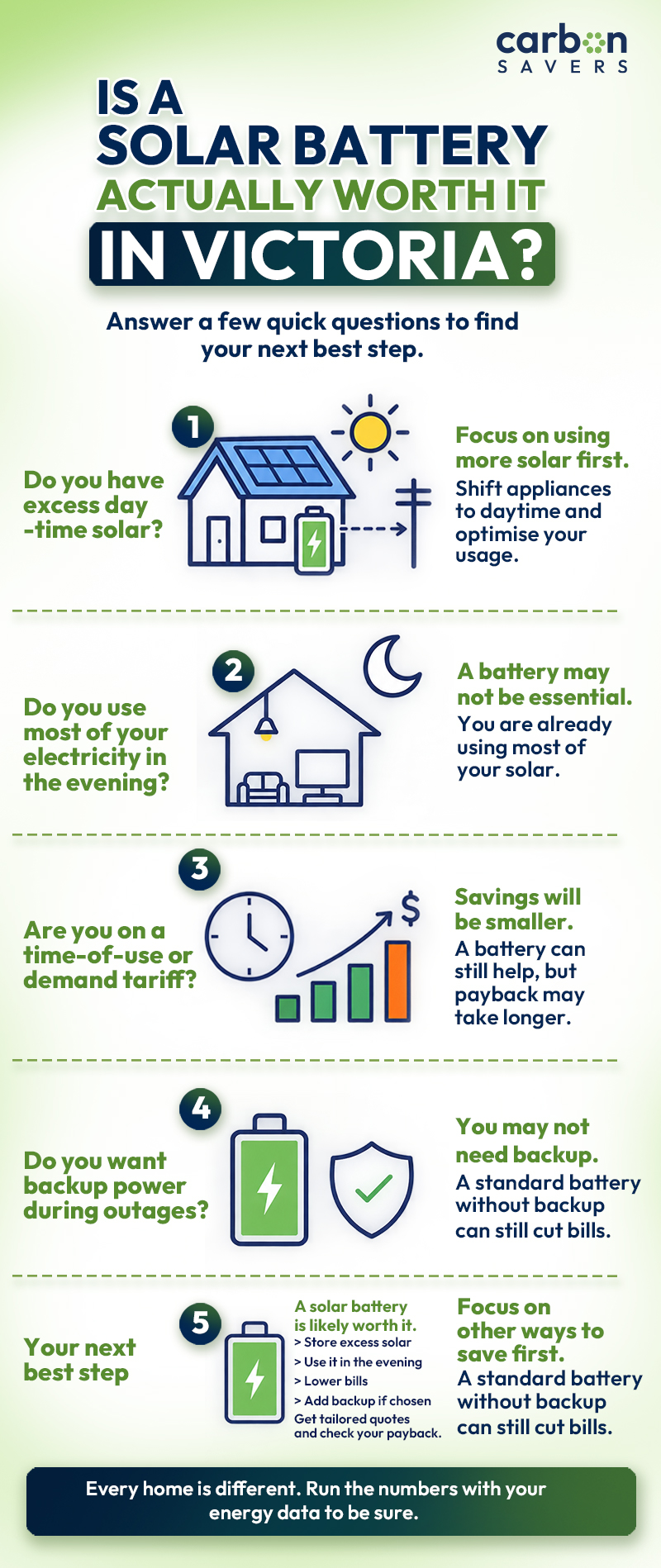
The case becomes stronger when you regularly export surplus solar during the day and then buy significant electricity back from the grid later.
Lower feed-in tariffs widen that gap even more. Since 1 July 2025, Victoria no longer has a regulated minimum feed-in tariff, and retailers can set their own export rate down to zero.1
If you use most of your solar while it is being generated, export little electricity or have relatively low evening consumption, a battery has fewer opportunities to save money.
Before buying battery storage, it can be worth moving flexible loads such as hot water, dishwashing or EV charging into solar-producing hours.
Generic payback claims are weak evidence.
A proper assessment should look at your imports, exports, tariff, and when electricity is consumed.
For this reason, many independent battery calculators use detailed models and interval or smart-meter data because those patterns materially affect expected savings.2
It’s better to compare battery prices based on the complete installed system, not just the advertised battery hardware.
The following table shows the recent data on average installed costs after the federal battery rebate:
| Battery size | Battery system only | Backup Time | Battery + inverter/charger |
|---|---|---|---|
|
5 kWh |
$5,325 |
4-6 hours |
$7,425 |
|
10 kWh |
$8,450 |
8-10 hours |
$10,150 |
|
15 kWh |
$11,325 |
12+ hours |
$13,125 |
|
20 kWh |
$14,300 |
24+ hours |
$16,500 |
Note: These figures are indicative Australian market averages only. They are not fixed Victorian prices and should be checked against current quotes.
The final battery cost depends on your installation complexity, switchboard work, backup equipment, battery location and the existing solar system. All of this can change the final quote.
The above figures include installation, GST and the federal battery rebate, while additional costs for difficult installations may sit outside the average.
This is an area where outdated information can cost homeowners money significantly.
Government incentives can change, so outdated information may lead to missed savings or incorrect expectations.
Always check the official Victorian Government website for the latest eligibility requirements, rebate amounts and program updates before making a decision.
Eligible batteries can receive support through the federal Small-scale Renewable Energy Scheme.
Instead of a fixed cash rebate, eligible systems create Small-scale Technology Certificates (STCs), which are commonly assigned to an agent or retailer in exchange for an upfront discount.
For installations from 1 May to 31 December 2026, the STC factor is 6.8 certificates per kWh of usable capacity before the size taper is applied.3
From 1 May 2026, support is tiered:
| Usable capacity band | STC factor applied |
|---|---|
|
Up to 14 kWh |
100% |
|
Above 14 to 28 kWh |
60% |
|
Above 28 to 50 kWh |
15% |
Only the first 50 kWh of usable capacity receives STCs, although eligible battery systems can have a nominal capacity between 5 and 100 kWh.4
Worked Example for Better Understanding
A qualifying 10 kWh usable battery installed in August 2026 sits entirely within the 100% tier.
At the 6.8 factor, that equates to 68 STCs.
Therefore,
The STC clearing-house price is fixed at $40 per certificate excluding GST, making 68 certificates worth $2,720 at that price before considering how the certificates are assigned, sold or incorporated into the retailer’s discount.5
Solar Victoria states that it is no longer taking applications for its interest-free solar battery loan. Homeowners researching a battery today should therefore not rely on previous advertising.6
Not all solar batteries are created equal. They have different chemistries, performance levels, and pricing.
Before comparing brands or prices, consider these eight factors.
At the decision level, compare these 8 things:
Capacity is measured in kilowatt-hours (kWh); power is measured in kilowatts (kW). They answer different questions: how much energy can be stored versus how quickly the system can deliver it.
Additionally, understanding the Depth of Discharge (DOD) can enhance your battery’s efficiency.
It tells you how much energy you can safely draw without degrading the battery’s lifespan. Look for batteries with 80% or higher to avoid frequent maintenance charges
Also, sizing, chemistry, battery lifespan and detailed specifications deserve their own explanation.
For these, see our guide on [ Battery Basics That Actually Matter: Size, Chemistry and What They Mean for You] rather than choosing from a spec sheet alone.
Before buying a battery, start with lifetime value rather than the lowest advertised price.
Look for an approved product, sensible warranty conditions, local technical support, compatibility with the wider system, and a reliable solar battery installer with a credible path for handling failures.
The Clean Energy Council maintains the approved battery list used for federal incentive eligibility; that list currently contains more than 1,000 lithium-based battery products and is updated as products are approved, suspended or delisted.7
Moreover, our brand-by-brand rankings and warranty comparisons belong in [ Which Battery Brand Is Right for You? Comparing Value, Not Just Price].
The important point here is simple: two batteries with the same capacity and a “10-year warranty” can still offer very different value.
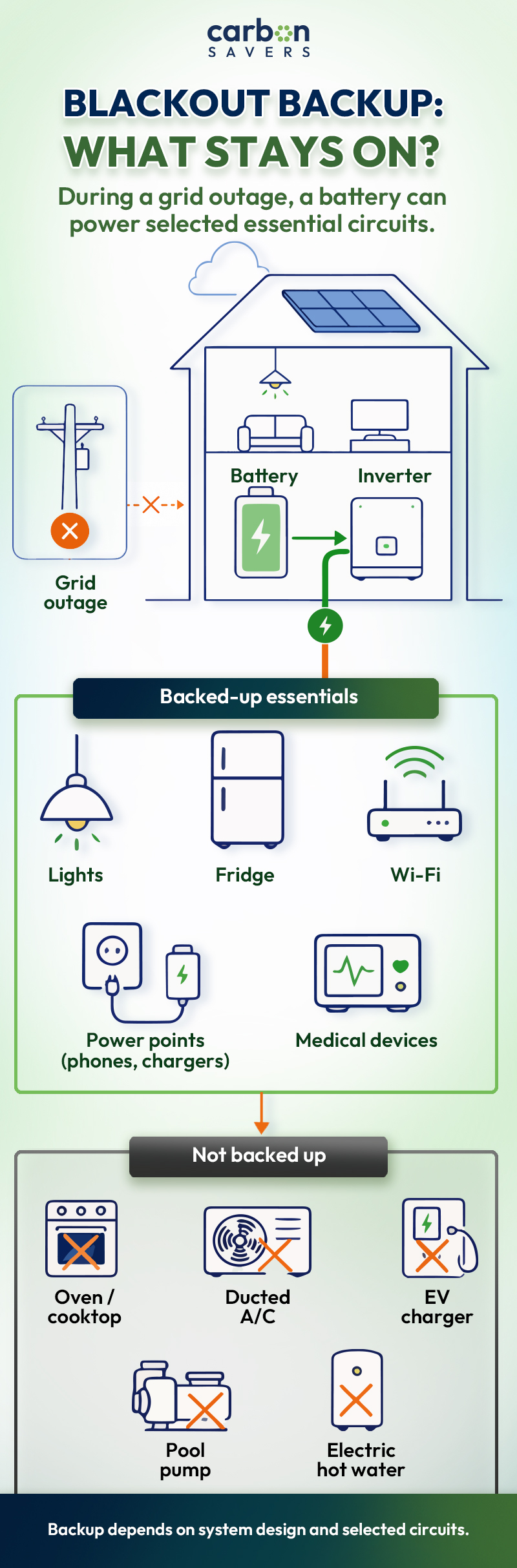
Solar Victoria explains that blackout operation depends on the battery, inverter and overall system design.
The home must safely disconnect from the grid during an outage, and the system needs to be specifically designed to supply backup power.8
Many households choose to protect a smaller group of circuits, such as the fridge, lighting, internet, and selected power points, rather than trying to run every appliance.
Ask your installer exactly which circuits remain live during a blackout.
Stored energy and output power are different things.
A battery may contain enough energy for hours of basic loads but still be unable to start or run several high-power appliances simultaneously.
Since Victoria removed its regulated minimum feed-in tariff, the value of exported solar depends on the retailer and plan.
The Essential Services Commission notes that solar’s major financial benefit comes from avoiding retail electricity purchases by using generation yourself.9
Hence, adding a battery can extend that self-consumption into the evening.
Victoria’s 2026–27 residential Victorian Default Offer includes a lower-priced 11 am-4 pm solar-soak period, a 4 pm-9 pm peak period and off-peak pricing outside those hours.10
For example, in the CitiPower zone, the 2026–27 VDO time-of-use rates are 16.59c/kWh during solar soak and 38.31c/kWh during the evening peak.
The Victorian Government says the optional Midday Power Saver will be available from 1 October 2026, with three hours of free electricity from 11 am to 2 pm every day for eligible households.11
The eligibility list includes having a smart meter and being with a retailer covered by the scheme.
Some battery systems can charge when grid electricity is inexpensive and discharge when rates are higher.
Whether that improves your result depends on the full tariff, not simply one attractive “free” or off-peak period.
A Virtual Power Plant, or VPP, connects many batteries so an operator can coordinate charging or export to support the electricity system.
Depending on the offer, participants may receive payments, credits or other benefits.
The federal battery program requires eligible grid-connected systems to be technically capable of VPP participation.
If you are planning to join, check payment terms, how much control the provider receives, whether minimum battery reserves apply, and how additional cycling interacts with your warranty beforehand.
Your local solar battery installer matters almost as much as the battery. To help your battery perform reliably over the long term, follow these guidelines:
Check that the battery is on the approved product list
Federal STC eligibility requires eligible battery products to appear on the Clean Energy Council approved battery list.
Check installer accreditation and electrical compliance
Eligible systems must be installed by an appropriately Solar Accreditation Australia-accredited installer with battery accreditation. Victorian electrical work must also meet state safety and licensing requirements.
Look beyond the headline warranty
Do not stop at “10 years”. Check what the warranty actually promises about retained capacity, throughput or usage limits, operating conditions, labour and replacement.
Ask who handles failures, labour and warranty claims
Find out whether you call the installer, retailer or manufacturer first. Ask whether diagnostic visits, removal, transportation and reinstallation are covered if hardware fails.
Prefer an installer that will support the system after installation
A premium installation should include proper system design, commissioning, monitoring setup, documentation and an identifiable local support path.
Incorrectly installed battery systems can present serious electrical safety risks.
A good battery quote should start with your electricity use, existing solar, tariff, switchboard, backup priorities and future plans.
That is more work than quoting the biggest battery that fits the budget, but it also helps you avoid paying for capacity you cannot use, discovering your “backup” does less than expected, or choosing a system that becomes awkward when your household electrifies.
For Victorian homeowners, the best next step is a home-specific battery assessment that shows the assumptions behind the recommendation and the complete installed cost after current incentives.
For some homes, yes, particularly where there is substantial excess daytime solar and high evening grid use. Your own interval data, tariff and installed price are far more useful than a generic payback claim.
Recent data puts a basic 10 kWh installation at roughly $7,000-$11,000 after the federal incentive. Complex electrical work, backup equipment or inverter changes can increase the total.
Solar Victoria is no longer accepting applications for its interest-free battery loan. Eligible homeowners can instead benefit from the federal Cheaper Home Batteries Program through STCs.
There is no single fixed dollar amount. From May to December 2026, the base factor is 6.8 STCs per eligible usable kWh, with reduced support above 14 kWh and again above 28 kWh.
It depends on your solar surplus, evening use and goals. A 5-10 kWh battery can be a best fit for small homes or covering basic evening peaks without an electric vehicle.
Only if the battery, inverter and electrical system are designed for backup operation. Ask exactly which circuits will remain powered.
Often, yes, but compatibility and the best connection method depend on your existing inverter and system design.
There is no universal winner. Compare brands based on warranty conditions, usable capacity, backup capability, software, installer support, product approval status and whole-of-life value rather than price alone.
Some systems can. Solar Victoria notes that compatible systems and software can use cheaper grid periods for charging, including strategies that respond to tariffs or expected solar generation.
1. vic.gov.au/electricity-and-gas/prices-tariffs-and-benchmarks/minimum-feed-tariff/minimum https://www.esc.-feed-tariff-review-2025-26
2. https://www.energy.gov.au/rebates/sunspot-solar-and-battery-calculator
3. https://cer.gov.au/schemes/renewable-energy-target/small-scale-renewable-energy-scheme/small-scale-technology-certificates/calculate-small-scale-technology-certificate-entitlements
4. https://cer.gov.au/schemes/renewable-energy-target/small-scale-renewable-energy-scheme/small-scale-renewable-energy-systems/solar-batteries
5. https://cer.gov.au/schemes/renewable-energy-target/small-scale-renewable-energy-scheme/small-scale-technology-0
6. https://www.solar.vic.gov.au/solar-battery-loan
7. https://cleanenergycouncil.org.au/industry-programs/products-program/batteries
8. https://www.solar.vic.gov.au/solar-battery-buyers-guide/section-3-solar-battery-systems-explained
9. https://www.esc.vic.gov.au/electricity-and-gas/prices-tariffs-and-benchmarks/minimum-feed-tariff/minimum-feed-tariff-review-2025-26
10.https://www.esc.vic.gov.au/electricity-and-gas/prices-tariffs-and-benchmarks/victorian-default-offer/victorian-default-offer-price-review-2026-27
11. https://www.energy.vic.gov.au/households/save-energy-and-money/victorian-midday-power-saver