
by
Most Australians replace their hot water system only once or twice in a lifetime. That makes it easy to focus on the purchase price instead of the long-term running cost.
A cheaper system can end up costing much more over the next 10 to 15 years if it uses significantly more electricity.
A heat pump hot water system typically costs more upfront than a conventional electric storage system, but it usually consumes far less electricity, helping many households reduce ongoing bills.
This guide focuses on choosing the right system. You will learn how heat pumps compare with electric storage systems, how to estimate the right size for your household, and what features matter before you buy.
The purchase price is only one part of the equation. A hot water system operates every day, making its lifetime energy consumption far more important than the initial installation cost.
A conventional electric storage system heats water using an electric resistance element. Every unit of electricity becomes roughly one unit of heat.
A heat pump works differently. Instead of creating heat directly, it transfers heat from the surrounding air into the water.
As a result, many heat pumps can deliver several units of heat for every unit of electricity they consume, depending on operating conditions.
That difference often translates into much lower running costs.
Feature | Heat Pump | Electric Storage |
Purchase price | Higher | Lower |
Electricity use | Much lower | Higher |
Running costs | Lower over time | Higher |
Government incentives | Often available for eligible households | Usually limited |
Best suited for | Long-term savings | Lower upfront budget |
Although a standard electric storage system may appear more affordable initially, ongoing electricity costs often outweigh the initial savings over its lifetime.
Your actual savings will depend on several factors, including:
Many Australian households also improve savings by scheduling their heat pump to operate during periods of lower electricity prices or when solar panels are producing excess energy.
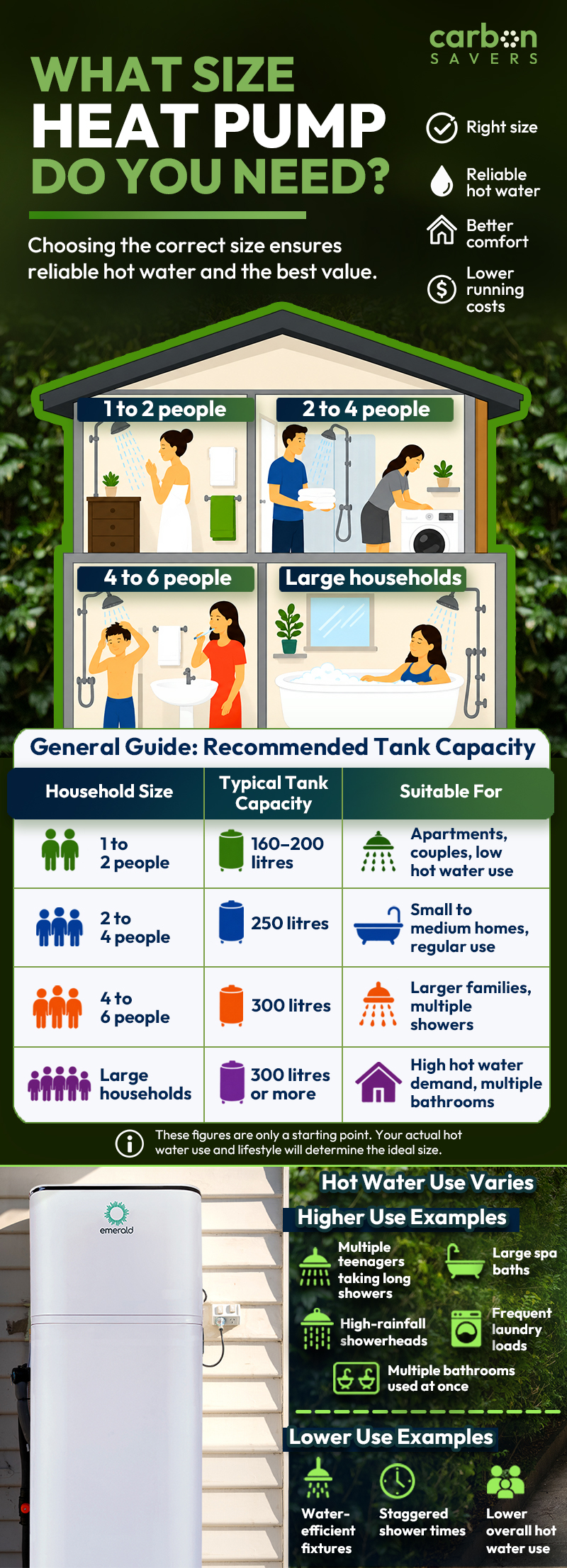
Choosing the correct size is just as important as choosing the right brand.
A system that is too small may struggle during periods of high demand, while an oversized system can cost more than necessary.
The right size depends on your household’s hot water demand, usage patterns and the system’s heating capacity.
Bedrooms | Recommended tank size |
1 to 2 bedrooms | 150-225 L |
3 bedrooms | 225-300 L |
4+ bedrooms | More than 300 L |
These figures are only a starting point.
Some households use considerably more hot water than others. For example:
On the other hand, households that use water-efficient fixtures or stagger shower times may require less storage.
Installers also consider recovery rate, which is how quickly the system reheats water after it has been used. A well-sized heat pump balances storage capacity with reheating performance.
Bedroom count is a useful starting point, as household occupancy can change over the 10-15-year lifespan of a hot water system.1
For example, hot water demand may increase with the addition of children or tenants. The suggested system sizes include extra capacity to accommodate changes in water use and variations in the number of occupants.
Not every heat pump performs the same way.
Looking beyond the purchase price helps ensure you select a system that performs efficiently for many years.
Choosing the right hot water system involves more than comparing brands or upfront prices. Before making a decision, consider how well the system suits your household, property and long-term budget.
It is worth comparing:
The cheapest system upfront is not always the most economical over its lifetime.
Heat pump and solar hot water systems generally have higher purchase costs but can cost less to run over time, while conventional electric storage systems may be cheaper to buy but can have higher running costs when they are not supported by rooftop solar.2
Taking the time to compare both upfront and long-term costs can help you choose a system that better suits your household and delivers stronger value over its working life.
One of the biggest differences between models is efficiency.
Manufacturers often publish performance ratings that indicate how efficiently the system transfers heat into the water.
Higher efficiency generally means lower electricity consumption over time.
Check what is covered and for how long.
A quality system may include separate warranties for:
Warranty terms vary between manufacturers, so always read the documentation carefully.
Heat pumps include a fan and compressor, so they produce some operating noise.
Most modern systems are relatively quiet, but specifications vary.
If the unit will be installed near bedrooms, neighbouring properties or outdoor entertaining areas, ask your installer about the expected operating noise and suitable placement.
Australia has a wide range of climates. Some heat pumps perform exceptionally well in warm coastal regions, while others are specifically designed to maintain efficiency in colder conditions.
If you live in alpine regions or areas with cold winters, choose a model suitable for lower ambient temperatures.
Heat pumps require adequate airflow to operate efficiently.
A suitable installation location should provide:
An experienced installer will assess the site before installation.
Many Australian households may be eligible for rebates, incentives or energy certificate schemes depending on their state or territory and the system installed.
Upgrade your old gas or electric hot water system to a brand-new, energy-efficient heat pump and claim up to $2,380 in government rebates.
Eligibility requirements change over time, so always confirm current programs through official government sources before making a purchasing decision.
Consider the manufacturer’s reputation for:
A well-supported brand can make future servicing much easier.
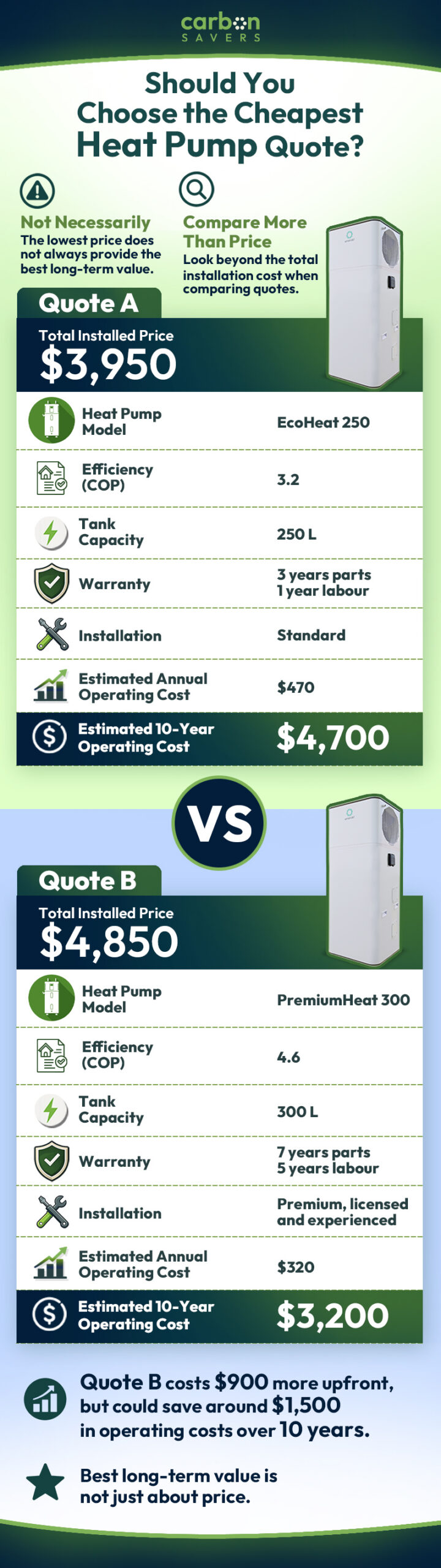
Not necessarily. The lowest price does not always provide the best long-term value.
When comparing quotes, look beyond the total installation cost.
Consider:
Compare These Factors | Why It Matters |
Heat pump efficiency | Lower running costs |
Tank capacity | Meets household demand |
Warranty coverage | Long-term protection |
Installation quality | Reliable performance |
Brand reputation | Better support and servicing |
Included components | Fair comparison between quotes |
Estimated operating costs | More accurate lifetime value |
A higher-quality installation can often reduce maintenance issues and improve long-term efficiency.
Choosing an experienced installer is just as important as choosing the equipment itself.
For many Australian households, yes.
If you already have rooftop solar, a heat pump can often be programmed to heat water during the middle of the day when your solar system is generating electricity.
Instead of exporting excess solar energy to the grid, your household uses that energy to produce hot water.
This can reduce electricity purchases while increasing the value of your solar generation.
Households on time-of-use electricity tariffs may also benefit by scheduling operation during lower-cost periods, depending on their retailer’s pricing.
The best operating schedule depends on your electricity plan, daily water usage and whether you have solar.
Before purchasing a heat pump, try to avoid these common mistakes.
The best heat pump is not necessarily the one with the lowest price tag. System efficiency, sizing, installation quality, warranty coverage and long-term electricity use can all have a much bigger impact on what you ultimately pay over the life of the system.
That is why it is worth comparing the total cost of ownership, not just the upfront quote. And for Victorian households, available incentives may also reduce the initial cost of making the switch.
Before choosing a system, speak with Carbon Savers about your home, current hot water setup and available Victorian heat pump incentives so you can compare the true lifetime cost, not just the upfront quote.