
by
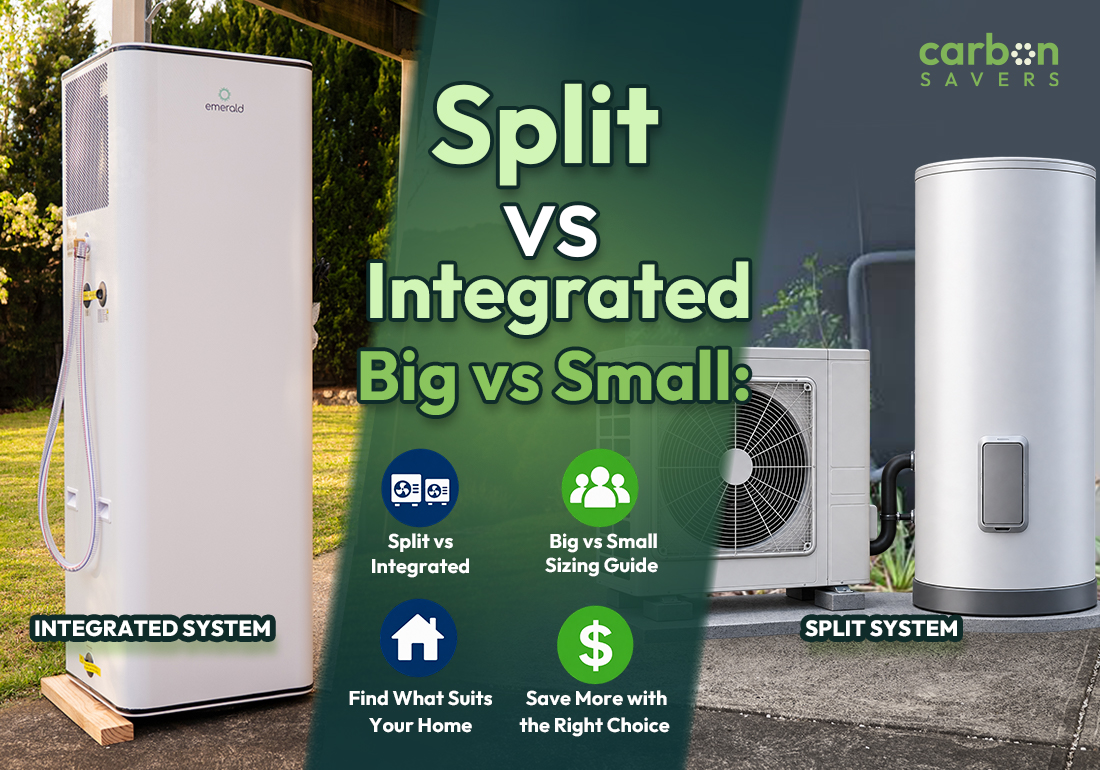
Buying a heat pump hot water system is a long-term investment that can deliver years of lower energy bills, but only if it’s the right fit for your home.
The best system isn’t necessarily the biggest or the most expensive. Instead, it’s the one that matches your household’s hot water demand, property layout and local climate.
If you’re deciding between a split or integrated heat pump, or wondering what size you actually need, this guide will help you make an informed decision.
In Victoria, many homeowners naturally focus on tank size, but that’s only one part of the equation. Factors such as recovery rate, peak hot water demand, installation space, and household routines can have a big influence on how well a system performs.
By understanding these key factors before installation, you’ll be better equipped to choose a system that suits your home and avoid common sizing mistakes in the future.
When homeowners compare heat pump hot water systems, tank capacity is often the first specification they notice. While storage volume is important, it’s only one part of choosing the right system.
In most cases, the goal isn’t to install the largest available tank. Instead, it’s to ensure the system can comfortably meet your household’s daily hot water demand while operating efficiently.
A correctly sized heat pump should provide enough hot water during your busiest periods without requiring unnecessary electric boosting or extended recovery times.
So, choosing the wrong size can affect both comfort and operating costs over the life of the system.
It’s easy to assume that purchasing a larger system will eliminate the risk of running out of hot water.
However, a larger tank generally means a higher purchase price, requires more installation space, and stores more water than your household regularly uses.
Unless your household genuinely needs the additional capacity, buying larger than necessary may provide little practical benefit.
What if your heat pump storage is too small?
A system that is too small for your household may struggle to meet peak hot water demand, especially during busy periods.
As a result, you may experience:
For this reason, the Victorian Energy Upgrades (VEU) Hot Water Buyer’s Guide1 recommends selecting a system based on expected hot water demand rather than relying solely on occupant numbers.
There isn’t a single tank size that’s perfect for every home. Household size provides a useful starting point, but it’s only one of several considerations.
Experienced installers also assess how your family uses hot water throughout the day.
Any two households with the same number of people may require different systems depending on their routines.
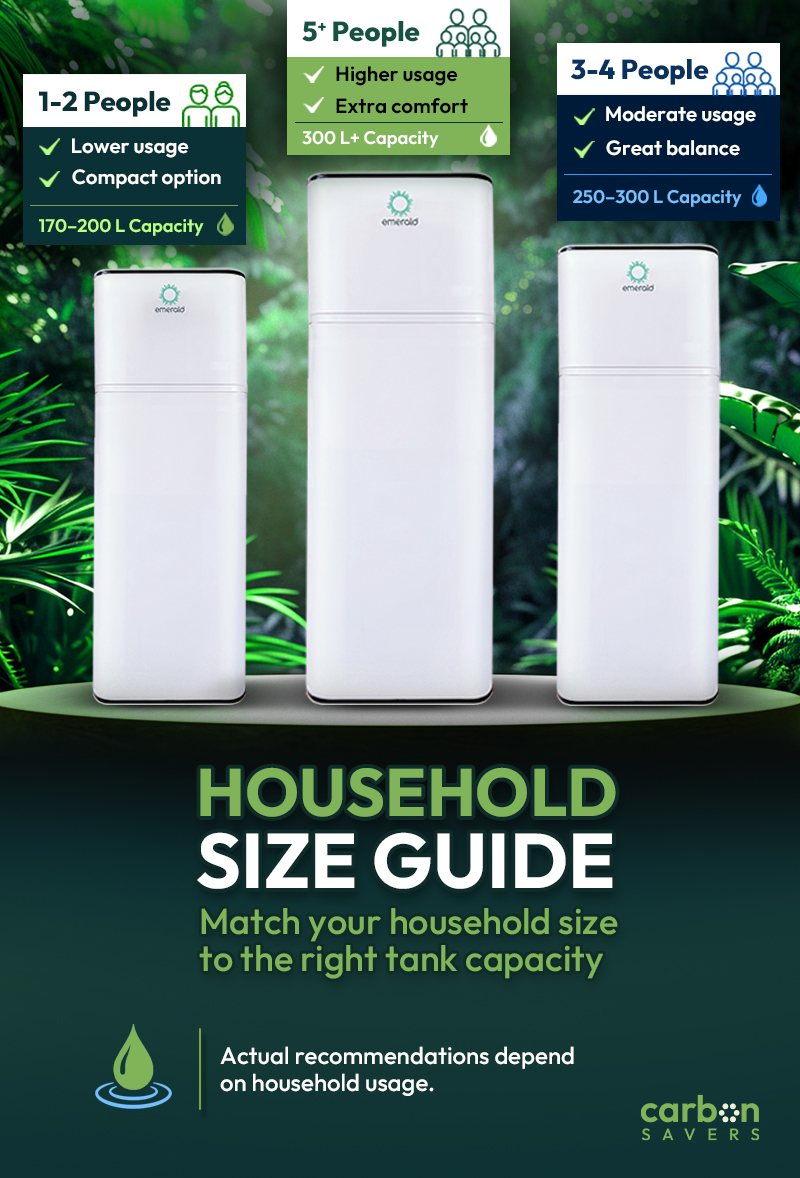
Household | Typical Tank Capacity* |
1-2 people | 170-200 L |
3-4 people | 250-300 L |
5+ people | 300 L+ |
*Indicative only. Final sizing should follow manufacturer recommendations and a professional site assessment.
These figures should be treated as a guide rather than a rule. The most suitable system depends on several practical factors.
When assessing the right size, installers commonly consider:
For example, retirees who stagger showers across the day may have very different requirements from a family with young children who all shower within an hour.
Likewise, households planning renovations or expecting additional family members may benefit from considering future hot water demand rather than sizing only for today’s needs.
One of the biggest misconceptions is that larger storage automatically means better performance. In reality, storage capacity is only part of the equation.
Another factor that’s often overlooked is recovery rate: how quickly the system reheats water after it has been used.
A smaller tank with a suitable recovery rate may comfortably meet demand, while a larger tank with slower recovery could still struggle during consecutive showers.
That’s why two systems with similar storage capacities can perform very differently.
For example, imagine two households with four occupants.
Scenario 1:
The first household spreads showers across the morning and uses relatively little hot water during the day.
Scenario 2:
The second household has teenagers, two bathrooms and four consecutive showers before everyone leaves for work and school.
Worked Example
| Household A | Household B | |
| Occupants | 4 | 4 |
| Bathrooms | 1 | 2 |
| Shower pattern | Spread throughout morning | Four consecutive showers |
| Evening hot water demand | Moderate | High |
| Likely consideration | Standard sizing may be suitable | Recovery rate becomes more important |
Although both homes have the same number of occupants, the second household places much higher demand on the hot water system over a shorter period.
In this situation, recovery rate becomes just as important as storage capacity.
This illustrates why identical household sizes don’t always receive identical recommendations. The professional recommendations usually consider both storage volume and recovery performance together rather than in isolation.
Once you’ve chosen an appropriate system size2, the next decision is whether a split or integrated heat pump better suits your property.
Both systems use the same basic technology, extracting heat from the surrounding air to warm water, but they arrange their components differently.
Neither configuration is inherently superior. The right choice depends on your home’s layout, installation constraints and site conditions.
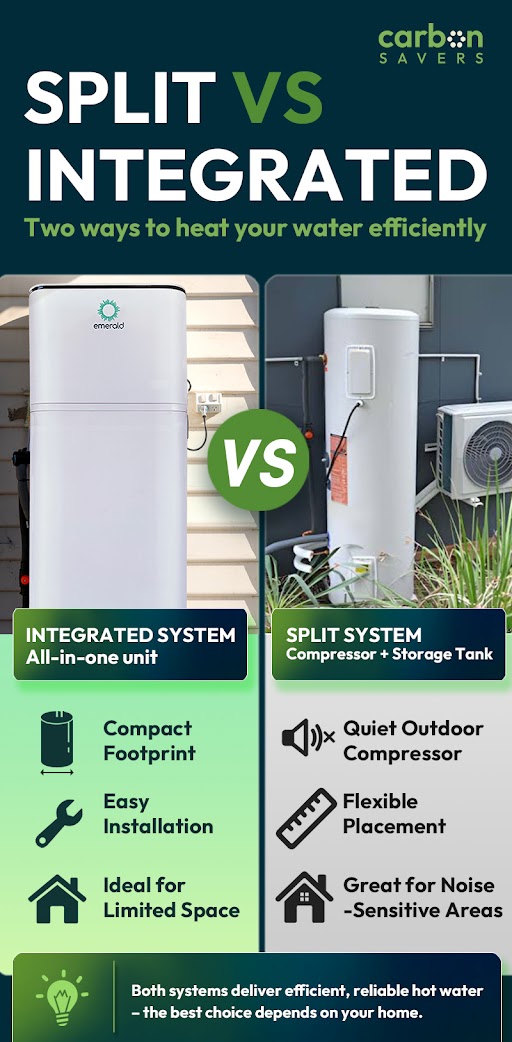
Integrated systems combine the storage tank and heat pump into one self-contained outdoor unit.
Because all major components are housed together, installation is often more straightforward, with fewer external connections.
For homes with sufficient outdoor space where the complete unit can be installed in a suitable location with adequate airflow, integrated systems work best.
Typical characteristics include:
Split systems separate the compressor from the storage tank using refrigerant pipework.
This allows the tank and compressor to be positioned independently, providing greater flexibility where space, access or noise considerations influence installation.
For example, the storage tank may be located near existing plumbing while the compressor is installed further away, subject to manufacturer installation requirements.
Typical characteristics include:
| Feature | Integrated | Split |
| Space | Best where one tall unit fits comfortably | Better when components need separate locations |
| Installation | Usually simpler | More flexible but may be more complex |
| Placement | Tank and compressor stay together | Tank and compressor can be positioned separately |
| Noise | Noise comes from the main unit’s location | Compressor can be placed farther from bedrooms or living areas |
| Best for | Homes with a straightforward installation area | Homes with limited space, difficult access, or layout restrictions |
Rather than asking which system is “better”, ask which configuration suits your property.
Your installer should assess plumbing connections, available space, airflow requirements and practical installation considerations before making a recommendation.3
Heat pumps rely on ambient air, so installation conditions matter.
Many modern heat pump systems are designed to operate across a broad range of temperatures, including much of Victoria.
However, efficiency generally decreases as outdoor temperatures fall, and some systems may rely on electric boosting under certain conditions.
Rather than focusing solely on climate, homeowners should discuss the following with their installer:
Installation location is equally important.
Heat pumps require:
Noise may also influence placement.
While modern systems are generally quieter than many outdoor appliances, positioning the compressor unit thoughtfully can improve household comfort and help minimise disturbance.4
Avoid choosing an installation location purely because it is hidden from view. Restricted airflow or difficult servicing access may compromise long-term performance.
✔ Consider how your household actually uses hot water.
✔ Think about future family changes.
✔ Ask about recovery rate besides storage tank size.
✔ Confirm your available installation space.
✔ Discuss local climate conditions.
✔ Don’t choose purely on purchase price.
This guide focuses specifically on choosing the right heat pump size and configuration.
If you’re ready to compare heat pump brands, understand warranties, explore government rebates or learn how to maximise long-term energy savings, see our complete guide:
How to Choose the Right Heat Pump Hot Water System for Your Home.
It covers those broader buying decisions in detail without repeating the information here.
Many four-person households suit a 250-300 L system, but the right size also depends on hot water usage patterns and recovery requirements.
Not necessarily. The better option depends on your property’s layout, installation space and practical site constraints.
Yes. Modern heat pumps are designed to operate in cooler conditions, although efficiency varies with temperature and system design.
It may take longer to recover after heavy hot water use and could rely more on electric boosting during peak demand.
No. Oversizing can increase upfront costs without improving everyday performance if your household doesn’t need the additional capacity.
Heat pumps need adequate airflow, drainage and servicing access. Your installer should confirm the installation site meets the manufacturer’s requirements.
1 . https://www.energy.vic.gov.au/victorian-energy-upgrades/products/hot-water-system-discounts/hot-water-buyers-guide
2 . https://www.solar.vic.gov.au/solar-hot-water-buyers-guide/section-4-deciding-your-hot-water-system-size-and-tank#what-size-system-suits-your-household
3 . https://www.solar.vic.gov.au/solar-hot-water-buyers-guide/section-6-planning-heat-pump-hot-water-system
4 . https://www.energy.gov.au/households/hot-water-systems