
by
Installing solar panels is one of the smartest long-term investments many Victorian homeowners can make.
A well-designed solar system can lower your electricity bills, reduce your reliance on the grid and help cut your household’s carbon emissions.
With government incentives available and electricity costs continuing to put pressure on household budgets, many homeowners are asking the same question:
How does rooftop solar reduce your electricity bills?
Understanding how solar energy flows through your home makes it much easier to see where the biggest savings come from.
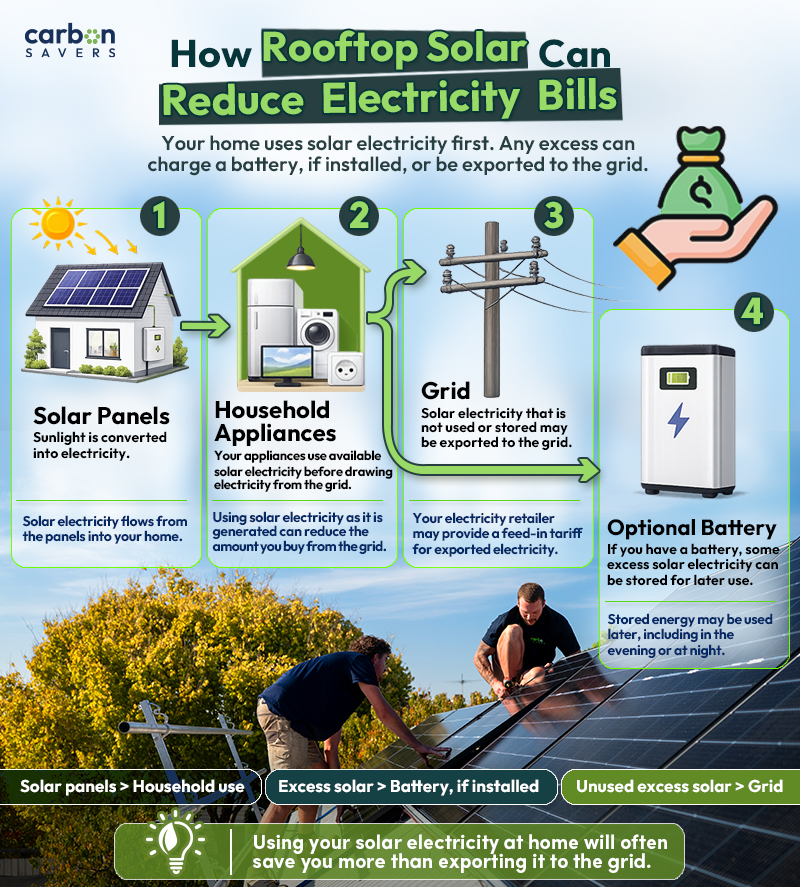
When your solar panels generate electricity during the day, that energy is used by your home first to power appliances such as your refrigerator, air conditioner, washing machine and other household devices.
If your system includes a battery, any surplus electricity can be stored for use later. Only the remaining excess energy is exported to the electricity grid.
The key point is that using your own solar electricity (known as self-consumption) usually delivers far greater financial benefits than exporting it.
That’s because the price you avoid paying for grid electricity is typically much higher than the feed-in tariff your retailer pays for exported solar energy.
Solar is generally an excellent investment if you:
These households are more likely to use a higher proportion of the electricity their system generates, increasing the value of every kilowatt-hour produced.
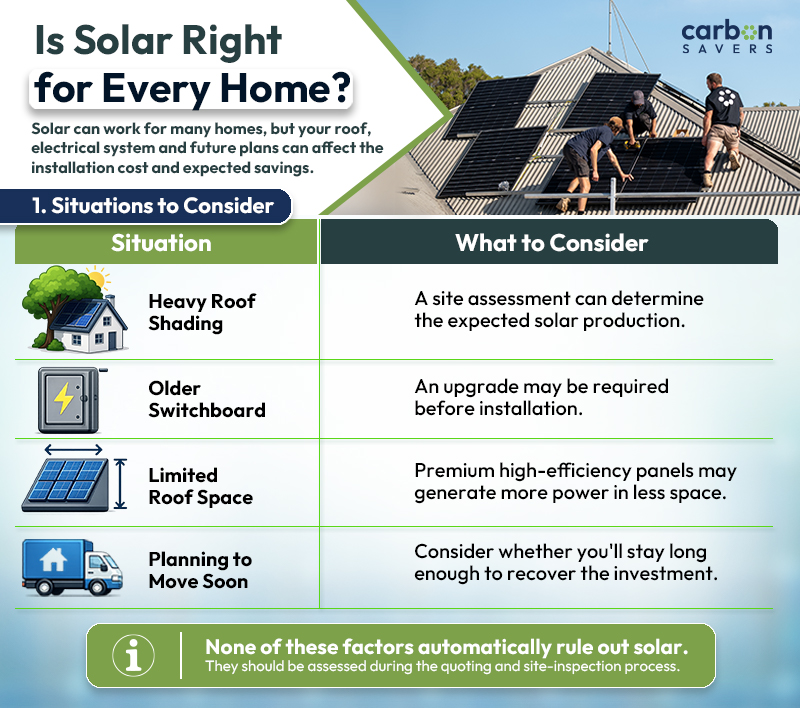
Not always. Some properties require additional planning before installation. For example:
Situation | What to consider |
Heavy roof shading | A site assessment can determine whether solar will produce enough energy. |
Older switchboard | An upgrade may be required before installation. |
Limited roof space | A premium, high-efficiency panel may generate more power in less space. |
Planning to move soon | Consider whether you’ll remain in the home long enough to benefit from the investment. |
None of these automatically rule out solar, but they should be discussed with your installer during the quoting process.
Imagine two households each install the same 6.6 kW solar system.
The first household works from home, runs appliances during the day and charges an electric vehicle on weekends.
The second household is empty until the evening, meaning most of its solar generation is exported.
Although both systems generate similar amounts of electricity, the first household is likely to achieve greater bill savings because it uses more of its own solar energy.
The lesson is simple: the best solar system is one that’s designed around how you use electricity, not just how many panels fit on your roof.
Victoria offers some of Australia’s most generous solar incentives, helping eligible homeowners reduce the upfront cost of installing a rooftop solar system.
There are two key incentives to understand:
These incentives are separate but can usually be combined, making solar significantly more affordable for eligible households.
| Incentive | What it offers | Who provides it |
| Solar Panel Rebate | Up to $1,400 towards an eligible solar PV system | Solar Victoria |
| Interest-free Loan | Loan equal to the rebate amount for eligible applicants | Solar Victoria |
| Small-scale Technology Certificates (STCs) | Upfront discount applied by your installer | Australian Government |
The Solar Homes Program helps eligible owner-occupiers reduce the cost of installing rooftop solar.
The rebate covers up to 50% of the purchase cost, capped at $1,400, after other discounts such as STCs have been applied. Eligible applicants can also apply for an interest-free loan for the same amount.
As of 1 July 2026, the combined taxable income of all property owners must be below $150,000 per year, and the completed property must be valued below $3 million. The address must also meet Solar Victoria’s rules concerning previous rebates and recent solar installations.
Other requirements include using a Solar Victoria authorised retailer and eligible products.
Check the official Solar Victoria eligibility page before requesting or accepting a quote because program rules can change.2
Eligibility checked: July 2026
Eligible rooftop solar systems may create Small-scale Technology Certificates (STCs) under the Australian Government’s Small-scale Renewable Energy Scheme (SRES).
Rather than receiving money after installation, most customers assign these certificates to their retailer or agent in exchange for an upfront discount on the quoted system price.
The value of the discount is not fixed. It depends on factors including the system size, installation location, year of installation and the market value of STCs at the time the quote is prepared. 3
Solar panel costs and potential savings vary depending on your household’s energy use, system size, and roof conditions.
A standard 6.6 kW solar system generally costs between $4,000-$8,000 (after incentives).
| Typical Household | Estimated Daily Usage | Suitable System Capacity |
|---|---|---|
| Small household of 1-2 people | 8-14 kWh | 5kW |
| Average household of 2-3 people | 14-20 kWh | 6.6kW |
| Household of 3-4 people | 20-30 kWh | 6.6kW or 10kW |
| Household of 4-5 people | 30-45 kWh | 10kW or 13kW |
| Large, fully electrified household with EVs | 45kWh+ | 13kW or 15kW |
4
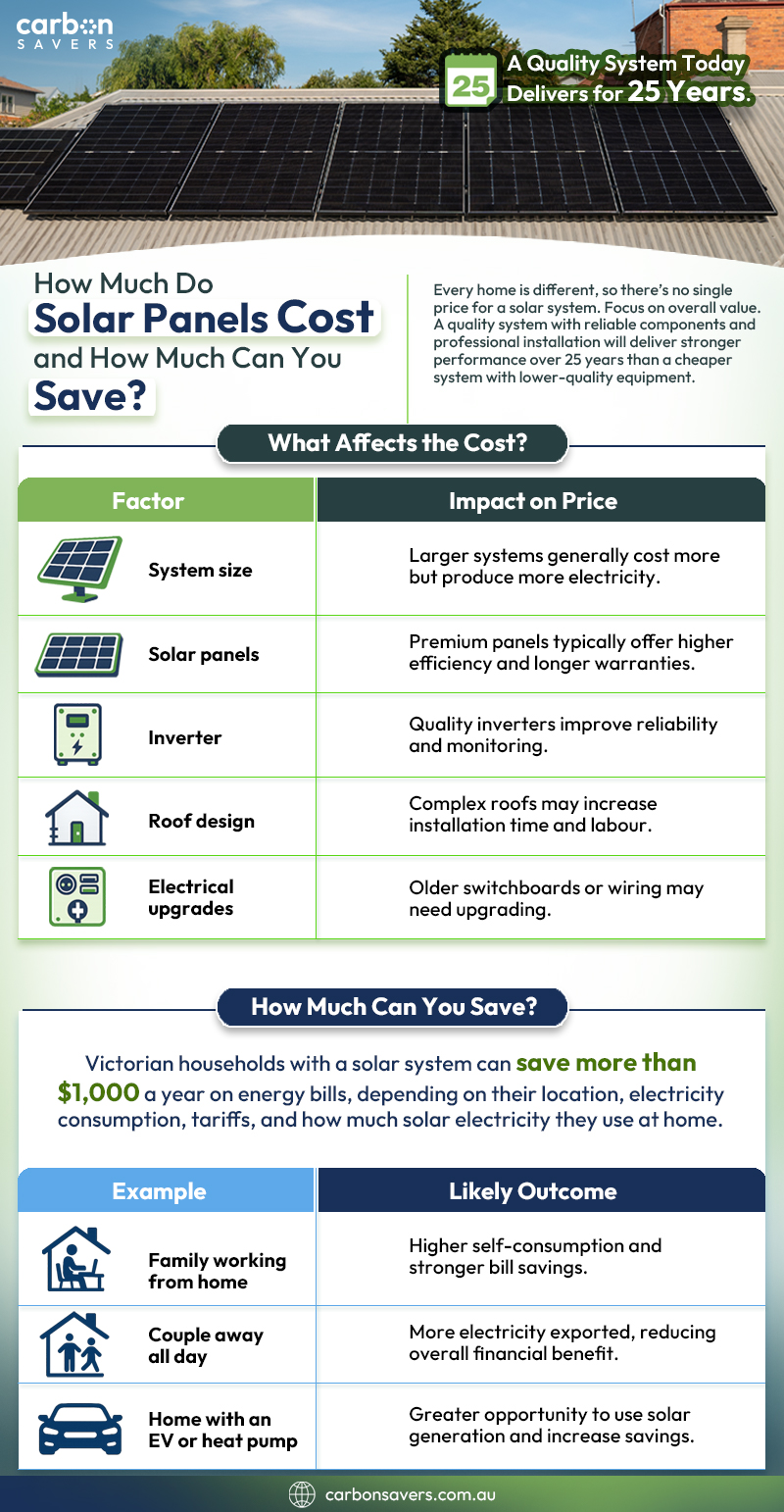
Rather than looking for the cheapest quote, focus on overall value. A quality system with reliable components and professional installation is more likely to deliver strong performance over 25 years than a cheaper system with lower-quality equipment.
| Factor | Impact on price |
| System size | Larger systems generally cost more but produce more electricity. |
| Solar panels | Premium panels typically offer higher efficiency and longer warranties. |
| Inverter | Quality inverters improve reliability and monitoring. |
| Roof design | Complex roofs may increase installation time and labour. |
| Electrical upgrades | Older switchboards or wiring may need upgrading. |
For many households, the savings generated by solar can recover the initial investment within approximately 4 to 7 years. This timeframe is called the simple payback period and refers to the point when cumulative electricity bill savings match the amount paid for the system.
Households with a solar system can save more than $1,000 every year on energy bills, depending on their location, electricity consumption, tariffs, and the amount of solar electricity used within the home.6
Results vary by Australian city and household circumstances. The Australian Government reports that the average rooftop system saves a household more than $1,500 per year.5,7
Example
| Household | Likely outcome |
| Family working from home | Higher self-consumption and stronger bill savings. |
| Couple away all day | More electricity exported, reducing overall financial benefit. |
| Home with an EV or heat pump | Greater opportunity to use solar generation and increase savings. |
Solar is likely to deliver stronger financial returns if you:
| Lower-priced system | Premium system |
| Basic equipment | Higher-quality components |
| Shorter workmanship warranty | Longer workmanship warranty |
| Limited monitoring | Advanced performance monitoring |
| Lower upfront cost | Greater long-term reliability and support |
Paying slightly more upfront can reduce maintenance issues and improve energy production over the system’s lifespan.
Solar panels can be a worthwhile long-term investment for Victorian homeowners, but the best results come from choosing a system that suits your property, electricity usage and future energy needs.
Every home is different, so a professional assessment is the best way to understand the right system size and potential savings for your property.
A typical Victorian household could expect to save approximately $900 to $2,100 per year on energy bills, but this depends on various factors such as system size, energy usage and energy rates.
Explore Carbon Savers and request a personalised solar quote to find out how much you could save.
Yes. For many homeowners, solar can reduce bills by generating electricity you can use at home. The best savings come from maximising self-consumption.
Eligible homeowners may receive a Solar Victoria rebate of up to $1,400, plus an optional interest-free loan. Most systems also qualify for STCs.
The right size depends on your electricity usage, roof space and future energy needs, such as an electric vehicle or battery.
Yes. Solar panels still generate electricity on cloudy days, although they produce less energy than in full sunshine.
A battery may be worthwhile if you use most of your electricity at night, want to increase solar self-consumption or need backup capability. Backup functionality depends on system design.
A feed-in tariff is the rate your electricity retailer pays for excess solar electricity exported to the grid.
Yes. Many homeowners install solar panels first and add a compatible battery when their energy needs or budget change.
Solar panels require very little maintenance. Occasional cleaning and periodic inspections help maintain optimal performance.
Look for a Solar Victoria authorised retailer, compare detailed quotes and review warranties, product quality and customer feedback.
While not guaranteed, a quality solar system may improve your home’s appeal to buyers looking for lower energy costs.
Ask about system size, expected energy generation, warranties, product brands, installation timelines and what is included in the quoted price.


Discover the latest government rebates that can help you save up to $11,000