
by
Imagine this. You request three quotes for a solar system.
Each installer recommends a 6.6 kW system, yet one quote is $5,200, another is $7,800, and the third exceeds $10,000.
How can the same-sized system vary by thousands of dollars?
The answer is simple: you’re not comparing the same product.
Although the systems may have similar capacities, they can differ significantly in panel quality, inverter technology, installation standards, warranties, electrical work, and long-term performance.
Some quotes include everything needed for a compliant installation, while others exclude costs that only become apparent after a site inspection.
For Victorian homeowners, choosing solar isn’t just about finding the lowest price; it’s about understanding what you’re paying for and whether the system will continue delivering value for years to come. 1
There is no fixed price for residential solar in Victoria because every home is different.
Even neighbouring properties can receive very different quotes depending on their roof, electrical infrastructure and the quality of equipment being installed.
A reputable installer designs a system specifically for your property rather than offering a one-size-fits-all package.
The biggest factors affecting the final price include system size, equipment quality, installation complexity, electrical upgrades, warranty coverage and available government incentives.
| Quote Stage | Estimated Cost |
| Initial estimate | $6,450 |
| Additional Switchboard upgrade | +$850 |
| Scaffolding requirement | +$650 |
| Meter upgrade | +$250 |
| Final installed price | $8,200 |
| Factor | Why It Changes the Price |
| System size | Larger systems require more panels, mounting hardware and labour. |
| Solar panels | Premium panels generally offer higher efficiency, stronger warranties and lower long-term degradation. |
| Inverter | The inverter influences system performance, monitoring features and future battery compatibility. |
| Roof complexity | Steep, multi-storey or difficult-to-access roofs usually require more labour and safety equipment. |
| Electrical work | Older homes may require switchboard upgrades, additional cabling or meter changes. |
| Installation quality | Experienced installers typically spend more time on design, compliance and commissioning. |
| Warranty | Longer workmanship warranties often reflect greater confidence in installation quality. |
| Government incentives | STCs and the Solar Victoria rebate can significantly reduce the upfront cost for eligible households.1 |
One of the biggest misconceptions about buying solar is that two systems with the same capacity should cost roughly the same.
On paper, that assumption seems reasonable. If both quotes specify a 6.6 kW solar system, why should one be thousands of dollars more expensive?
The answer is that system capacity is only one part of the equation.
Think of it like comparing two new cars with the same engine size.
They may look similar in a brochure, but differences in safety features, technology, build quality, warranty, and after-sales support can significantly impact the final price. Solar systems work in much the same way.
Not all quotes include the same equipment, warranties, or services. Some installers include system monitoring, commissioning, and longer workmanship warranties, while others charge extra for these services.
That’s why it’s important to compare what’s included, not just the total price.
As Solar Victoria advises, reviewing equipment quality, warranties, and installer credentials can help you choose the best long-term value rather than simply the lowest quote.2
Initial advertised system: $5,900
Site inspection identified:
Final installed price: $7,350
Now, none of these costs was unexpected; they reflected the home’s installation requirements.
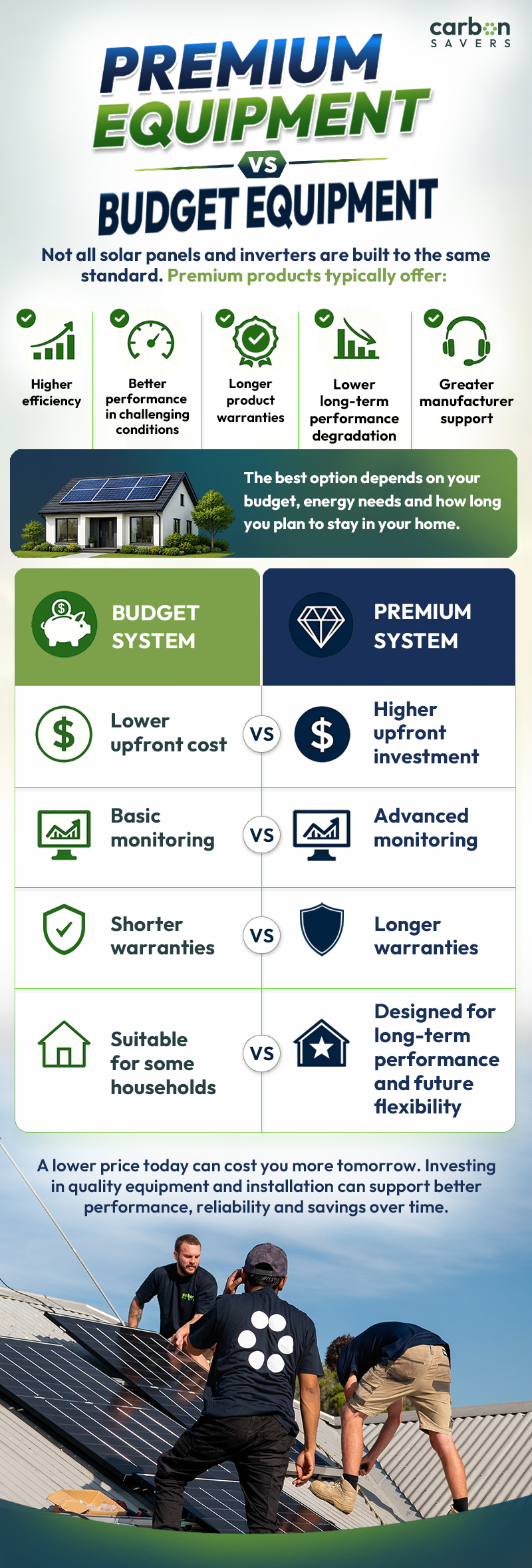
Not all solar panels and inverters are built to the same standard.
Premium products typically offer:
Budget equipment may reduce the upfront cost but may offer fewer features or shorter warranty periods.
The best option depends on your budget, energy needs and how long you plan to stay in your home.
| Budget System | Premium System |
| Lower upfront cost | Higher upfront investment |
| Basic monitoring | Advanced monitoring |
| Shorter warranties | Longer warranties |
| Suitable for some households | Designed for long-term performance and future flexibility |
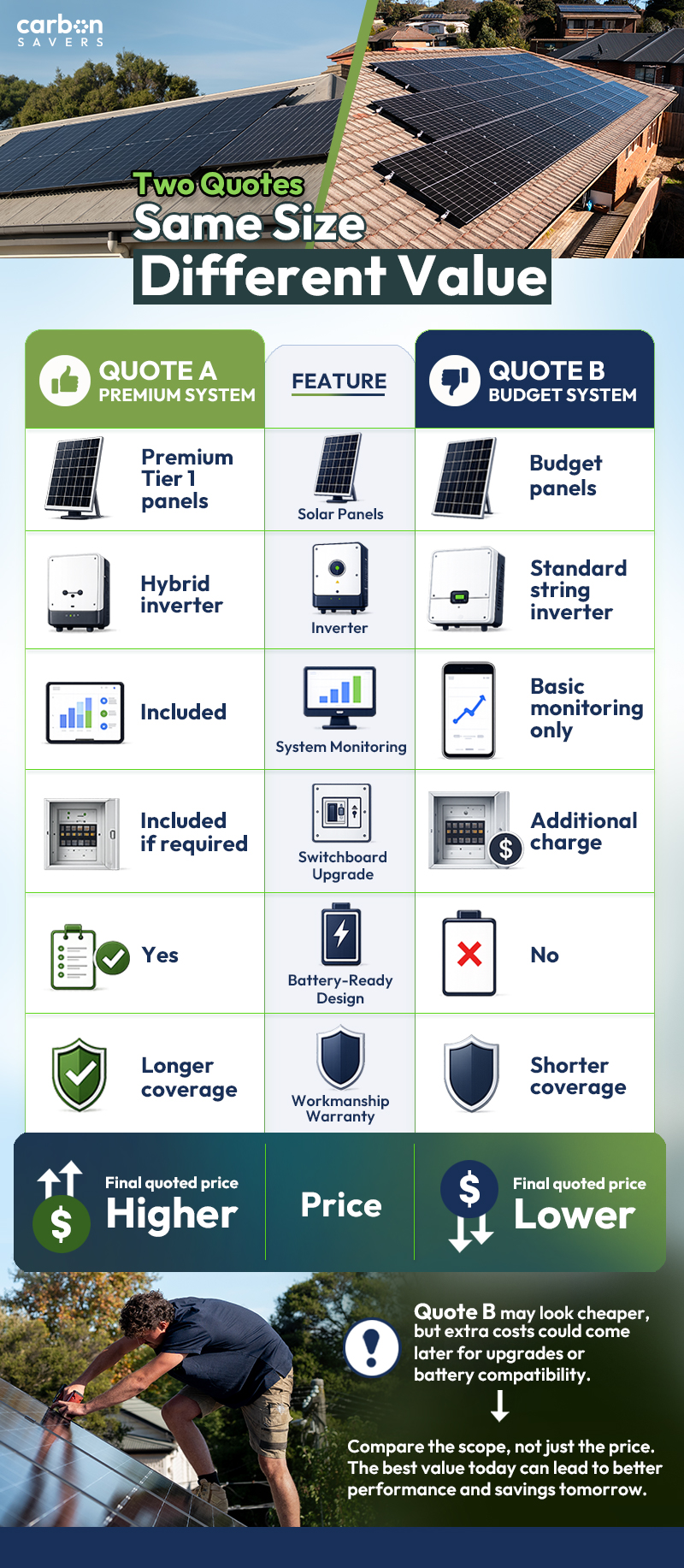
The following example illustrates why comparing only the bottom-line price can be misleading.
| Feature | Quote A | Quote B |
| System size | 6.6 kW | 6.6 kW |
| Solar panels | Premium Tier 1 panels | Budget panels |
| Inverter | Hybrid inverter | Standard string inverter |
| System monitoring | Included | Basic monitoring only |
| Switchboard upgrade | Included if required | Additional charge |
| Battery-ready design | Yes | No |
| Workmanship warranty | Longer coverage | Shorter coverage |
| Final quoted price | Higher | Lower |
Although Quote B appears less expensive, the homeowner may later need to pay separately for electrical upgrades or future battery compatibility.
Comparing the scope of work often provides a clearer picture of overall value than comparing price alone.
A low advertised price doesn’t always reflect the final cost of installing solar. It can’t always be confirmed until a site inspection has been completed.
Here are some of the most common additional costs:
| Possible Additional Work | Why It May Be Required |
| Switchboard upgrade | Older switchboards may not meet current electrical standards or have enough capacity for solar. |
| Roof repairs | Damaged or ageing roofing should be repaired before panels are installed. |
| Scaffolding | Required for safety on some double-storey or steep roofs. |
| Additional cabling | Longer cable runs may be needed depending on the location of the inverter and switchboard. |
| Meter upgrades | Some properties require a new or reconfigured electricity meter before the system can be connected. |
A trustworthy installer should explain any potential variations before work begins and provide a detailed breakdown of what is and isn’t included in the quoted price.
Yes, high-quality solar panels won’t perform at their best if they’re installed incorrectly.
While homeowners often focus on brands and system size, the quality of the installation can have just as much impact on the system’s long-term reliability and performance.
Professional installation involves far more than mounting panels on a roof. It includes careful system design, correct panel placement, compliant electrical work, safe cable management, thorough testing and proper commissioning.
Choosing an experienced installer can also reduce the risk of future issues, such as water leaks, poor system performance or warranty disputes.
What to Compare Between Installers and Why it Matters
System design: Ensures the system suits your roof, energy usage and future needs.
Installation standards: Quality workmanship improves safety and long-term reliability.
Electrical compliance: Helps ensure the installation meets Australian standards.
Workmanship warranty: Provides protection if installation-related issues arise.
After-sales support: Makes it easier to resolve problems or expand the system later.
A higher quote often reflects additional time spent on system design, installation quality and customer support rather than simply more expensive equipment.
Government incentives can significantly reduce the upfront cost of installing solar, but it’s important to understand how they work and whether they’ve already been included in your quote.
Eligible Victorian homeowners may be able to access:
Before accepting a quote, ask whether these incentives have already been deducted from the advertised price.
Many homeowners focus on price first, but this can lead to costly decisions later. In reality, the biggest mistakes include:
A thorough comparison today can help avoid unexpected costs and disappointment later.
Before purchasing, it’s important to know what you’re really paying for.
A solar quote should clearly show what is included, why the system suits your home and where additional costs may arise.
Speak with Carbon Savers for a tailored solar assessment and a transparent quote.
Solar quotes vary because they may include different equipment, installation standards, warranties, electrical work and levels of after-sales support.
No. While premium systems often include better equipment and longer warranties, a higher price doesn't automatically guarantee better value.
Many installers deduct STCs and, where applicable, the Solar Victoria rebate from the quoted price. Always ask which incentives have been included so you understand the true installation cost.
A detailed quote should list the panel and inverter models, installation costs, warranties, monitoring system, electrical work, government incentives and any exclusions or additional charges.
Getting at least three detailed quotes gives you a better understanding of pricing, equipment options and installation approaches, making it easier to identify genuine value.
Not necessarily. Lower-priced systems may exclude electrical work, use lower-cost components or provide shorter warranty coverage
Yes. Many homeowners install solar panels first and add a battery later. If that's your plan, ask your installer to recommend equipment that's compatible with future battery storage.
Premium panels often come with longer product warranties and are designed for strong long-term performance, although lifespan and warranty coverage vary by manufacturer.
No. Product warranties are provided by manufacturers, while workmanship warranties are offered by the installer. Compare both when reviewing quotes.


Discover the latest government rebates that can help you save up to $11,000