
by
Installing solar is only the first step. The speed at which it pays for itself depends less on the panels themselves and more on how your household uses the electricity they generate.
While every home is different, average payback periods for solar range between 3-7 years, and understanding what drives solar savings can help you make smarter decisions before and after installation.
This guide explains the key factors that influence solar payback and shares practical ways to maximise the value of your investment.
A solar payback period is the amount of time it takes for the savings on your electricity bills to recover the upfront cost of installing a solar system.
For example, if your system costs $7,000 after incentives and reduces your electricity costs by $1,400 per year, the simple payback period would be approximately five years.1
However, actual payback varies depending on electricity prices, household energy use, system performance, and how much of the solar energy you consume yourself rather than export to the grid.
It’s also important to distinguish payback from lifetime savings.
Once a system has recovered its upfront cost, it may continue reducing electricity bills for many years, subject to ongoing maintenance and equipment performance.
Every household has a different payback period because every household uses electricity differently.
These five factors usually have the greatest influence.
The electricity your home uses directly from your solar system is known as self-consumption.
To get more value from your solar system, try to use electricity during the day when your panels are generating power.
Running appliances such as the washing machine, dishwasher, or heat pump during daylight hours can help you use more of your own solar energy and rely less on electricity from the grid.
This is one of the most effective ways to improve the financial return from rooftop solar.
Solar offsets electricity that you would otherwise purchase from your retailer.
As retail electricity prices increase, the value of every kilowatt-hour you use from your own solar system also increases, potentially improving overall savings.
Actual savings will depend on your electricity plan and consumption patterns.
Feed-in tariffs provide payment for surplus electricity exported to the grid.
While export income contributes to overall savings, most Victorian households receive greater financial value by using solar electricity within the home rather than exporting it.
Feed-in tariff rates vary between electricity retailers and plans.
A larger solar system doesn’t automatically produce a faster payback.
If a system generates substantially more electricity than the household can use, more energy may be exported to the grid, where it typically attracts a lower value than electricity used within the home.
Choosing the right system size for your household is an important part of maximising long-term value.
For guidance on choosing the right system size, see our Solar Costs and Payback Guide.
Solar panels perform best when the system has been designed around the household’s energy needs, roof orientation and available sunlight.
A well-designed system helps maximise usable electricity throughout the day, supporting stronger long-term financial outcomes.
Although weather and seasons influence solar generation, homeowners can often improve their savings by adjusting how and when they use electricity.
Where practical, operate high-energy appliances while your solar system is producing electricity.
Examples include:
Using these appliances during daylight hours may increase self-consumption and reduce electricity purchased from the grid.
Many modern appliances include programmable timers.
Scheduling appliances to run during peak solar generation can help households make greater use of their own electricity without changing daily routines.
Moreover, from 1 October 2026, eligible Victorian households may be able to opt into the Midday Power Saver initiative, which offers three hours of free electricity daily between 11 am and 2 pm. 2
Households should compare the full tariff, as rates outside the free period may differ.
Charging home batteries (where installed), running pool equipment or operating electric heating during periods of strong solar production may improve overall energy efficiency.
Every household’s circumstances differ, so the best approach depends on lifestyle and electricity demand.
Electric vehicles, heat pump hot water systems and reverse-cycle heating can significantly increase household electricity demand.
Planning your solar system with future energy needs in mind may help avoid unnecessary upgrades later.
Adding a battery changes how solar energy is used by storing surplus electricity for later use instead of exporting it immediately.
Whether this shortens the payback period depends on several factors, including battery cost, household energy usage, electricity tariffs and available incentives.
Some households prioritise batteries for greater energy independence or backup capability rather than the fastest financial return.
For a detailed discussion of battery costs and financial considerations, see our Solar Costs and Payback Guide.
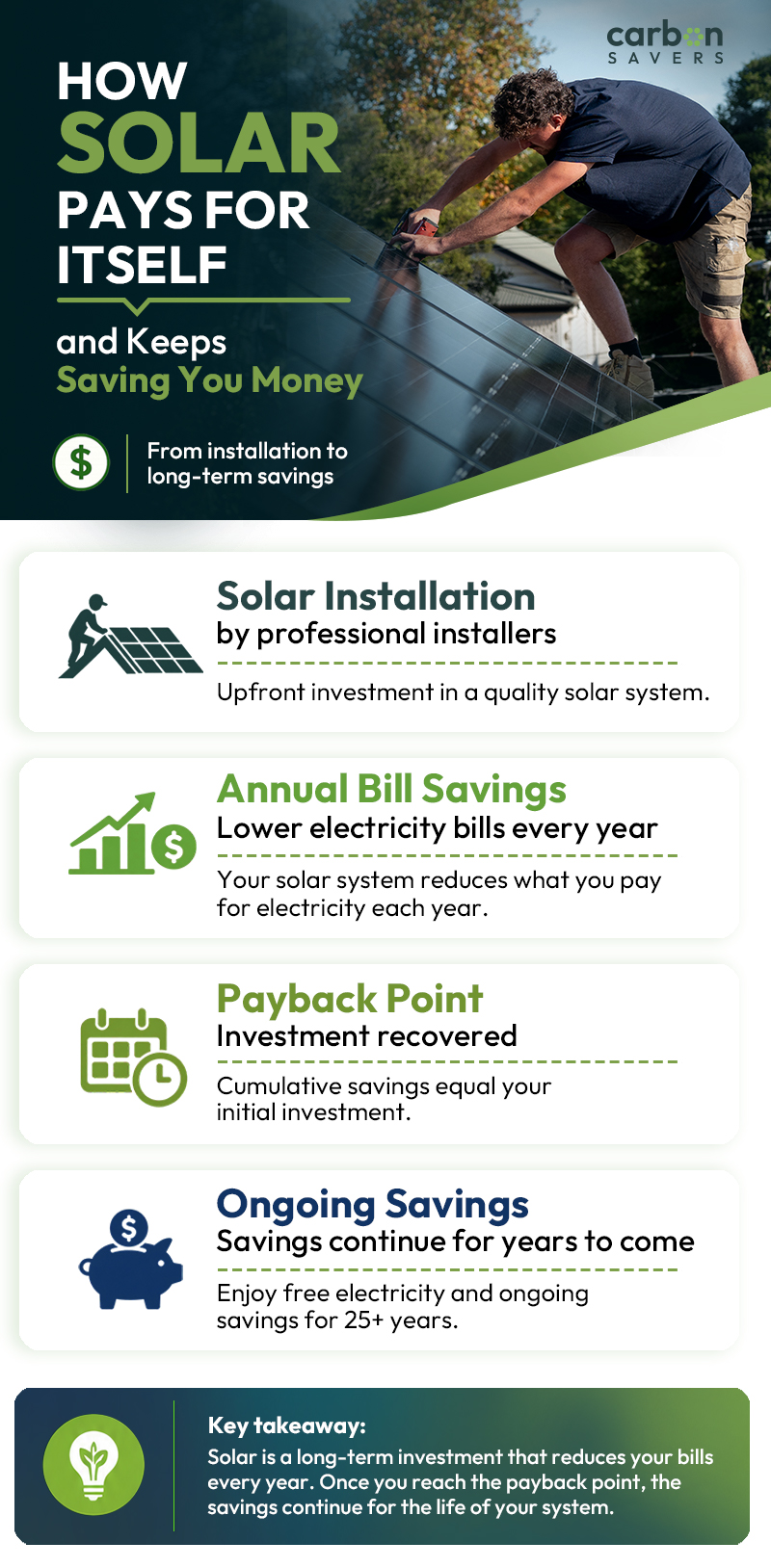
Some decisions can reduce the financial benefits of rooftop solar, even if the system performs well.
5 common mistakes include:
Reviewing your electricity usage and monitoring your system regularly can help ensure it continues delivering the expected savings over time.
Household | Household A | Household B |
Solar system | 6.6 kW | 6.6 kW |
Daytime occupancy | Mostly home | Away most weekdays |
Self-consumption | Moderate to High | Lower |
Electricity exported | Less | Higher |
Potential bill savings | Greater | Lower |
Note: Although both households have identical solar systems, their savings can differ because they use electricity at different times of day.
Solar pays for itself sooner when the system is designed around your household, and you use more of the energy it generates.
Victorian homeowners comparing solar options can explore Carbon Savers’ solar solutions for advice on system sizing, smarter energy use and long-term savings.
Payback varies from home to home but takes about 3-7 years on average. It depends on factors such as your electricity usage, system cost, electricity prices and how much of the solar energy you use yourself.
Yes. Running appliances while your solar system is generating electricity increases self-consumption, which typically delivers greater savings than exporting excess energy to the grid.
Not usually. Feed-in tariffs contribute to your savings, but using your own solar electricity generally provides a higher financial benefit than exporting it.
Potentially. As grid electricity becomes more expensive, each unit of solar power you use at home can offset higher energy costs, increasing your overall savings.
Not necessarily. An oversized system may export more electricity than you use, so choosing a system that matches your current and future energy needs often delivers better value.
No. Batteries increase self-consumption, but whether they shorten payback depends on battery costs, electricity tariffs, household usage and available incentives.
Yes. Shifting appliance use to daylight hours, monitoring system performance and improving household energy efficiency can all help maximise ongoing savings.


Discover the latest government rebates that can help you save up to $11,000