
by
If you’re researching solar for your home, you’ve probably noticed one thing: prices seem to be all over the place.
One company advertises a complete system for under $4,000, while another quotes more than $10,000 for what appears to be a similar installation.
Add rebates, Small-scale Technology Certificates (STCs), interest-free loans, and varying electricity savings into the mix, and it’s difficult to know what a solar system should actually cost or whether you’re comparing like with like.
So, what does solar really cost in Victoria?
Here’s the short answer:
While every home is different, most Victorian homeowners invest between $4,000 and $8,000 for a quality 6.6 kW solar system after government incentives.
However, the final cost depends on factors such as system size, equipment quality, roof complexity, installation requirements, eligibility for government incentives, and the system’s design.
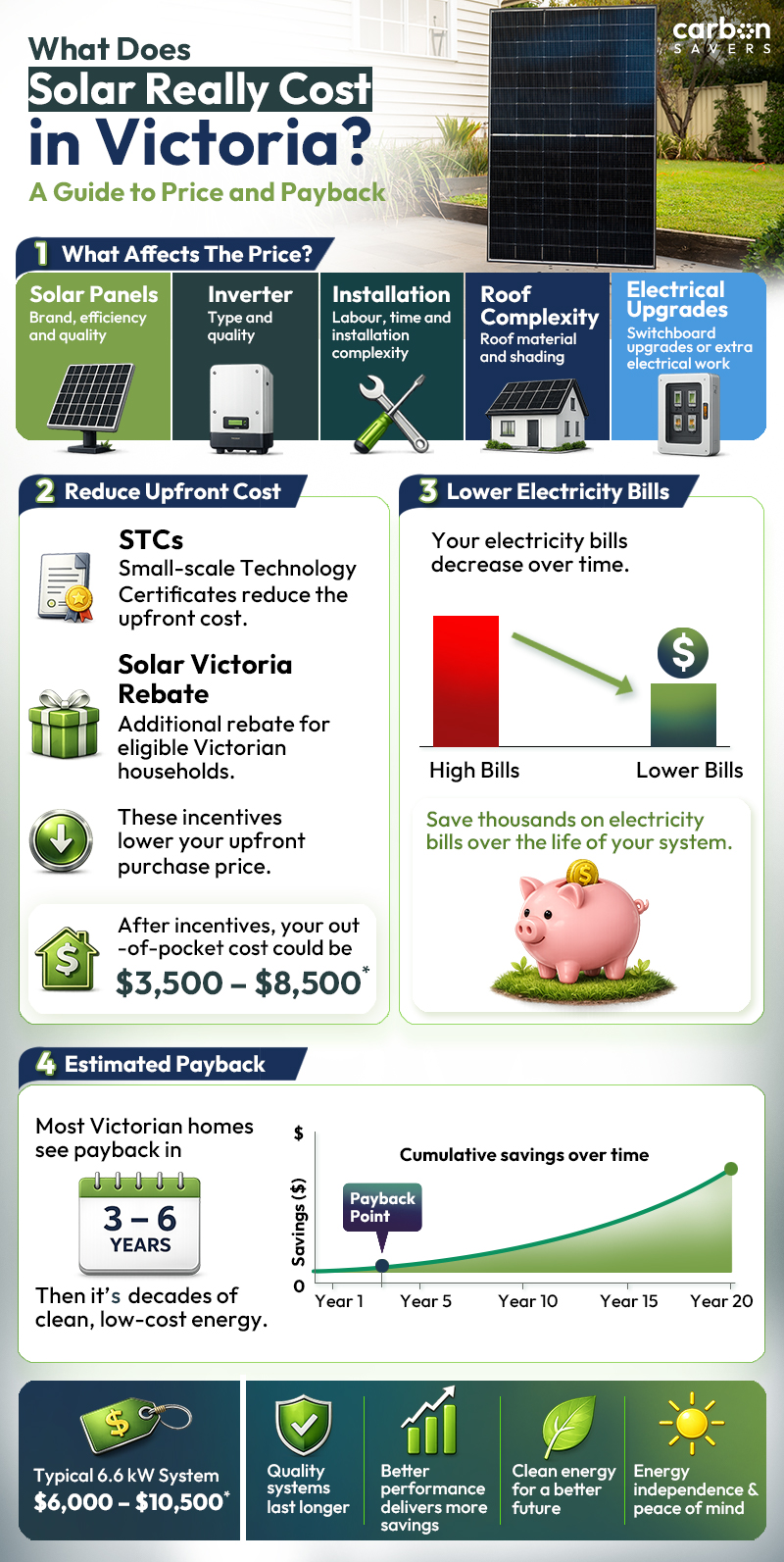
A low advertised price tells you very little about the long-term value of a solar system.
Instead of asking, “Which installer is cheapest?”, a better question is:
“What am I receiving for my investment over the next 25 years?”
A higher-quality solar system may cost more upfront, but better components, expert installation and longer warranties can deliver greater long-term savings and reliability than a cheaper alternative.
That is why comparing quotes solely on price often leads homeowners to the wrong decision.
For example, two neighbouring homes could each install a nominally similar 6.6 kW system yet receive substantially different quotes because one requires:
Likewise, eligibility for incentives can significantly reduce upfront costs.
Eligible Victorian owner-occupiers may be able to access:
These incentives are separate and should not be confused. STCs are generally applied as an upfront discount by the installer, while the Solar Victoria rebate and loan have their own eligibility requirements and application process.
It’s equally important to understand what isn’t included in many advertised prices.
Some promotional offers exclude site-specific work such as switchboard upgrades, roof repairs, meter alterations or additional electrical labour, all of which can affect the final quotation.
If you’ve searched online for solar prices, you’ve probably seen advertisements promising systems for just a few thousand dollars.
While these offers may be genuine in specific circumstances, they rarely represent the final cost for every home.
A more useful approach is to understand what influences the price of different system sizes and what those prices generally include.
Here’s an indicative price range representing solar cost in Victoria:
| System Size | Suitable For | Average Daily Usage | Estimated Daily Generation | Typical Cost Before Rebates | After Incentives |
| 3kW | 1-2 people | 5-10 kWh/day | 10-15 kWh/day | $4,000–$6,000 | $2,500–$4,500 |
| 5kW | 2-3 people | 8–15 kWh/day | 17-23 kWh/day | $5,500–$8,000 | $3,500–$6,000 |
| 6.6kW | Average family (3-4 people) | 10–20 kWh/day | 22–30 kWh/day | $6,500–$9,500 | $4,000–$7,500 |
| 10kW | High usage, EV charging | 20–30 kWh/day | 35–45 kWh/day | $10,000–$14,000 | $7,000–$12,000 |
Note: There is no government-set price for residential solar. Prices are indicative averages and may vary depending on installer, equipment quality, roof type, and installation complexity.
The right system size depends on your household’s electricity consumption, available roof space and future plans such as purchasing an electric vehicle or installing a battery.2
| System Size | Best Suited For | Typical Daily Generation* | Typical Household |
| 3–5 kW | Low electricity use | Varies by season and location | 1–2 people |
| 6.6 kW | Average family home | Varies by season and location | 3–4 people |
| 8–10 kW | High daytime electricity use | Varies by season and location | Larger households |
| 10–13.2 kW+ | Large homes, pools, EV charging or future battery integration | Varies by season and location | High-energy households |
*Actual energy production depends on panel orientation, roof pitch, shading, weather conditions and system design.
Two systems with the same advertised capacity can differ significantly in price because the equipment and installation requirements are rarely identical.
| Price Factor | Why It Matters |
| Panel quality | Premium panels often provide higher efficiency, stronger product warranties and lower long-term degradation. |
| Inverter selection | String inverters, hybrid inverters and microinverters differ in cost, monitoring capability and performance in shaded conditions. |
| Roof complexity | Multi-storey homes, steep roofs or complex layouts generally require more labour and safety equipment. |
| Electrical upgrades | Older switchboards or non-compliant electrical infrastructure may need upgrading before installation. |
| Installation quality | Experienced installers typically invest more time in cable management, roof penetrations, commissioning, and compliance documentation. |
| Warranty coverage | Longer workmanship warranties may reflect greater confidence in installation quality. |
| Future-ready design | Systems designed to accommodate batteries or EV charging may require additional hardware or upfront planning. |
These questions often reveal why one quote is considerably cheaper than another.
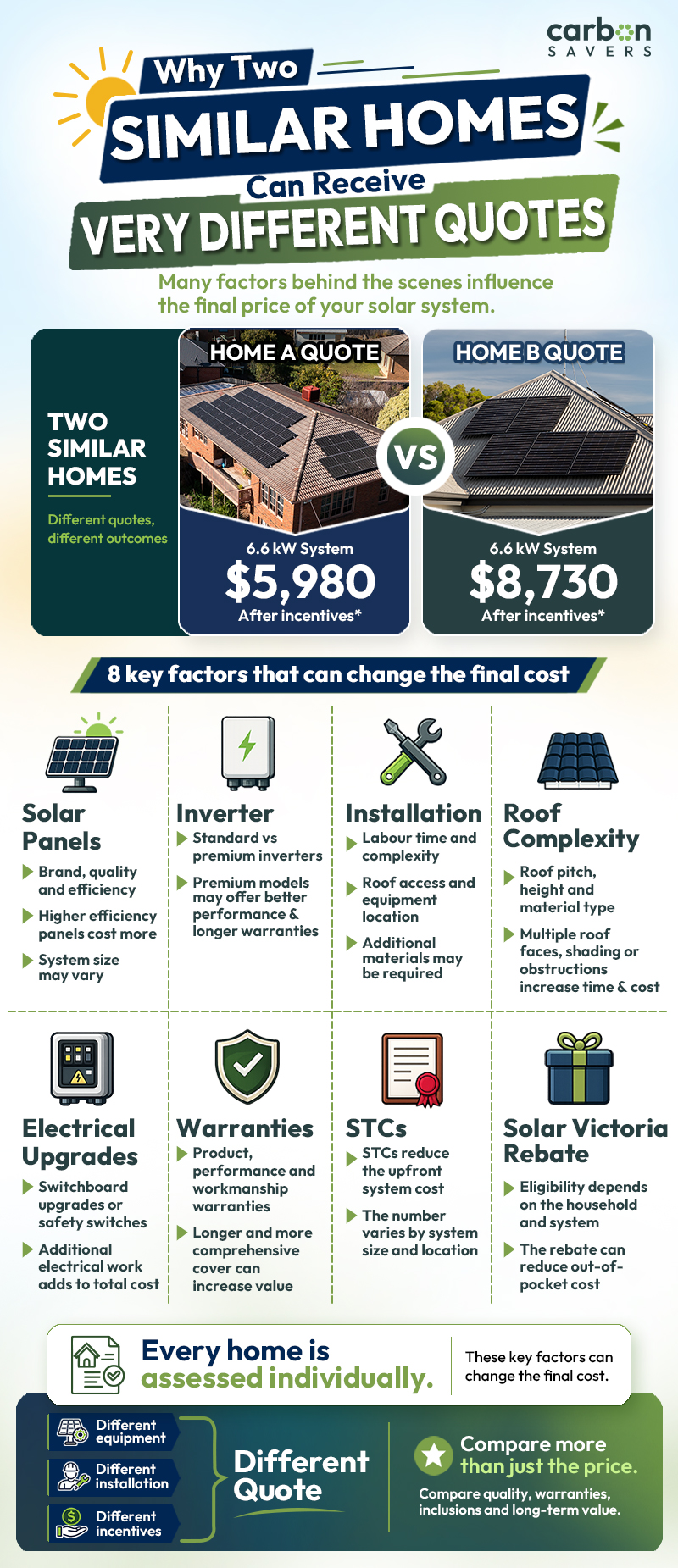
Consider two neighbouring homes that both require a nominal 6.6 kW solar system.
| Feature | Home A | Home B |
| Single-storey roof | ✓ | ✗ |
| Simple roof layout | ✓ | ✗ |
| Existing compliant switchboard | ✓ | ✗ |
| No shading | ✓ | Partial afternoon shading |
| Premium inverter requested | ✗ | ✓ |
| Battery-ready design | ✗ | ✓ |
Although both homeowners are purchasing a system of similar capacity, Home B requires additional design work, electrical upgrades and different equipment, resulting in a higher overall investment.
This illustrates why comparing systems based solely on advertised wattage can be misleading.
Not all solar quotes include the same products or services.
In fact, two quotes with the same system size can differ significantly because one includes everything needed for a compliant installation, while the other excludes site-specific work that later becomes an additional cost.
Before comparing prices, compare scope.
A comprehensive quote should clearly identify every major component, the installation process, warranties, expected performance, and any assumptions made about your property.
| Component | What to Check | Why It Matters |
| Solar panels | Brand, model, power rating, efficiency, product warranty | Panel quality affects long-term performance and durability. |
| Inverter | Brand, model, capacity, monitoring features, warranty | The inverter is central to system performance and future battery compatibility. |
| Mounting system | Roof compatibility and corrosion resistance | Correct mounting protects both system longevity and roof integrity. |
| Installation labour | Accredited installation and commissioning | Proper installation reduces the risk of faults and warranty issues. |
| Electrical work | Isolation switches, cabling, and protection devices | Required for compliance and safety. |
| Grid connection | Network application and commissioning | Necessary before the system can legally export electricity. |
| Monitoring | Mobile or web-based monitoring platform | Enables homeowners to track system performance and identify issues early. |
| Warranties | Product, performance and workmanship warranties | Different warranty types cover different risks. |
Before accepting a quote, ask:
The more transparent the answers, the easier it becomes to compare value rather than simply comparing price. For example:
Although Quote B appears less expensive initially, the overall value proposition may differ once exclusions and future upgrade costs are considered.
Many advertised prices assume a straightforward installation on a modern home. In reality, some properties require additional work that cannot always be confirmed until a site inspection has been completed.
Understanding these potential costs helps avoid unexpected variations between the advertised price and the final quotation.
| Possible Additional Work | Why It May Be Required |
| Switchboard upgrade | The existing switchboard does not meet current standards or lacks capacity. |
| Roof repairs | Damaged roofing should generally be repaired before installation. |
| Meter upgrades | Required depending on the electricity network and existing metering. |
| Additional cabling | Long cable runs between the roof and the switchboard. |
| Scaffolding | Required for safety on some multi-storey or steep roofs. |
| Roof access equipment | Complex roof designs may require additional installation equipment. |
| Tree trimming | Shading can significantly reduce energy production. |
Whether these items apply depends on your property’s condition and design.
Government incentives can substantially reduce the upfront cost of installing solar, but they are often misunderstood.3
Three separate mechanisms may influence what you ultimately pay.
Eligible owner-occupiers may access a rebate of up to $1,400 through the Solar Homes Program.
Eligibility requirements include factors such as:
The various schemes and eligibility criteria may change over time.
Eligible applicants can access an interest-free loan of up to $1,400, with no collateral required. If approved, the loan is paid directly to your solar retailer alongside your rebate.4
The loan must be selected during the application process from 1 May 2026.
Repayments are made monthly over four years ($29.17 per month for a $1,400 loan).
Payments are automatically deducted from your nominated bank account.
Repayments begin 30 days after your installation is approved.
STCs are a federal incentive administered by the Clean Energy Regulator.5
The number of certificates depends on factors including:
Most homeowners assign these certificates to the installer in exchange for an upfront reduction in system cost.
| Incentive | Administered By | Purpose |
| Solar Panel Rebate | Solar Victoria | Reduce upfront purchase cost |
| Interest-Free Loan | Solar Victoria | Spread the upfront payment |
| STCs | Clean Energy Regulator | Federal renewable energy incentive |
Rather than asking whether solar is “worth it”, a more useful question is:
How quickly can the system recover its upfront cost through reduced electricity purchases?
There is no universal answer because payback depends on how your household uses electricity.
However, for most households, the recommended solar system size is one that, where possible, will pay for itself in approximately 3 to 7 years.6
| Factor | Effect |
| Daytime electricity use | Greater self-consumption generally improves value. |
| Electricity prices | Higher retail electricity prices may improve savings. |
| System size | Oversized systems may export more electricity than is used onsite. |
| Feed-in tariff | Export payments vary by retailer and plan. |
| Roof orientation | Influences annual energy production. |
| Shading | Reduces generation. |
So, ask yourself:
These questions often have a greater impact on long-term value than selecting the lowest-priced system.
Once homeowners understand solar costs, the next question is whether adding battery storage improves the return on investment.
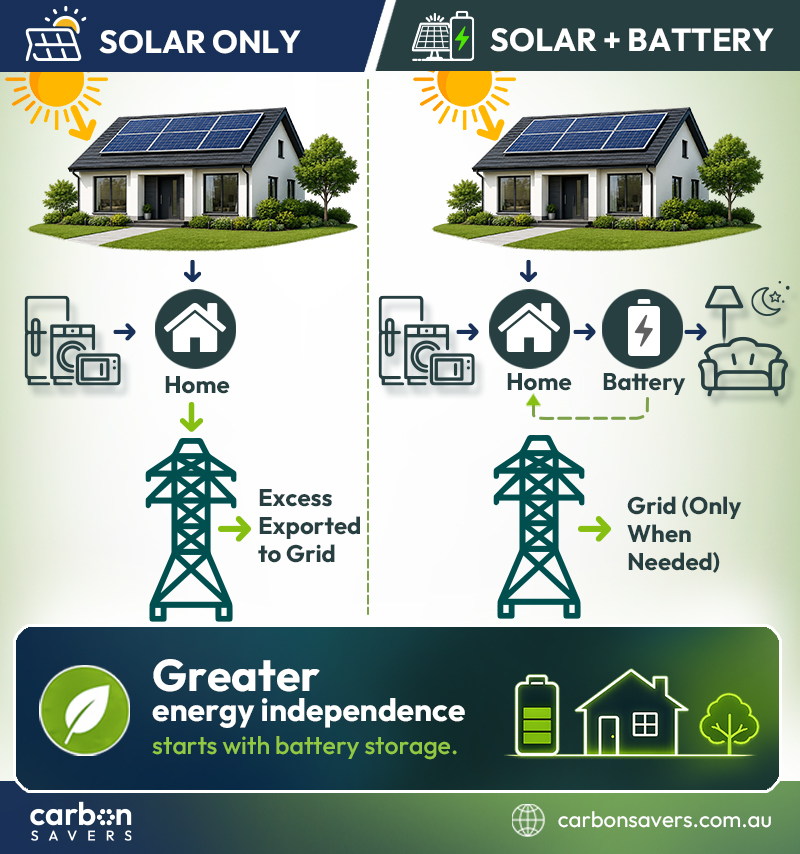
Adding battery storage changes how solar energy is used.
Without a battery, excess daytime generation is typically exported to the grid. With a battery, more of that energy can be stored for later household use.
| Solar Only | Solar + Battery |
| Lower upfront cost | Higher upfront investment |
| Exports excess generation | Stores excess generation |
| Simpler installation | Greater system complexity |
| Suitable for many households | May suit homes seeking greater energy independence or backup capability |
A battery may be worth considering if you:
If your primary goal is reducing upfront cost, many households begin with solar panels and evaluate battery storage later.
A good solar quote should help you understand what you’re buying, not simply what you’re paying.
| Compare | Why It Matters |
| Equipment brands | Long-term reliability |
| Warranties | Risk protection |
| Installer experience | Installation quality |
| Monitoring | Performance tracking |
| Future battery compatibility | Upgrade flexibility |
| Included electrical work | Avoid unexpected costs |
| Workmanship warranty | Installation confidence |
One of the biggest mistakes homeowners make is choosing a solar system based solely on the advertised price rather than the overall value it delivers.
Others select a system size without first analysing their household’s electricity usage or considering future energy needs, such as an electric vehicle or battery storage.
It’s also common to assume all solar panels and inverters perform the same, overlook the installer’s workmanship warranty, or fail to read the quote carefully for exclusions and additional costs.
Before signing a contract, always confirm your eligibility for available rebates and incentives to avoid unexpected surprises.
The true cost of solar is not simply the number at the bottom of a quote. It is the balance between upfront price, system quality, installation standards and the savings your household can achieve over time.
Before choosing a system, make sure the quote reflects your roof, electricity usage and future plans, not just an advertised package price.
Ready to understand which solar option suits your home?
Explore Carbon Savers’ solar solutions and take the next step towards a system designed around your household and energy goals.