
Blog › What you’ll really pay after rebates
Rebates
Hot water
A heat pump water heater can look expensive at first glance, but the price on the quote isn’t necessarily what you’ll end up paying.

By Laura Sweeney
11 Nov 2026 ·
On this page
According to Victorian Government data, an installed heat pump water heater can cost between $2,500 and $7,500 before incentives. So, what could you actually pay after rebates?1
The final cost will depend on the system you choose, installation requirements and the incentives available to your household.
In Victoria, eligible homeowners can claim up to $2,380 in government rebates when replacing an old gas or electric hot-water system with a new energy-efficient electric heat pump system.
So, let’s look at the rebates, likely upfront costs and ongoing running costs to see what a heat pump could really mean for your household budget.
There is no single fixed legitimate “after-rebate price” for every Victorian household.
The Victorian Government’s pre-incentive installed range is $2,500-$7,500, while recent market data from July 2026 shows that for a Victorian home replacing an electric hot-water system, the typical cost is around $4,544 after the federal STC discount.
This cost is further reduced to roughly $2,829 when another state rebate is applied.
While this isn’t a guaranteed price, it provides a useful benchmark for comparing quotes and determining whether you’re getting a reasonable deal.
A simple way to understand the price:
However, these incentives aren’t necessarily available to every customer or stackable in every situation, so the final rebate amount depends on eligibility and the system being installed.
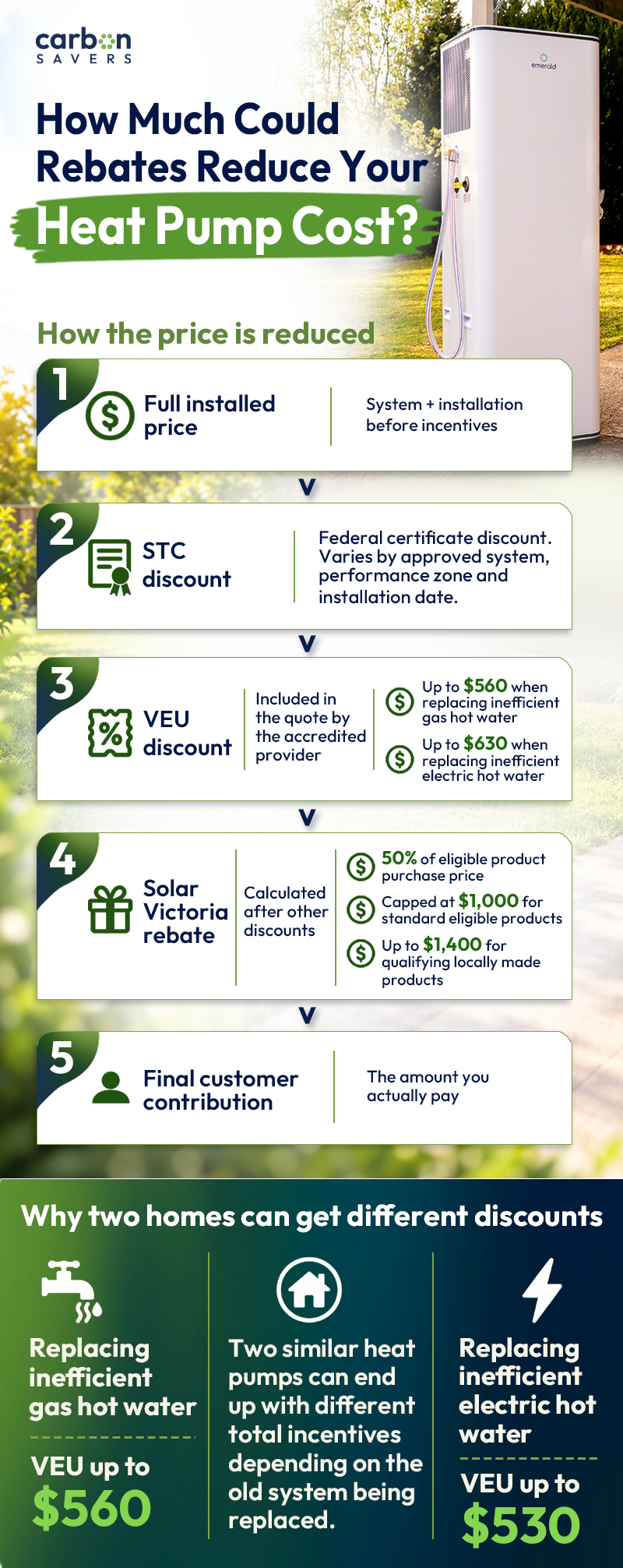
Solar Victoria’s hot-water rebate is 50% of the eligible product purchase price after other discounts have been applied, capped at $1,000 for other eligible products or $1,400 for qualifying locally made products.2
For example, using Solar Victoria’s formula:
| Eligible product price | 50% calculation | Standard product rebate | Eligible locally made product |
|---|---|---|---|
| $1,600 | $800 | $800 | $800 |
| $2,400 | $1,200 | $1,000 cap | $1,200 |
| $2,800 | $1,400 | $1,000 cap | $1,400 cap |
So, if the eligible price is $1,600, 50% is $800, so the rebate is $800.
At $2,400, 50% is $1,200, but a standard product is capped at $1,000, while an eligible locally made product can receive the full $1,200. At $2,800, the locally made rebate reaches its maximum of $1,400.
The current Victorian Government offer VEU discounts, for example, up to $560 when replacing an inefficient gas system or $630 when replacing an inefficient electric system.3
The accredited provider must include the discount in the quote.
That means two neighbours choosing similar heat pumps can legitimately end up with different incentive totals simply because one is replacing gas and the other is replacing electric hot water.
Eligible air-source heat pumps can create STCs under the Australian Government’s Small-scale Renewable Energy Scheme.
Most customers assign the right to create those certificates to a registered agent in exchange for an upfront reduction in the purchase price.4
The certificate entitlement varies by factors including the approved system, its performance zone and installation date, so a fixed “$X federal heat-pump rebate” should not be treated as universal.5
Solar Victoria calculates its rebate after STCs and Victorian Energy Efficiency Certificate discounts have already been applied.
So the correct calculation is not simply “$1,400 + $630 + STCs” for every customer.
There is also a discrepancy between current Victorian Government pages.
For instance:
Solar Victoria says its rebate combined with VEU can reduce upfront costs by up to $2,030 for an eligible locally made system or $1,630 for another eligible system,6 while the VEU page currently states combined maxima of $1,960 and $1,560.7
So, the safest number to rely on is the itemised discount shown on your current approved quote, rather than a generic maximum advertised.
It’s obvious that government incentives reduce eligible costs, but they do not make every property identical to install.
Electrical work, plumbing changes, relocation, difficult access and the product itself can change the final customer contribution.
These crucial factors can change the final cost of a hot water system in your Victorian home.
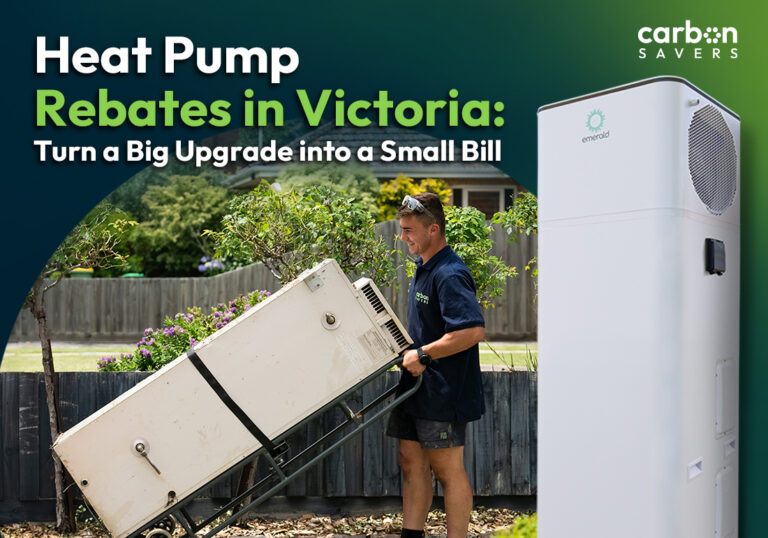
For the full breakdown of what drives installed price and how to compare quote quality, see Heat Pump Rebates in Victoria: Turn a Big Upgrade into a Small Bill rather than treating a very low advertised changeover price as a complete quote.
Want a quote that shows every discount, line by line? We’ll itemise it for your home.
Upfront cost is only half the financial decision.
Sustainability Victoria’s 2025 modelling shows a substantial running-cost gap between efficient heat-pump hot water and common gas systems for a four-person household.
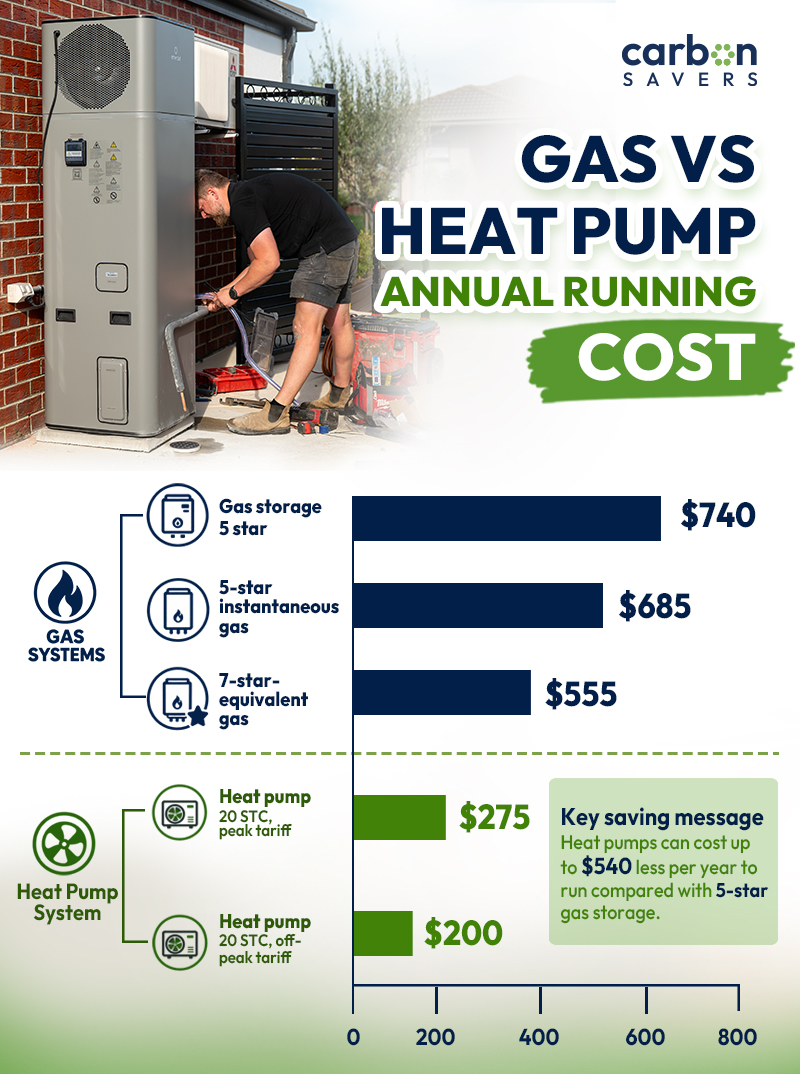
Four-Person Victorian Household Comparison8
| Hot-water system | Modelled annual energy cost |
|---|---|
| Gas storage – 5 star | $740 |
| Gas instantaneous – 5 star | $685 |
| Gas instantaneous – 7-star equivalent | $555 |
| Heat pump – 20 STC, peak tariff | $275 |
| Heat pump – 20 STC, off-peak tariff | $200 |
Using these modelled figures, replacing 5-star gas storage at $740 a year with the 20-STC heat-pump examples gives a difference of around $465 a year on the modelled peak tariff or $540 a year on the modelled off-peak tariff.
Similarly, compared with 5-star instantaneous gas at $685, the modelled difference is approximately $410-$485 a year.
Even compared with the more efficient 7-star-equivalent instantaneous gas example at $555, the difference is around $280-$355 a year.
Therefore, for households looking to cut ongoing hot-water costs, a heat pump can be a stronger long-term option, with substantially lower annual energy costs than the gas systems compared above.
A household with long showers and high hot-water demand will use more energy than a low-use household.
Likewise, tariff structure and heat-pump efficiency affect how much electricity the system costs to run.
However, rooftop solar can improve the economics further when the system is operated to use daytime generation, but solar optimisation belongs to the broader savings discussion.
This is where the financial comparison can change again.
The running-cost table above covers the energy used to heat your water, but households connected to gas also pay a separate fixed gas supply charge, regardless of how much gas they use.
Victorian Government says households that can electrify fully and disconnect from gas may avoid around $350-$400 a year in fixed network charges.9
Keep in mind, if you still use gas for heating or cooking, that fixed charge remains.
Ignore the biggest “rebate value” on the advertisement and find these four numbers instead:
The VEU program requires a minimum customer contribution of $200 including GST, and eligible VEU upgrades cannot be offered or installed free of charge.
So, your best comparison is:
final customer contribution + clearly identified exclusions
That lets you compare like with like rather than comparing one installer’s full price with another’s headline after-rebate figure.
Heat-pump rebates in Victoria can remove a meaningful part of the upfront cost, but there isn’t one honest “everyone pays this” figure.
Solar Victoria’s rebate is percentage-based and capped, VEU changes according to the old system, STCs vary by product and installation, and the remaining installation cost depends on the property.
But one thing is clear: if the upgrade lets you disconnect gas entirely, the whole-home saving may be larger.
When you’re ready to compare systems, ask for a heat pump quote showing every incentive and the final customer contribution. That’s the number worth making the decision on.
Laura specialises in hot water heat pump systems, helping customers select the right system size, maximise rebates, and achieve long term energy savings.
Talk to an expert
Tell us a little about your home and what you’re keen on. We’ll come back with your options, and the rebates you could get. No sales pressure, no cookie-cutter systems, no jargon.
We’ll check which rebates apply to your home and show the final amount you pay before you commit.
$0 upfront with our repayment plan. No call-out fees. No obligation.
More answers in the FAQ hub →
There is no universal final price. The Victorian Government puts pre-incentive installed water-heater costs at $2,500–$7,500, with Solar Victoria, VEU and STCs potentially reducing the amount you pay.
It is 50% of the eligible product purchase price after other discounts, capped at $1,000, or up to $1,400 for an eligible locally made product.
The current indicative discount is $560 when replacing inefficient gas hot water and $630 when replacing inefficient electric hot water with a heat pump.
There isn’t one fixed dollar amount. STC entitlement varies with the eligible product, performance zone and installation date, and customers commonly assign the certificates for an upfront discount.
The advertisement may assume a particular product, rebate entitlement and straightforward installation. Your quote may include additional electrical, plumbing or site work.
Yes, a high-efficiency heat pump costs $200-$275 a year, compared with $555–$740 for gas. Your final bill will depend on usage and tariffs.
No. VEU requires a minimum $200 customer contribution, including GST, and its buyer guide states that water-heating products cannot be offered or installed free of charge under the program.
Laura Sweeney
12 Nov 2026
Laura Sweeney
11 Nov 2026