- $0 upfront with our repayment plan
- No call-out fees
- 24-hour response
Blog › How much can you save
Batteries
Rebates
Victorian homeowners can now cut the upfront cost of an eligible home battery through the Australian Government’s Cheaper Home Batteries Program.

By Reno Damianou
Operations Manager ·
25 Nov 2026 ·
On this page
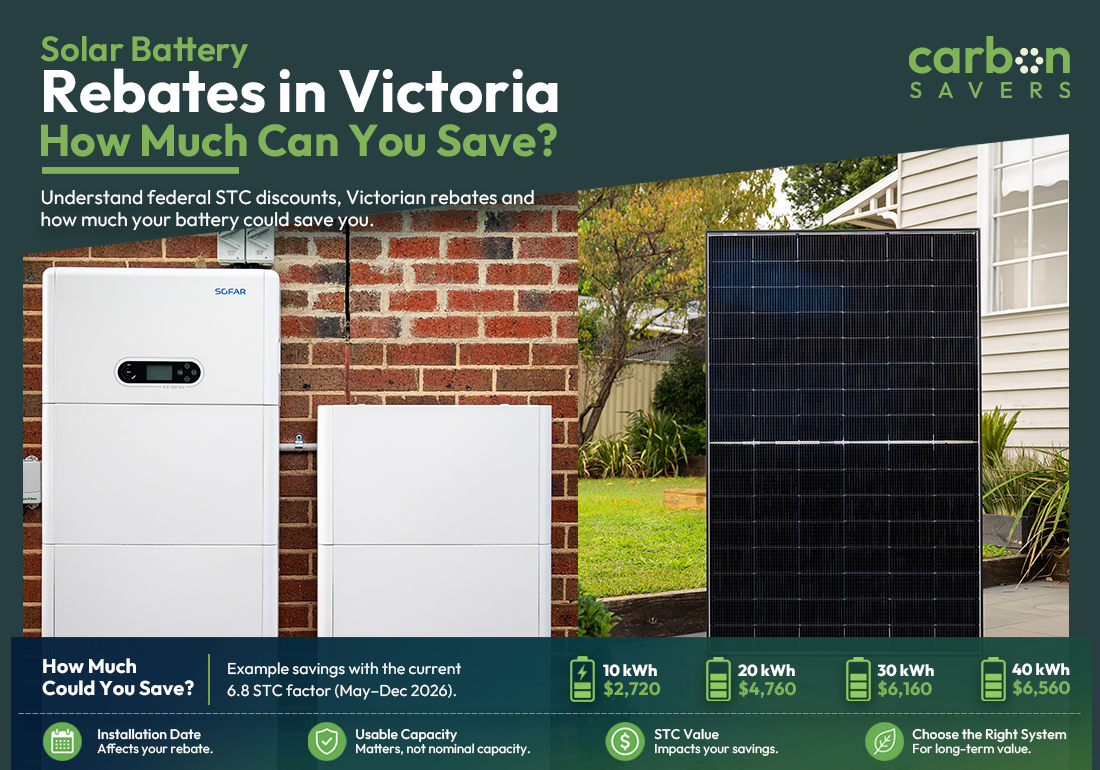
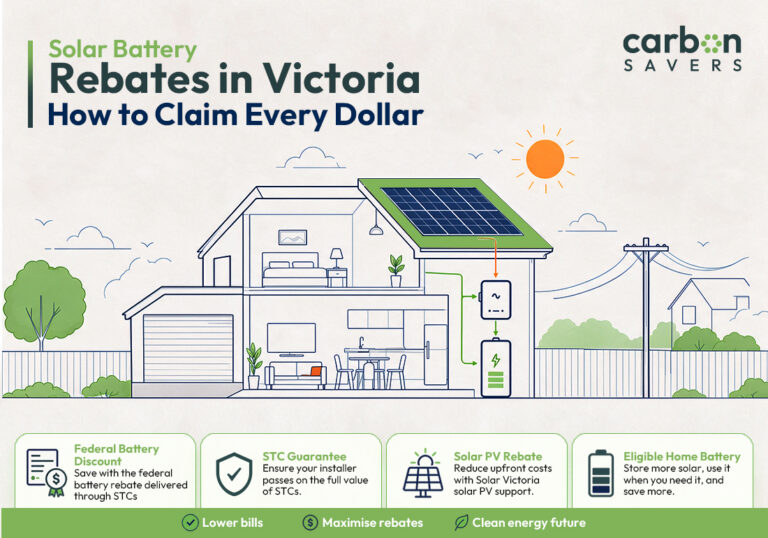
The discount is delivered through STCs and is designed to reduce eligible battery costs by around 30%.1
Victoria no longer offers a separate Solar Victoria battery loan to new applicants. However, eligible households may still be able to claim up to $1,400 off a solar panel system, alongside the federal battery discount.2
So, how much could you actually save on a battery? It mainly comes down to the battery’s usable capacity, when it’s installed, the STC factor that applies and the value of those STCs.
For most Victorian homeowners buying a battery in 2026, the key battery-specific incentive is the federal Cheaper Home Batteries Program.
The program operates through the Small-scale Renewable Energy Scheme. Eligible batteries create STCs, which are normally assigned to the installer, retailer or registered agent in exchange for an upfront discount.3
Victoria previously offered an interest-free Solar Victoria battery loan, but Solar Victoria states that it is no longer taking new applications for that program.4
With the right solar and battery setup, Victorian households could potentially save around $2,000-$4,000 a year on energy bills.
| Incentive | Government | Current status | Applies to |
|---|---|---|---|
| Cheaper Home Batteries Program | Federal | Active | Eligible batteries |
| Solar panel PV rebate | Victoria | Active | Eligible solar PV |
| Interest-free PV loan | Victoria | Active | Eligible solar PV |
| Solar Victoria battery loan | Victoria | Closed to new applications | Battery |
This means there is no separate current Victorian battery rebate to add on top of the federal battery STCs.
The federal incentive is often described as a battery rebate, but technically it works through Small-scale Technology Certificates.
The government has designed the program to provide an incentive of around 30% across a range of battery systems. That does not mean every customer simply receives 30% off the retail price.
The actual certificate entitlement depends on the battery system and when it is installed.
Four numbers are particularly important:
For batteries installed from 1 May to 31 December 2026, the base STC factor is 6.8 certificates per eligible kWh, before the capacity taper is applied.5
The installation date matters because the STC factor reduces over time. It is the installation date, rather than the date you accepted the quote, that determines the applicable factor.
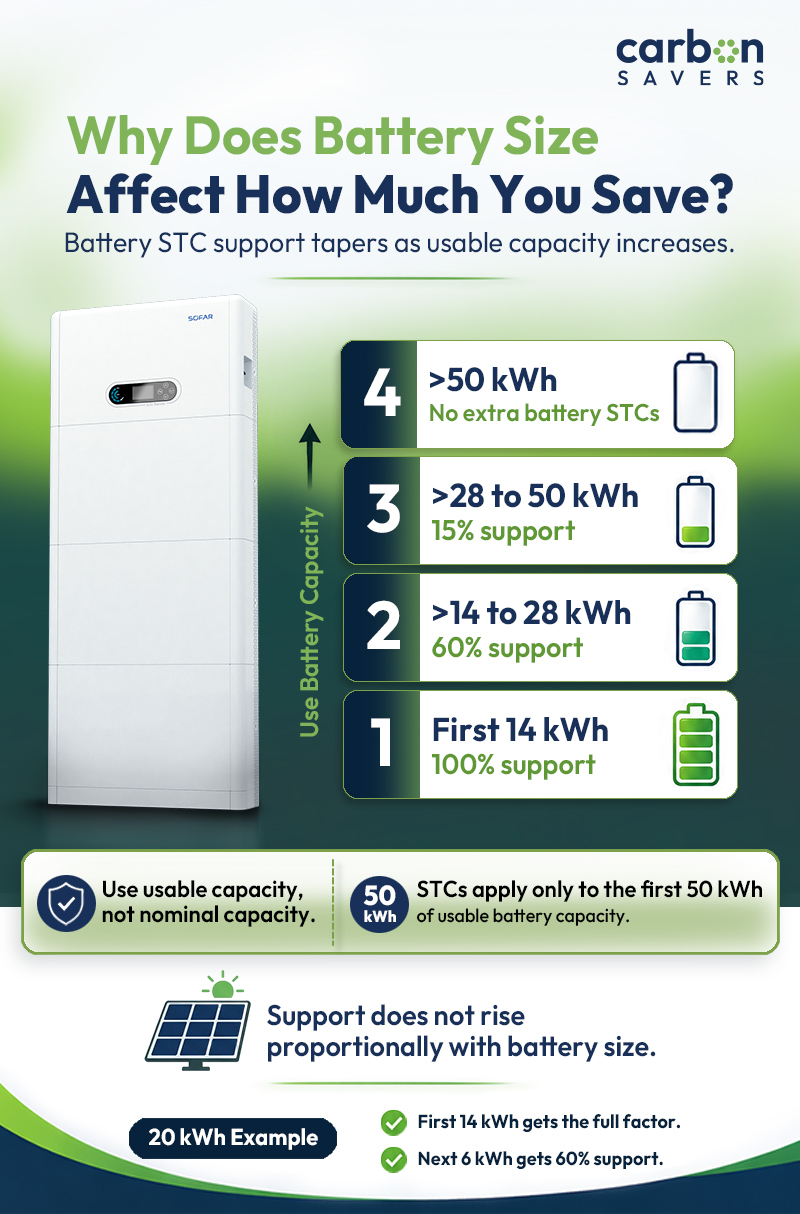
Since 1 May 2026, the federal program gives different levels of support to different portions of a battery’s usable capacity.
| Portion of usable battery capacity | STC factor applied |
|---|---|
| First 14 kWh | 100% |
| Above 14 kWh to 28 kWh | 60% |
| Above 28 kWh to 50 kWh | 15% |
| Above 50 kWh | No additional battery STCs |
This taper means the rebate does not rise proportionally as battery capacity increases.
For example, you cannot calculate a 20 kWh battery by simply multiplying 20 by 6.8. The first 14 kWh receives the full factor, while the remaining 6 kWh receives only 60% of the factor.
It is also important to use usable capacity, not just the nominal capacity printed on the battery. The Clean Energy Regulator states that STCs can only be claimed for the first 50 kWh of usable battery capacity.
There is no single dollar rebate amount that applies to every Victorian battery.
For batteries installed between 1 May and 31 December 2026, these examples use the current 6.8 STC factor and the capacity taper described above.
The STC Clearing House price is fixed at $40 per STC, excluding GST. STCs can also be traded outside the Clearing House, so the actual value passed through by an installer may differ.6
| Usable battery capacity | Approx. STCs | Value at $40 per STC |
|---|---|---|
| 10 kWh | 68 | $2,720 |
| 13.5 kWh | 91 | $3,640 |
| 20 kWh | 119 | $4,760 |
| 30 kWh | 154 | $6,160 |
| 40 kWh | 164 | $6,560 |
Figures are illustrative and based on the May–December 2026 STC factor and $40 clearing-house price. Actual upfront discounts may differ depending on certificate values, retailer arrangements and installation dates. Larger batteries do not necessarily offer better financial returns.
This is one of the most important points when comparing battery quotes.
The number of STCs and the dollar discount offered for those STCs are related, but they are not the same thing.
DCCEEW states that the Clearing House price is $40 per STC excluding GST, while STCs can also be sold on the open market.
Retailers and registered agents may also account for administration costs when converting the certificates into an upfront discount.
The simplest way to think about the current system is:
Federal support reduces eligible battery costs. Victorian support can reduce eligible solar PV costs.
A Victorian homeowner installing a new solar and battery system may potentially receive federal STCs for the solar PV system, federal battery STCs through the Cheaper Home Batteries Program, and Solar Victoria assistance for the eligible solar PV component. Each incentive has separate rules.
For example:
| Project | Federal battery STCs | Solar Victoria PV rebate | Solar Victoria PV loan |
|---|---|---|---|
| Battery added to existing solar | Potentially | Not for the battery | Not for the battery |
| New solar only | No | Potentially | Potentially |
| New solar plus battery | Potentially | Potentially for solar | Potentially for solar |
Solar Victoria’s current PV rebate is worth up to $1,400, and eligible households can opt for an interest-free loan of up to the approved rebate value.
Before accepting a battery quote, make sure you understand how the STC discount has been calculated.
Use this quick check:
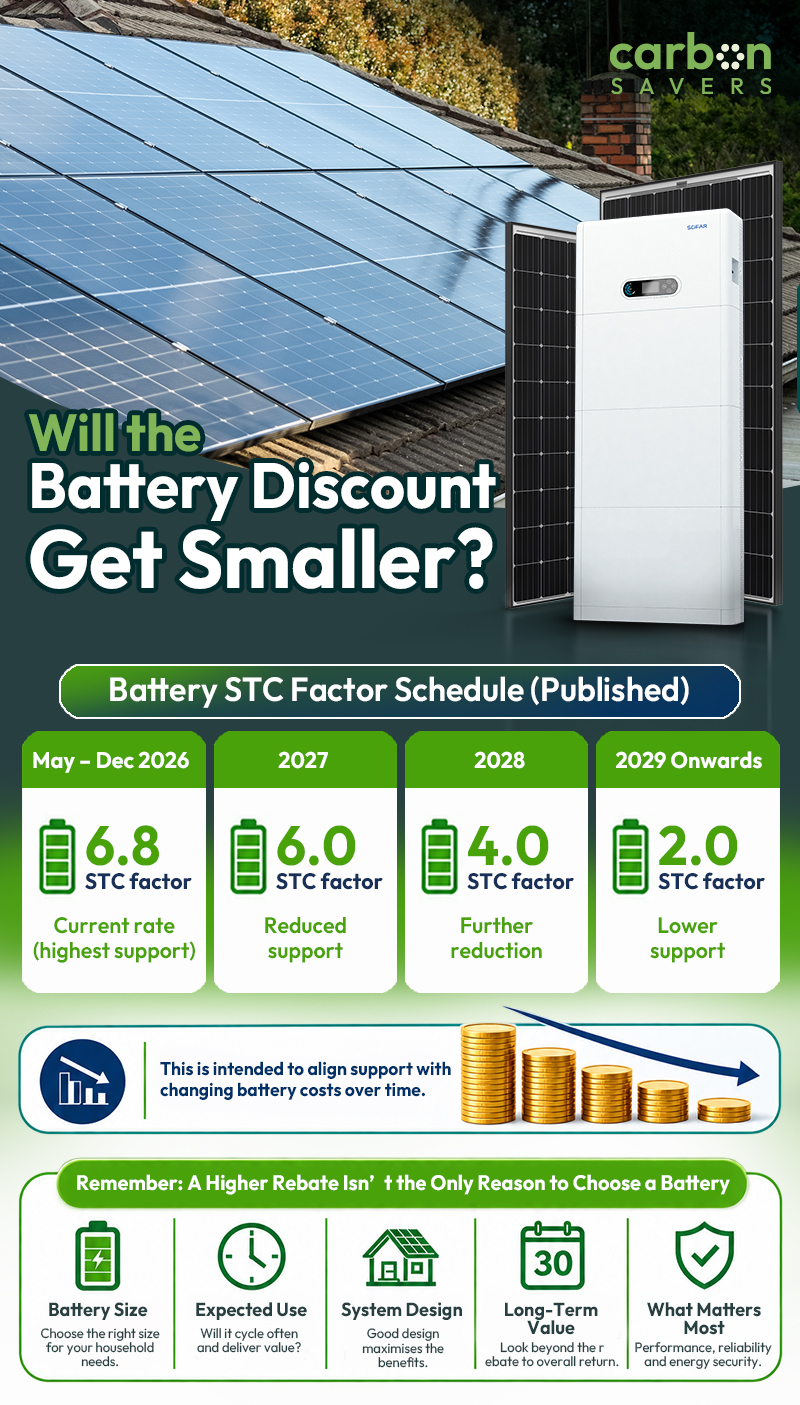
Under the current published schedule, yes.
The base STC factor is scheduled to decrease from 6.8 in May–December 2026 to 5.7 in January–June 2027, followed by 5.2 in July–December 2027. This means an otherwise identical battery may receive fewer STCs if installed later, although the actual discount will also depend on certificate values and applicable program rules.7
This is intended to align support with changing battery costs over time.
However, a higher rebate should not be the only reason to choose a battery. Battery size, expected use, system design and long-term value still matter.
Not sure which battery suits your home? We’ll compare them for you.
Battery rebates can make home energy storage more affordable, but the actual savings depend on your battery size, installation date and STC value.
If you are thinking about adding a solar battery to your home, you can check your eligibility for solar battery rebates in Victoria and explore the options available for your property.
Talk to an expert
Tell us a little about your home and what you’re keen on. We’ll come back with your options, and the rebates you could get. No sales pressure, no cookie-cutter systems, no jargon.
We’ll match a battery to your home, your solar and your energy use, and check the rebates you could get.
$0 upfront with our repayment plan. No call-out fees. No obligation.

David Bonaddio
25 Nov 2026
Reno Damianou
Operations Manager
25 Nov 2026
Reno Damianou
Operations Manager
25 Nov 2026