
Blog › Are solar batteries worth it in Victoria
Batteries
Rebates
For some Victorian households, a solar battery is worth installing now. The strongest candidates export substantial solar during the day, buy electricity after sunset and can use the battery regularly.

By Reno Damianou
Operations Manager ·
20 Nov 2026 ·
On this page

For others, using more solar directly during daylight hours may deliver better value without the cost of storage. The federal battery discount improves the calculation, but it does not guarantee a fast payback.
This article focuses on the financial decision. For a broader explanation of battery operation, lifespan, backup power and buying considerations, see Solar Batteries Explained: Should You Store Your Own Power in Victoria?.
The honest answer is that batteries make financial sense for some homes, but not all.
Solar Victoria says a battery may help reduce bills when the electricity savings are greater than the upfront cost.
It also warns that payback within a typical battery warranty period can be difficult without careful system sizing.
A battery is more likely to provide value when:
The calculation is weaker when your solar exports are low, most electricity is already used during the day, or the proposed battery is larger than your normal evening consumption.
The decision is also affected by your reason for buying.
A battery purchased mainly for blackout protection may still feel worthwhile even if its financial payback is slow.1
The biggest recent change is the Australian Government’s Cheaper Home Batteries Program.
The program began on 1 July 2025 and provides an upfront discount of around 30 per cent on eligible small-scale batteries connected to new or existing rooftop solar.2
The discount is delivered through Small-scale Technology Certificates (STCs), which are typically assigned to a retailer or installer in exchange for an upfront discount. The final amount varies depending on battery capacity, installation date and certificate value.
From 1 May 2026, the certificate calculation became tiered according to usable battery capacity. Larger batteries still receive support, but additional capacity above the first tier attracts progressively less assistance. This reduces the incentive to install an unnecessarily large system purely to maximise the discount.3
Victoria’s feed-in tariff rules have also changed. Since 1 July 2025, the Essential Services Commission has no longer set a minimum feed-in tariff. Retailers can set their own export rates, although they cannot set them below zero.
Lower export payments can make storing solar more attractive because less income is lost when electricity is placed into the battery instead of exported. However, a low feed-in tariff alone does not make a battery profitable.
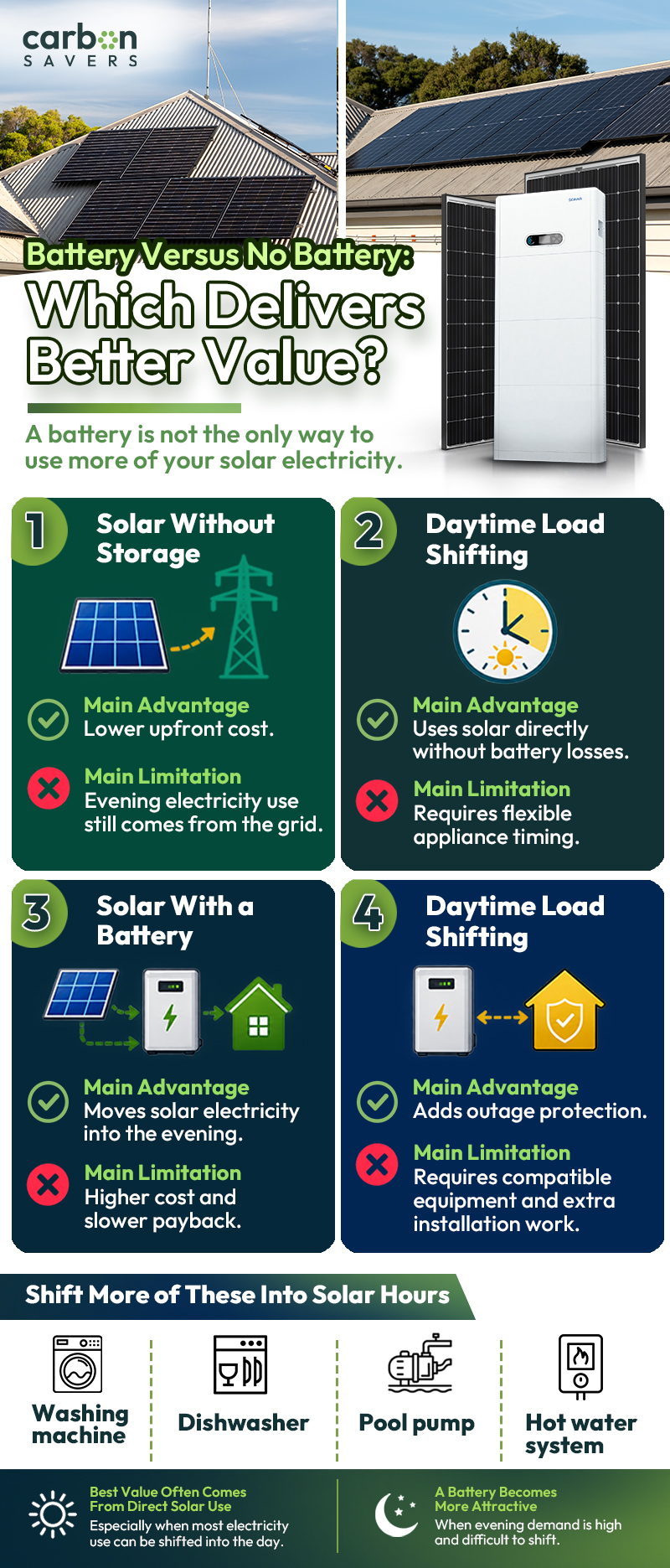
A battery is not the only way to use more of your solar electricity.
Running appliances during daylight hours can avoid grid purchases without paying for storage. Washing machines, dishwashers, pool pumps and hot water systems may be scheduled to operate while the panels are generating.
| Option | Main advantage | Main limitation |
|---|---|---|
| Solar without storage | Lower upfront cost | Evening use still comes from the grid |
| Daytime load shifting | Uses solar directly without battery losses | Requires flexible appliance timing |
| Solar with a battery | Moves solar into the evening | Higher cost and slower payback |
| Battery with backup | Adds outage protection | Requires compatible equipment and extra installation work |
For a household that can move most electricity use into the day, direct solar consumption may produce the better return.
A battery becomes more attractive when evening demand is high and difficult to shift. This might include cooking, heating, cooling or other loads that occur when household members return home.
Battery savings estimates can become unrealistic when they rely on several optimistic assumptions at once.
A battery may not fully charge during cloudy weather or winter. It may also retain unused energy when overnight consumption is low.
Export income is usually small compared with the retail electricity rate, but it is not zero. It should be deducted from the value of stored solar.
Future electricity prices are unknown. A proposal should not depend entirely on large annual price increases.
Battery capacity generally reduces over time. A system may deliver less usable energy in later years than it did when new.
A statement such as “you save 30 per cent immediately” describes the incentive, not the battery’s long-term return.
Solar Victoria advises homeowners to consider how battery size and price affect payback. Extra capacity provides little financial value when it cannot be charged and used regularly.
Questions to Ask Your Battery Retailer:
Some homeowners are willing to accept a longer financial payback because storage provides other benefits.
A correctly designed battery system may supply selected appliances during a blackout. However, backup is not automatic and depends on the battery, inverter, gateway and switchboard configuration.4
Other non-financial benefits may include using more renewable electricity generated at home and reducing reliance on evening grid imports.
These benefits are legitimate, but they should be valued separately from bill savings. Combining them into one vague promise makes it harder to judge whether the battery meets your priorities.
Not sure which battery suits your home? We’ll compare them for you.
A battery may be worth buying now when you have strong solar exports, high evening consumption and a quote that remains acceptable under conservative savings assumptions.
Waiting may be sensible when your usage is changing, you lack a full year of solar data, or future plans such as an EV or heat pump could materially change your electricity profile.
Skipping storage may be the better choice when you have little surplus solar, low evening demand or can shift most major appliances into daylight hours.
Battery Decision Guide: Buy, Wait or Skip?
Buy now: The battery will be well used, the numbers remain reasonable under cautious assumptions, and backup has genuine value.
Wait: Your future consumption is uncertain, or you need more energy data.
Skip for now: The proposed battery is likely to remain underused or daytime load shifting provides better value.
Ultimately, the best-value battery is not the largest or most heavily discounted option, but the one that matches how your home actually produces and uses electricity.
Review your solar exports, evening demand, tariffs and backup priorities using conservative assumptions.
When you are ready to compare a suitable system, explore solar and battery options for Victorian homeowners to see what support and system may suit your property.
Talk to an expert
Tell us a little about your home and what you’re keen on. We’ll come back with your options, and the rebates you could get. No sales pressure, no cookie-cutter systems, no jargon.
We’ll match a battery to your home, your solar and your energy use, and check the rebates you could get.
$0 upfront with our repayment plan. No call-out fees. No obligation.
Reno Damianou
Operations Manager
20 Nov 2026
Reno Damianou
Operations Manager
20 Nov 2026


Andrew Damianou
CEO, Carbon Savers
13 Nov 2026
