
Blog › Which upgrades pay off most
Energy Tips
Which Home Energy Upgrades Pay Off Most in Victoria?

By Alex Howard
Divisional Head ·
26 Nov 2026 ·
On this page
An energy-efficient home could be worth more than you think. As buyers increasingly consider energy-efficient performance when comparing properties, the right upgrades may offer benefits beyond lower electricity bills.
Domain research reported a median price premium of around $197,000 (23.8%) for Melbourne houses advertised with energy-efficient features, compared with houses without them.1
That isn’t a guaranteed return from any individual upgrade, but it does show the growing appeal of efficient homes. Energy-efficient house listings also received 13.8% more views on Domain than houses without energy-efficient features.2
From solar panels and home batteries to heat pump hot water and better insulation, different improvements can reduce energy use and household costs.
So, with Victorian government rebates making some upgrades more affordable, which options offer the best value?
Let’s explore what influences payback periods and which improvements could deliver the greatest long-term value.
Comparing the Costs and Long-Term Savings of Home Energy Upgrades
The best home energy upgrades generally do one of three things:
- Reduce the electricity you buy,
- Make existing appliances more efficient,
- Prevent your home from wasting energy.
Here’s how five popular upgrades compare.
| Upgrade | Indicative installed cost | Main financial benefit |
|---|---|---|
| Rooftop solar | $5,750 for 6 kW; $8,870 for 10 kW | Lower grid electricity purchases |
| Solar battery | $7,384-$7,984 for 10 kWh | Use stored solar electricity after sunset |
| Heat pump hot water | $4,405 Victorian average before state incentives | Lower water-heating energy costs |
| Reverse-cycle heating and cooling | $1,500-$3,000 for a small split; $8,000-$20,000+ for ducted | More efficient heating and cooling |
| Ceiling insulation | Property-specific quote required | Reduced heating and cooling demand |
Note: Indicative prices only, not Carbon Savers quotes. Some include federal discounts, others are before state incentives.
Solar Panels: Strong Long-Term Electricity Savings for Your Victorian Homes
Rooftop solar is one of the most established energy investments for Victorian homeowners.
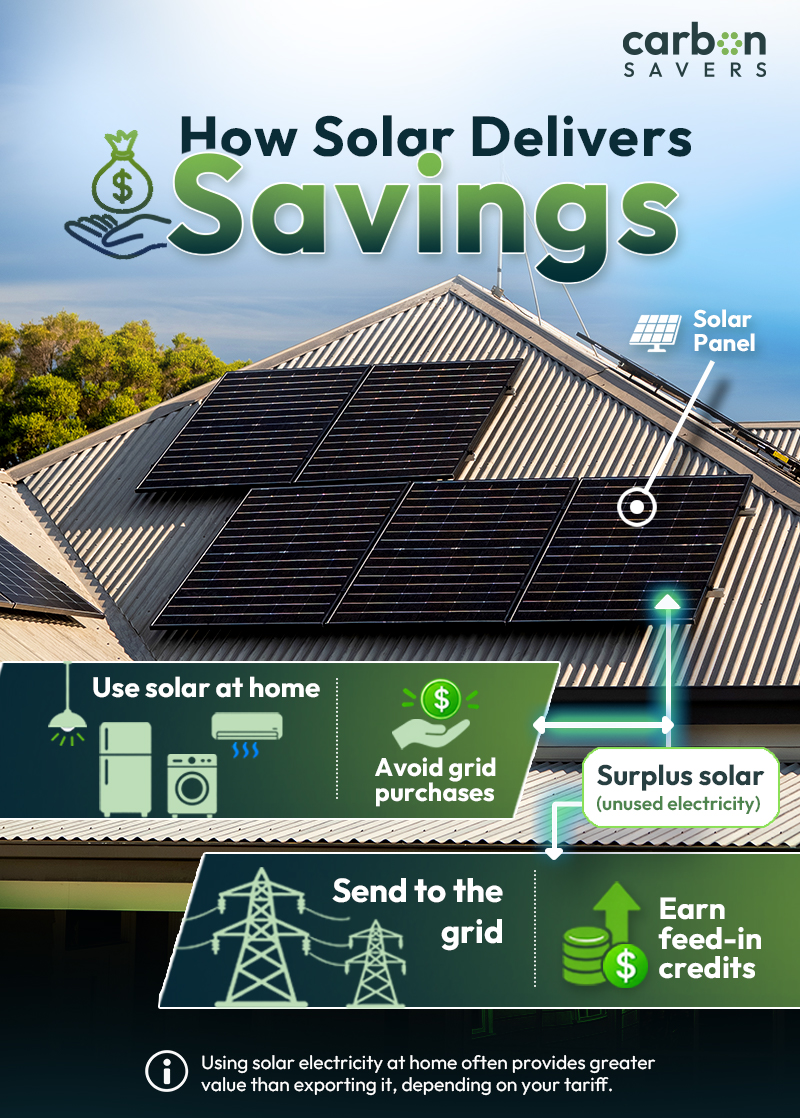
Instead of buying all your electricity from the grid, your household generates some of its own.
According to Solar Choice’s November 2026 price index, Melbourne’s average installed price is approximately $5,750 for a 6 kW system or $8,870 for a 10 kW system, including federal STC discounts and GST.3
What determines solar payback?
Three factors make the biggest difference:
- Self-consumption: Electricity used directly in your home generally offsets grid purchases.
- System output: Roof orientation, shading, location and system capacity influence generation.
- Electricity tariffs: Higher avoided import costs can improve returns.
Exported solar can also earn feed-in credits. However, Victoria no longer has a regulator-set minimum feed-in tariff, so the amount depends on your retailer.
Solar Batteries: Are the Extra Savings Worth the Cost?
A battery allows homeowners to store surplus solar electricity for evening or overnight use.
This can reduce grid imports, particularly for households that export substantial electricity during the day but use more after sunset.
Solar Choice’s November 2026 index places a 10 kWh battery at approximately $7,384 installed with an existing compatible inverter, or $7,984 when an additional inverter is included. Both figures incorporate the federal battery discount.
What affects battery return on investment?
Battery value depends on:
- How much surplus solar is available to charge it.
- How much stored electricity replaces grid purchases.
- Battery efficiency, usable capacity and lifespan.
- Electricity import rates and forgone feed-in credits.
A battery with backup capability may also provide additional value during outages, although backup operation depends on the system configuration.
The financial return is not automatically better simply because you install more storage.
For detailed information, explore Carbon Savers’ solar battery solutions.
Is a Heat Pump Hot Water System a Worthwhile Upgrade?
Hot water is a significant household energy expense, especially when an older electric storage system is used.
Heat pumps work differently from conventional electric heaters. Rather than directly generating most of their heat, they transfer heat from surrounding air into stored water.
The Australian Government states that heat pump water heaters can use around 30% of the energy required by conventional electric hot water systems.4
How much can homeowners save?
Victorian Government guidance indicates that many households could save around $400 annually when upgrading their hot water system, depending on the system replaced and household usage.5
A heat pump can also operate during solar generation hours, potentially further reducing purchased electricity.
For households replacing inefficient electric storage hot water, the reduction in energy consumption can make heat pumps an attractive long-term investment.
Reverse-Cycle Heating and Cooling: Better Efficiency and Comfort for Your Home
Heating and cooling can account for a significant share, nearly 20% to 50% of household energy costs, particularly in colder regional Victorian locations.6
Modern reverse-cycle air conditioners offer a practical solution by providing both heating and cooling in a single system.
Therefore, instead of relying on separate appliances for different seasons, households can use one energy-efficient system to maintain comfortable indoor temperatures throughout the year.
What savings are possible?
The Victorian Energy Upgrades (VEU) program estimates that replacing a non-ducted gas room heater with an eligible reverse-cycle system can save households up to $460 annually.
Replacing ducted gas heating with an eligible efficient reverse-cycle system may deliver savings of up to $1,140 annually, depending on the installation and usage.7
Home Insulation and Draughtproofing: Lower Costs Without New Appliances
Not every energy upgrade involves expensive equipment.
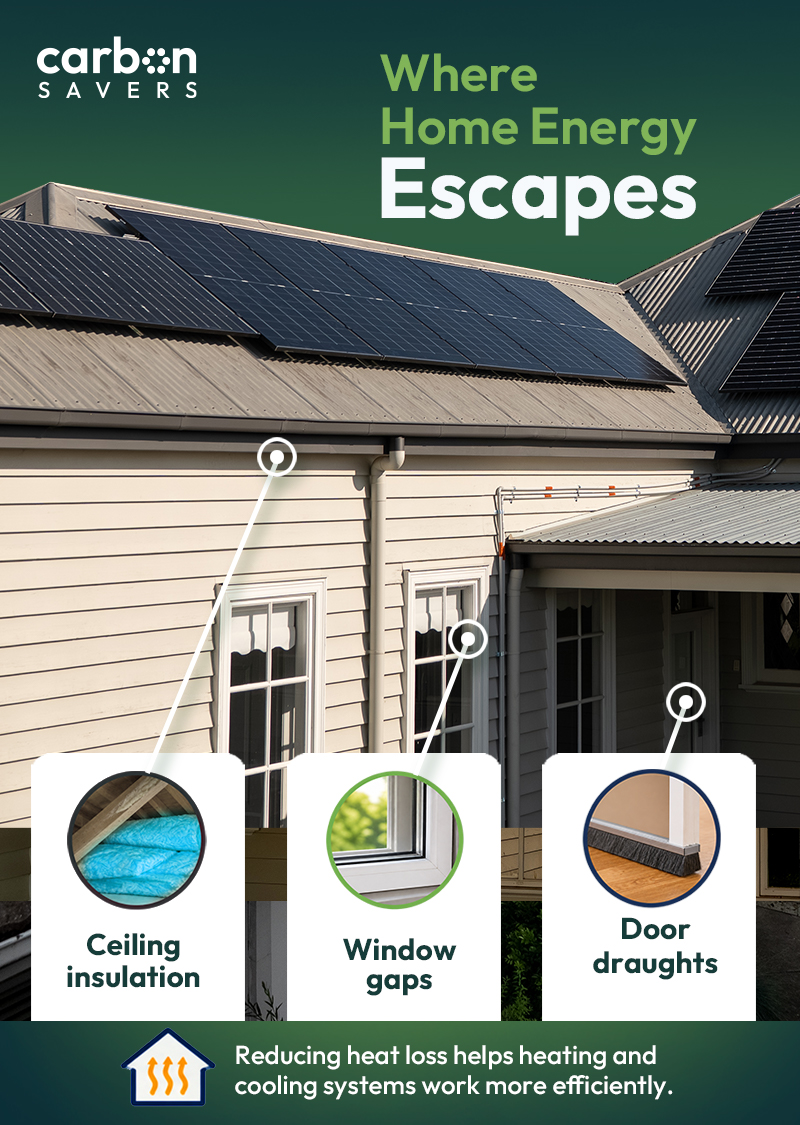
Insulation and draughtproofing can reduce the amount of heating or cooling required to maintain a comfortable indoor temperature.
Uncontrolled air leakage can account for up to 25% of winter heat loss in existing homes.
What makes insulation financially worthwhile?
Victorian Government guidance indicates ceiling insulation upgrades could save some households more than $400 annually.
Eligible properties may receive VEU discounts of up to $1,500 in metropolitan Melbourne or $2,100 in qualifying regional areas. The program expects discounts to reduce average installation costs by approximately 30 to 50%.8
Actual costs depend on ceiling area, existing insulation, access and electrical safety requirements.
What Government Rebates Are Available for Home Energy Upgrades in Victoria?
Government incentives can materially change the financial return because they reduce the amount homeowners need to invest.
Here are some important rebate details:
- Eligible Solar Victoria applicants can access an interest-free solar loan of up to $1,400. A loan reduces the immediate payment, not the total purchase cost.9
- Solar Victoria’s hot water rebate can reach $1,000 for eligible products or $1,400 for qualifying locally made products. The former Victorian interest-free battery loan program is closed to new applicants.10
- The federal Cheaper Home Batteries Program provides an upfront STC-based discount for eligible installations. Since 1 May 2026, certificate calculations have been tiered by battery capacity.11
For example, 100% applies to the first 14 kWh, 60% to capacity between 14-28 kWh, and 15% to capacity between 28 – 50 kWh.
However, eligibility, product approval and the ability to combine incentives must be checked before installation. Published installed prices may already include some discounts.
How Do You Calculate the Payback of an Energy Upgrade?
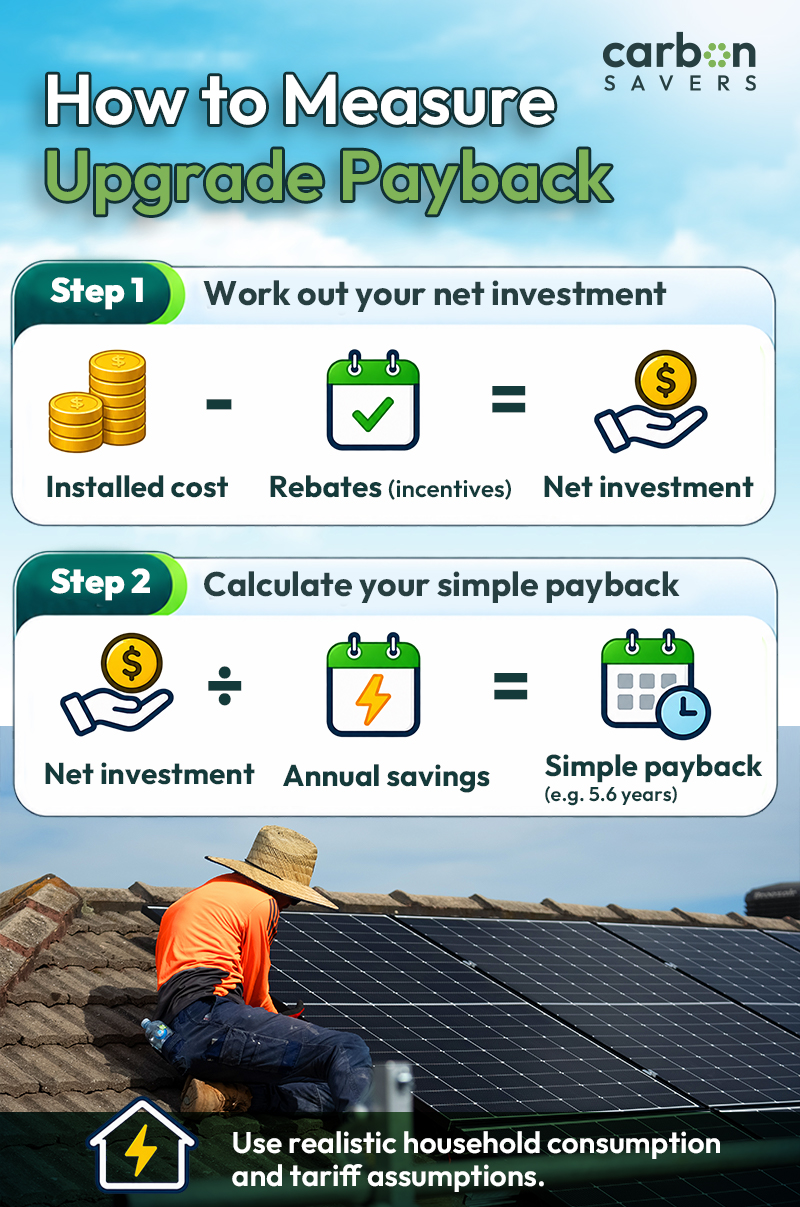
The payback period offers a straightforward way to measure an upgrade’s value:
Payback period = Net upfront investment / Estimated annual savings
Worked example: Solar payback
Consider a hypothetical Victorian household:
| Item | Amount |
|---|---|
| Installed solar cost after federal STCs | $7,000 |
| Eligible Solar Victoria rebate | −$1,400 |
| Net upfront investment | $5,600 |
| Assumed annual electricity savings | $1,000 |
| Simple payback | 5.6 years |
Note: Illustrative calculation only. The $1,000 annual saving is an assumption, not a predicted or guaranteed outcome.
Keep in mind, this calculation excludes financing costs, maintenance, equipment replacement, electricity price changes and the time value of money.
The same approach can be used for heat pumps, batteries and insulation.
For a replacement appliance, a more useful comparison is often the additional cost of the efficient option over the alternative you would otherwise purchase, rather than the entire upgrade price.
Can Energy-Efficient Upgrades Increase Your Property's Value?
Lower energy bills aren’t the only potential return.
Energy-efficient features may also make a home more attractive to buyers.
Domain reported a national median premium of 14.5%, or around $118,000, for houses advertised with energy-efficient features.12
Its Sustainability in Property Report 202513 also found two in three buyers would choose an energy-efficient home over a comparable standard home.
However, these figures do not mean installing solar or a heat pump will increase an individual home’s value by those amounts.
Ultimately, differences in property age, design, condition and location can also influence your sale prices.
Which Home Energy Upgrade Is Worth the Investment?
The strongest return depends on what your household currently spends and how effectively an upgrade reduces those costs.
In some homes, rooftop solar offers the opportunity to generate electricity for years. Also, heat pumps and reverse-cycle systems can substantially reduce energy consumption when replacing inefficient appliances.
Moreover, insulation improves thermal performance, while batteries help households use more of their solar generation.
So, for help assessing which improvement to make first, read Solar, Batteries or Heat Pumps: Which Upgrade Comes First?
At Carbon Savers, we help Victorian homeowners explore solar, battery storage, heat pump hot water and efficient heating and cooling.
Our team can assess your home’s needs, explain applicable incentives and recommend suitable solutions backed by professional installation and ongoing support.
Not sure which upgrade is worth it for your home? We will compare the options for you.
References
- www.domain.com.au/news/the-underrated-fast-track-to-boost-your-propertys-value-by-197000-1385022/
- www.domain.com.au/group/media-releases/green-homes-go-mainstream-energy-efficiency-now-a-top-priority-for-australians/
- www.solarchoice.net.au/solar-panels/solar-power-system-prices/
- www.energy.gov.au/households/hot-water-systems
- www.energy.vic.gov.au/victorian-energy-upgrades/products/hot-water-system-discounts
- www.energy.gov.au/households/hot-water-systems
- www.energy.vic.gov.au/victorian-energy-upgrades/products/heating-and-cooling-discounts
- www.energy.vic.gov.au/victorian-energy-upgrades/products/insulation-discounts
- www.solar.vic.gov.au/solar-panel-rebate
- www.solar.vic.gov.au/solar-homes-program
- cer.gov.au/news-and-media/news/2026/february/changes-to-rebate-solar-batteries-1-may
- www.domain.com.au/news/how-to-sell-your-house-for-118000-more-than-your-neighbour-2-1385316/
- insight.domain.com.au/research-insights/reports/sustainability-in-property-2025/
Alex Howard
Alex oversees the operational execution of localised energy solutions like solar & storage to drive business growth and sustainability.
Talk to an expert
Ready to save? Let's make it happen.
Tell us a little about your home and what you’re keen on. We’ll come back with your options, and the rebates you could get. No sales pressure, no cookie-cutter systems, no jargon.
- $0 upfront with our repayment plan
- No call-out fees
- 24-hour response
The right upgrade.
In the right order.
We’ll look at your home, your bills and the rebates you could get, then recommend what to do first.
$0 upfront with our repayment plan. No call-out fees. No obligation.
Frequently asked questions.
More answers in the FAQ hub →
What home energy upgrade offers the best ROI in Victoria?
Rooftop solar can provide strong long-term returns, while insulation and efficient appliance replacements can also pay back well. The result depends on existing equipment, usage and installation costs.
Are solar panels still worth installing in Victoria?
Yes, they can be financially worthwhile, particularly when households use a substantial share of their solar generation instead of purchasing grid electricity.
Do solar batteries pay for themselves?
They can, but returns depend on battery price, solar exports, evening consumption and electricity tariffs. A household-specific calculation is essential.
Is heat pump hot water worth the investment?
It can offer meaningful savings when replacing inefficient electric or gas hot water. Available incentives may also reduce the upfront cost.
How much can reverse-cycle heating save?
Victorian Government examples indicate annual savings of up to $460 for certain room-heater replacements and up to $1,140 for qualifying ducted gas heating replacements.
Does insulation offer a good return on investment?
It can, especially in poorly insulated homes. Savings depend on the building’s existing condition and its heating and cooling needs.
Can I combine Victorian energy rebates?
Some incentives can be combined, but eligibility conditions vary. Ask an authorised provider to confirm the applicable discounts before agreeing to installation.
What is the difference between kW and kWh?
Kilowatts (kW) measure power or system capacity, while kilowatt-hours (kWh) measure energy generated, consumed or stored. Both are important when comparing solar and batteries.
Keep reading
Alex Howard
Divisional Head
26 Nov 2026
Alex Howard
Divisional Head
26 Nov 2026

David Bonaddio
25 Nov 2026
