
by
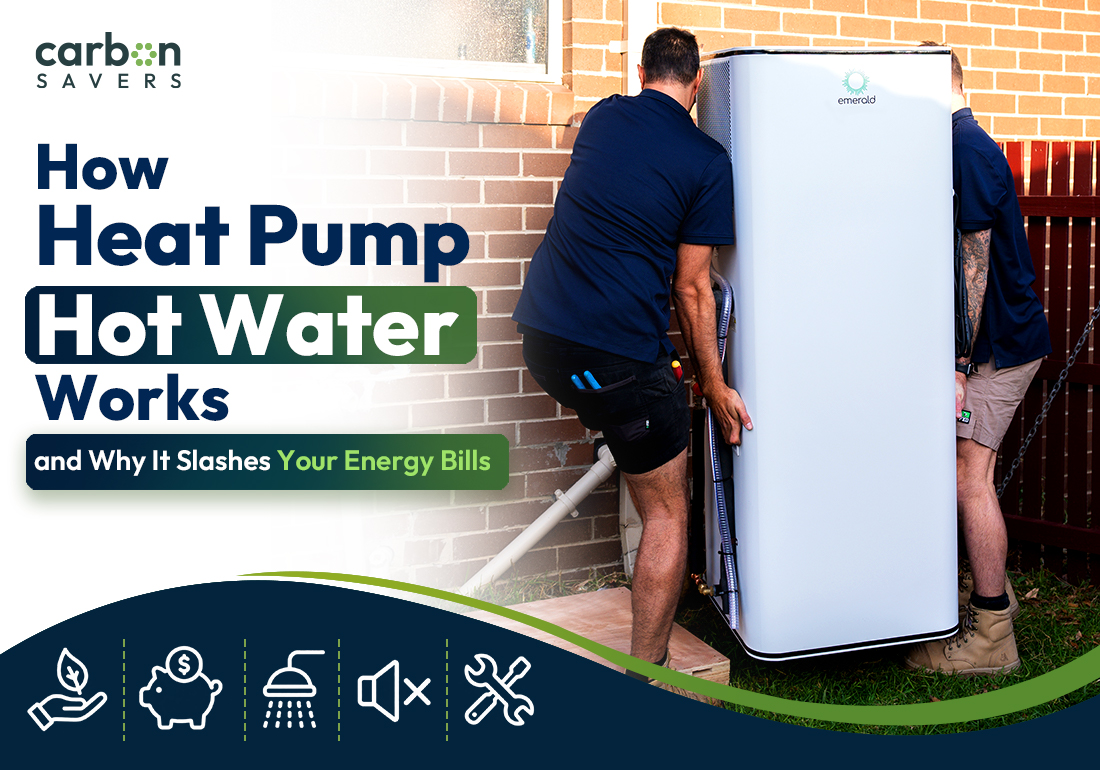
If you are wondering how a heat pump hot water system works and why it can lower your energy bills, the answer is surprisingly simple.
Rather than generating heat like a conventional electric water heater, it captures heat from the surrounding air and transfers it into your water using a highly efficient refrigeration cycle.
For many Australian households, this means using much less electricity to produce the same amount of hot water.
Since water heating accounts for around 15–30% of household energy use, improving its efficiency can make a noticeable difference to running costs.1 Understanding how heat pumps work is the first step in deciding whether they’re worth exploring further.
A traditional electric storage water heater produces heat by passing electricity through a heating element inside the tank.
Every litre of hot water relies on electricity being converted directly into heat. While this process is reliable, it is not the most energy-efficient way to heat water.
A heat pump takes a different approach. Instead of creating heat, it moves existing heat from the surrounding air into the water stored in the tank.
Electricity is still required, but mainly to operate a fan, compressor and circulation components rather than to generate heat itself. This allows the system to produce the same hot water while using considerably less electricity under suitable operating conditions.
The Australian Government’s Energy Rating program explains that heat pump water heaters are generally much more energy efficient than conventional electric storage systems because they transfer heat instead of producing it directly. 2
Actual performance depends on factors such as climate, household hot water demand and installation conditions.
Supporting Element: Comparison Table
Heat Pump Hot Water | Conventional Electric Storage |
Transfers heat from the air | Creates heat using an electric element |
Uses electricity to operate a refrigeration cycle | Uses electricity to generate all heating |
Generally higher energy efficiency | Lower energy efficiency |
Designed to reduce running costs | Typically higher running costs |
Although the technology sounds complex, the operating process is based on the same principles used in many refrigerators and air conditioners.
Instead of removing heat from inside a fridge, a heat pump collects warmth from the outside air and transfers it into your household hot water tank.
A fan draws outside air across an evaporator containing refrigerant. Even on cooler days, the air contains thermal energy that the refrigerant can absorb. As it warms, the refrigerant changes into a gas.
The gaseous refrigerant then passes through a compressor. Compressing the gas increases both its temperature and pressure, creating a much hotter refrigerant that is ready to transfer heat.
The hot refrigerant flows through a heat exchanger that surrounds or passes through the storage tank. Heat moves into the stored water while the refrigerant cools and returns to a liquid state, ready to begin the cycle again.
This process repeats automatically until the water reaches the required temperature.
The biggest reason heat pumps are more efficient is that they move heat instead of creating it. Generating heat directly requires a large amount of electrical energy.
Transferring existing heat from the surrounding air requires much less electricity.
You may also come across the term Coefficient of Performance (COP) when researching heat pumps. COP measures how efficiently a system converts electricity into useful heating.
A higher COP means the system delivers more heat for every unit of electricity it consumes. Actual performance varies depending on outdoor temperature, hot water demand and the specific product.
This greater efficiency is why heat pumps can substantially reduce electricity use compared with conventional electric storage water heaters, particularly in households with consistent hot water demand.
Supporting Element: Checklist
Why heat pumps are more efficient
✓ They transfer existing heat instead of creating it.
✓ The compressor uses less electricity than an electric heating element.
✓ Heat is recycled through a continuous refrigeration cycle.
✓ Less electricity is needed to deliver the same amount of hot water.
Running cost savings can vary depending on factors such as your existing hot water system, household size, hot water usage, local climate and electricity tariff.
Australian Government guidance states that heat pump water heaters use around 30% of the energy of a conventional electric hot water system, while conventional electric storage systems are generally more expensive to run.3
Heat pump systems can cost more to purchase and install than standard electric systems, but they use substantially less energy and can therefore reduce ongoing energy bills.
However, eligible Victorian households could save up to $800 a year on their energy bills.
Actual savings will vary from household to household. Factors such as ambient temperature, hot water demand, tank sizing, operating times and the use of booster heating can affect heat pump efficiency and running costs.
Supporting Element: Worked Example
Household | Current Setup | What Could Affect the Savings? |
Family replacing an older electric storage system | Conventional electric hot water | Heat pump water heaters use around 30% of the energy of a conventional electric hot water system, so replacing an older electric unit can substantially reduce the electricity needed for water heating.4 |
Home with rooftop solar | Electric hot water | A programmable heat pump can be scheduled to heat water while rooftop solar is generating, which can reduce the amount of electricity purchased from the grid. |
Household on a time-of-use electricity plan | Electric hot water | Programming the heat pump to operate when electricity prices are lower may further reduce running costs, depending on the household’s tariff and usage pattern. |
Note: These are general examples only. Actual savings vary by household, tariff, system size and installation quality.
Most quality heat pump hot water systems have an expected service life of around 10 to 15 years or more, depending on the product, installation quality, usage and maintenance.
Many manufacturers offer product warranties that range from several years to more than a decade, depending on the brand and model.
Storage tank warranties can also vary depending on the tank material and construction, as outlined in the Australian Government’s guide to hot water systems.5
Rather than focusing only on warranty length, it is worth considering the manufacturer’s support network and whether replacement parts are readily available in Australia.
Routine maintenance is generally straightforward. Keeping the unit free from debris, ensuring there is adequate airflow around the outdoor components and arranging servicing in line with the manufacturer’s recommendations can all help maximise its lifespan.
If you want detailed maintenance advice and tips for keeping your system operating efficiently, see our guide Heat Pump Hot Water Explained: The Cheapest, Cleanest Way to Heat Water.
What can help maximise a heat pump’s lifespan?
✓ Have the system installed by a qualified professional.
✓ Follow the manufacturer’s maintenance schedule.
✓ Keep leaves and debris away from the outdoor unit.
✓ Ensure adequate airflow around the system.
✓ Address faults promptly instead of delaying repairs.
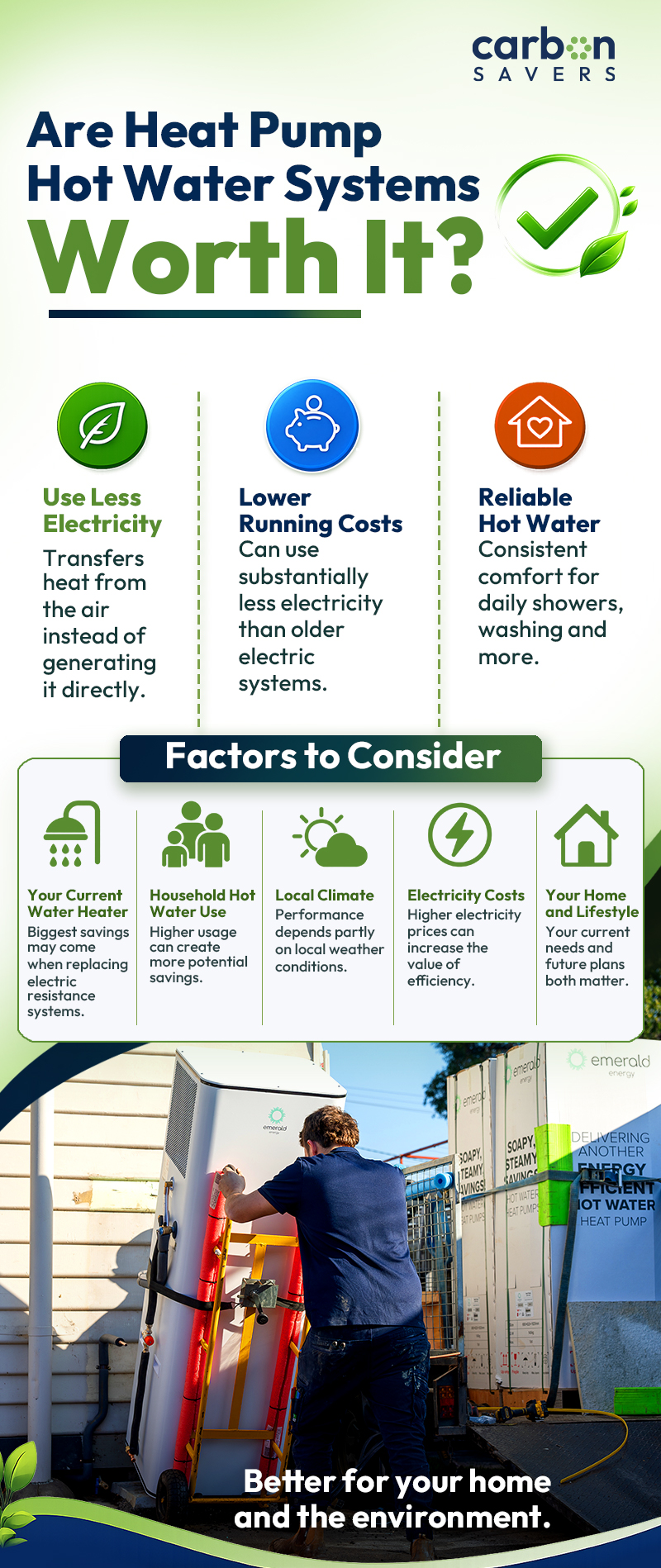
For many Australian households, a heat pump hot water system can be a worthwhile upgrade, particularly when replacing an older electric resistance storage water heater.
By transferring heat from the surrounding air instead of generating it directly, these systems can reduce electricity consumption while still supplying the hot water needed for daily showers, washing and household tasks.
Whether the investment makes sense for your home depends on several factors, including your current water heater, household hot water use, local climate and electricity costs.
While the technology offers the greatest benefits in many situations, every home is different, so it is important to assess your circumstances rather than relying on general savings claims.
Heat pump hot water systems offer a more energy-efficient way to heat water by using the warmth already available in the surrounding air. For the right household, upgrading can mean lower electricity use and reduced ongoing running costs.
However, whether a heat pump is the right choice for your home will depend on your existing hot water system, household needs, installation requirements and the support available in your area.
If you’re a Victorian homeowner considering an upgrade, a good next step is to check your eligibility for a heat pump hot water upgrade and find out what rebates may be available for your home.