
Blog › Is battery storage right for your home
Batteries
Energy Tips
You may need a solar battery if your home regularly exports surplus electricity during the day and then imports a similar amount after sunset.

By Reno Damianou
Operations Manager ·
20 Nov 2026 ·
On this page
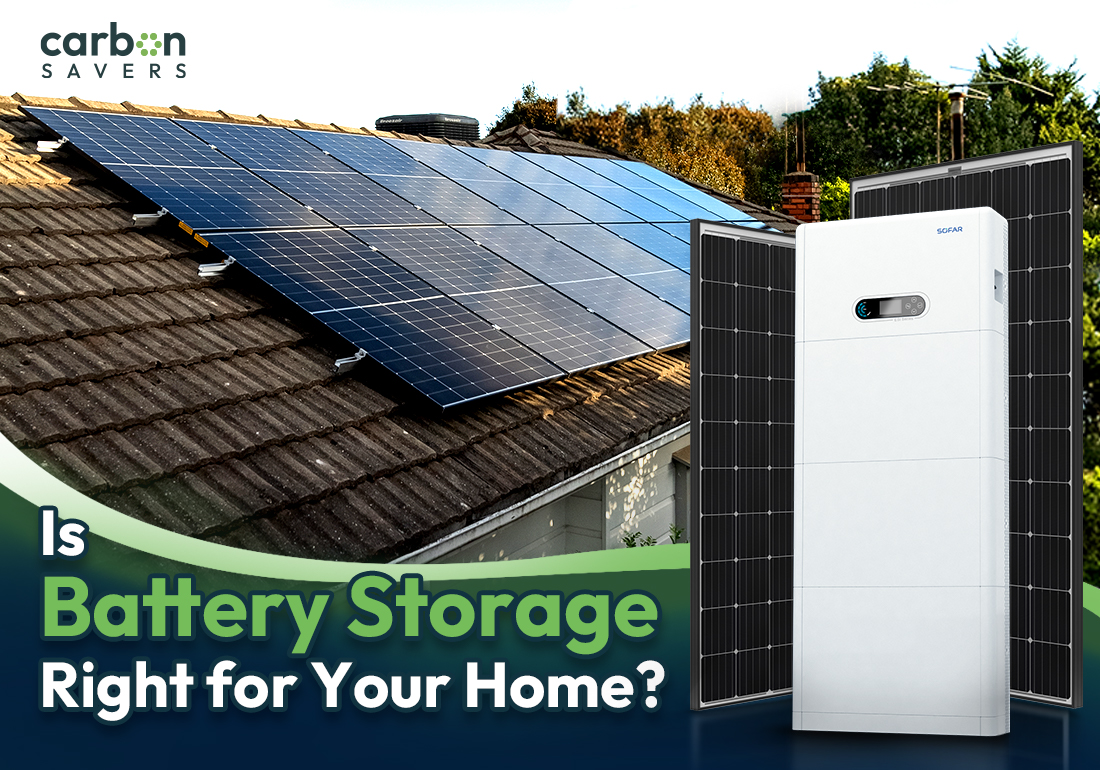
You may not need one if you already use most of your solar directly, have low evening demand or cannot generate enough surplus energy to charge it.
This blog focuses on household suitability, retrofit compatibility, and battery capacity. But first, we need to answer an important question: whether you can add a battery to an existing solar system.
In many cases, yes. A battery can often be retrofitted to an existing rooftop solar system, but an installer must first assess the inverter, switchboard, solar-array size, phase configuration and network connection.
As explained in Solar Victoria’s guide to solar battery systems, an existing solar inverter can either be replaced with a battery-compatible hybrid inverter or retained while a second, battery-dedicated inverter is added.1
Adding a separate inverter is known as AC coupling and is often one of the simplest ways to retrofit battery storage to an existing solar system.
Replacing the existing inverter with a hybrid model can provide more integrated control of the solar panels and battery. However, replacing an inverter that is still operating effectively may increase the upfront installation cost.
Homes with microinverters will generally require an AC-coupled battery with its own dedicated inverter.
An all-in-one battery with a built-in inverter may simplify this type of installation, although product and system compatibility must still be confirmed.
A compatible inverter does not automatically mean the rest of your home is ready for a battery.
An installer should assess:
Energy Safe Victoria’s battery storage guidance states that the existing switchboard must be thoroughly assessed before a battery or another supplementary electricity supply is added.2
A battery installation that is not properly designed, installed and inspected can create serious electrical safety risks.
Your electricity distributor may also place conditions on the connection. As outlined in Solar Victoria’s guide to planning a solar battery system, some properties may not receive the requested network pre-approval because of local grid conditions, while other approvals may include limits on how much electricity the system can export.3
Blackout backup changes the system design and should be discussed before accepting a quote.
Installing a battery does not automatically mean your home will continue receiving electricity during an outage.
The Australian Government’s guidance on batteries and backup supply explains that a battery must be specifically configured for backup, and not every battery system supports this function.4
Depending on the system, backup may require a compatible inverter, isolation equipment, additional switchboard work and dedicated essential circuits. It may power the entire property, selected circuits or only one phase of a three-phase home.
A battery is most useful when two conditions occur regularly:
A household may have high overall electricity use but still be poorly suited to storage. If most consumption occurs during daylight hours, the solar panels may already be supplying appliances directly, leaving little surplus for a battery.
The opposite can also happen. A household may export large amounts of solar but use very little electricity overnight. The battery could charge fully, but much of its stored energy may remain unused the next morning.
Practical advice: Do not rely only on your quarterly bill. It shows total electricity use, but not when the electricity was consumed.
Common mistake: Assuming high annual consumption automatically means a large battery will be valuable.
The best starting point is 12 months of smart-meter or interval data.
Look separately at:
Your evening and overnight imports provide a rough indication of how much stored energy the home could use. Your daytime exports indicate how much solar may be available to charge the battery.
For example, suppose a home exports an average of 7 kWh on suitable days but imports only 4 kWh overnight. A battery delivering much more than 4 kWh each night may be difficult to use fully unless consumption increases.
Another home might import 9 kWh overnight but export only 3 kWh. Its evening demand is high, but its current solar system may not generate enough surplus energy to charge a large battery.
| Energy Pattern | What It Suggests |
|---|---|
| High exports and high evening imports | Stronger storage opportunity |
| High exports and low evening imports | Smaller capacity may be enough |
| Low exports and high evening imports | More solar or grid charging may be needed |
| Low exports and low evening imports | Battery likely to be underused |
The Australian Government-supported SunSPOT calculator can estimate battery cost, savings and payback using household information. Having an electricity bill available improves the quality of the estimate.5
The right battery size depends on how much surplus solar electricity your home produces and how much electricity you use after sunset.
According to the Australian Government, household batteries typically have a capacity of 4 to 14 kWh. However, the most suitable size depends on your household’s energy consumption and available solar generation.6
The table below provides an illustrative guide to residential battery capacity.
| Battery capacity | Household suitability |
|---|---|
| 4-6 kWh | Homes with relatively low evening electricity demand and sufficient surplus solar to charge a smaller battery. |
| 7-10 kWh | Homes with moderate evening and overnight electricity needs and regular daytime solar exports |
| 11-14 kWh | Homes with higher overnight electricity consumption and enough surplus solar to regularly charge a larger battery. |
Actual suitability depends on usable battery capacity, household consumption and solar generation.
Choosing a battery that is too large for your household’s needs may increase upfront costs without delivering proportional savings.
As Solar Victoria’s battery buyers guide explains, battery sizing should consider your solar system’s capacity, typical overnight electricity consumption and whether you need blackout backup.7
Solar Victoria advises choosing a battery that can regularly store excess solar and then discharge most of that stored electricity later. Oversizing can increase the purchase price without creating proportional savings.
Eligible systems under the federal program must currently have a nominal capacity between 5 and 100 kWh, although only the first 50 kWh of usable capacity can receive STCs. These are incentive limits, not sizing recommendations.8
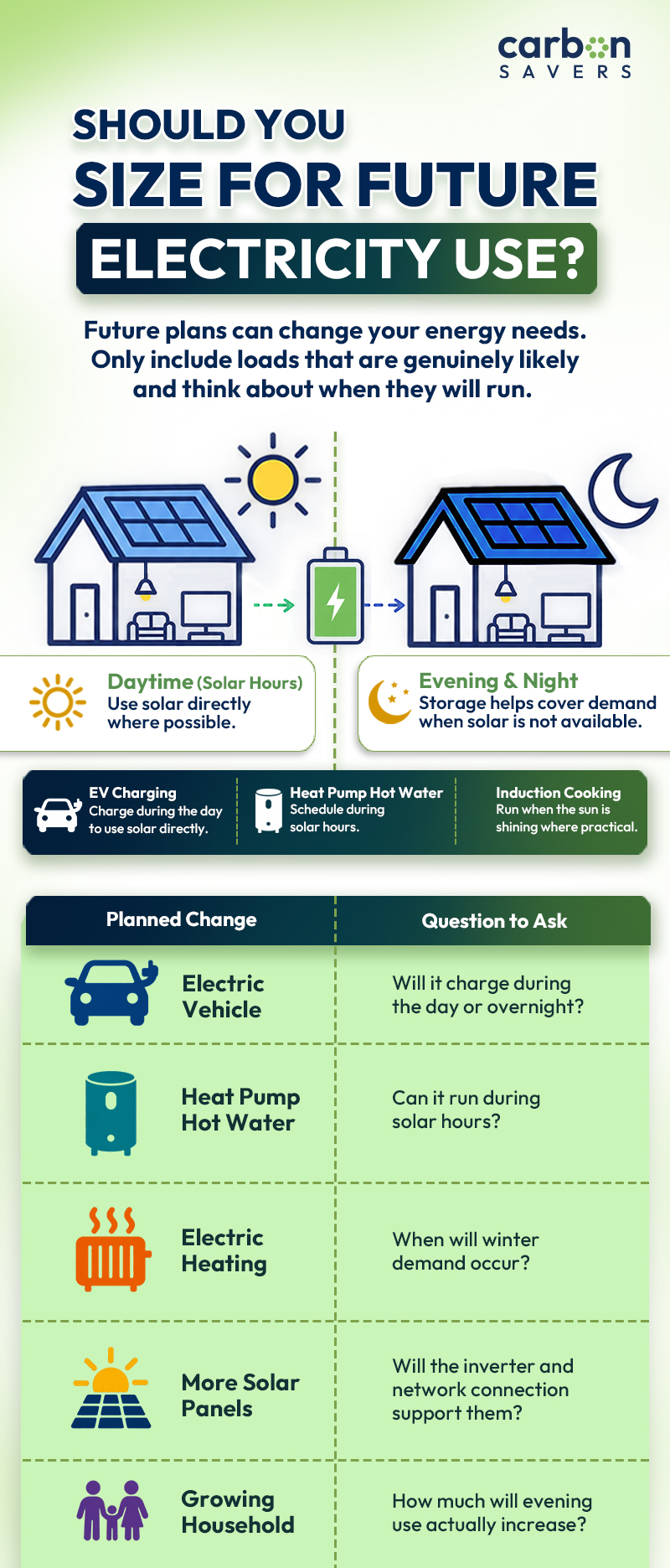
Future plans can change the answer, but only include loads that are genuinely likely.
An electric vehicle, heat pump hot water system, induction cooktop or electric heating may increase household electricity consumption. However, not every new load increases the ideal battery size.
An EV that charges during the day may use solar directly rather than stored electricity. A heat pump hot water system can also be scheduled into solar hours. Increasing battery capacity may be unnecessary when new appliances can operate while the panels are generating.
A larger battery may be reasonable where future demand will mainly occur at night, such as an EV returning home after sunset. Even then, the solar array must generate enough surplus energy to recharge it.
| Planned change | Question to ask |
|---|---|
| Electric vehicle | Will it charge during the day or overnight? |
| Heat pump hot water | Can it run during solar hours? |
| Electric heating | When will winter demand occur? |
| More solar panels | Will the inverter and network connection support them? |
| Growing household | How much will evening use actually increase? |
A battery deserves closer investigation when you can answer yes to most of these questions:
The right battery is not the largest one your roof, switchboard or budget can accommodate. It is the one your home can charge, use and justify.
Not sure which battery suits your home? We’ll compare them for you.
A solar battery should be sized around how your home actually produces and uses electricity, not simply the largest capacity available.
If you are considering battery storage but are unsure about system compatibility, backup requirements or the right usable capacity, exploring solar battery installation options suited to your household can help you make a more informed decision.
With a properly matched system, you can store more of your solar energy, reduce reliance on the grid and improve your long-term energy savings.
Talk to an expert
Tell us a little about your home and what you’re keen on. We’ll come back with your options, and the rebates you could get. No sales pressure, no cookie-cutter systems, no jargon.
We’ll match a battery to your home, your solar and your energy use, and check the rebates you could get.
$0 upfront with our repayment plan. No call-out fees. No obligation.
Reno Damianou
Operations Manager
20 Nov 2026
Reno Damianou
Operations Manager
20 Nov 2026


Andrew Damianou
CEO, Carbon Savers
13 Nov 2026
