
by
Installing solar panels can be a significant financial decision for Victorian homeowners. A quality system can lower your electricity bills, reduce your reliance on the grid and help cut your household’s carbon emissions.
But with electricity prices changing, feed-in tariffs lower than they used to be and countless installers offering different deals, it’s understandable to wonder whether solar is still a worthwhile investment.
The short answer is yes, it could be for many Victorian homeowners.
However, sometimes the answer is not the same for every household. Your savings depend on how much electricity you use, when you use it, the quality of the system you install and whether your home is suitable for solar.
For many homeowners, yes. The reason is simple. Every unit of electricity your solar panels generate and your home uses is electricity you don’t have to buy from your energy retailer.
Years ago, homeowners often made good money exporting excess electricity back to the grid through generous feed-in tariffs1.
Today, those payments are much lower. Instead, the biggest financial benefit comes from using your solar electricity while it is being generated.
That means solar is no longer just about putting panels on your roof. It’s about choosing the right system for your home and making the most of the electricity it produces.
Think of your solar system as your own small power station.
During the day, your panels generate electricity that can power appliances such as:
If those appliances run while your panels are producing electricity, you’re using your own energy instead of buying it from the grid.
Any electricity you don’t use can usually be exported, but because feed-in tariffs are now much lower than retail electricity prices, every kilowatt-hour you use yourself is generally worth more than one you export.
Some households naturally get better value from solar than others.
| Household | Likely Outcome |
| Family with someone working from home | High daytime electricity use often leads to stronger savings. |
| Retired couple | Good opportunity to use solar throughout the day |
| Household planning to buy an electric vehicle | Future electricity demand can increase the value of solar. |
| Family switching to electric heating or hot water | Solar can offset part of the additional electricity use. |
That doesn’t mean households away during the day shouldn’t install solar. It simply means their system should be designed around how they actually use electricity, rather than installing the biggest system possible.
Solar works well for many homes, but some properties need extra planning before installation.
| Situation | What to Consider |
| Heavy roof shading | Trees or neighbouring buildings can reduce energy production. |
| Limited roof space | Higher-efficiency panels may produce more electricity in a smaller area. |
| Older switchboard | An electrical upgrade may be required before installation. |
| Planning to sell your home soon | Consider whether you’ll stay long enough to recover the installation cost. |
These situations don’t necessarily rule out solar. They simply highlight why every home should be assessed individually before choosing a system.
This is usually the first question homeowners ask, and it’s also the most important.
For Victorian households, government guidance indicates that switching to rooftop solar can save a typical household more than $1,000 a year on energy bills.²
Actual savings vary depending on household electricity use, solar generation, electricity tariffs and how much solar power is used in the home rather than exported to the grid.
| Government example | Estimated result |
| 6.6 kW solar-only system | $1,600 saving/year |
| Example system cost | $7,000 |
| Indicative payback | 4.4 years |
Several factors influence how much you can save each year.
Factor | Why It Matters |
Daytime electricity use | Higher self-consumption usually means bigger savings. |
System size | A system should match both your current and future electricity needs. |
Roof orientation | North-facing roofs often receive the most consistent sunlight, although east and west-facing roofs can also perform well. |
Shading | Shade can reduce energy production. |
Quality of equipment | Better panels and inverters generally provide stronger long-term performance. |
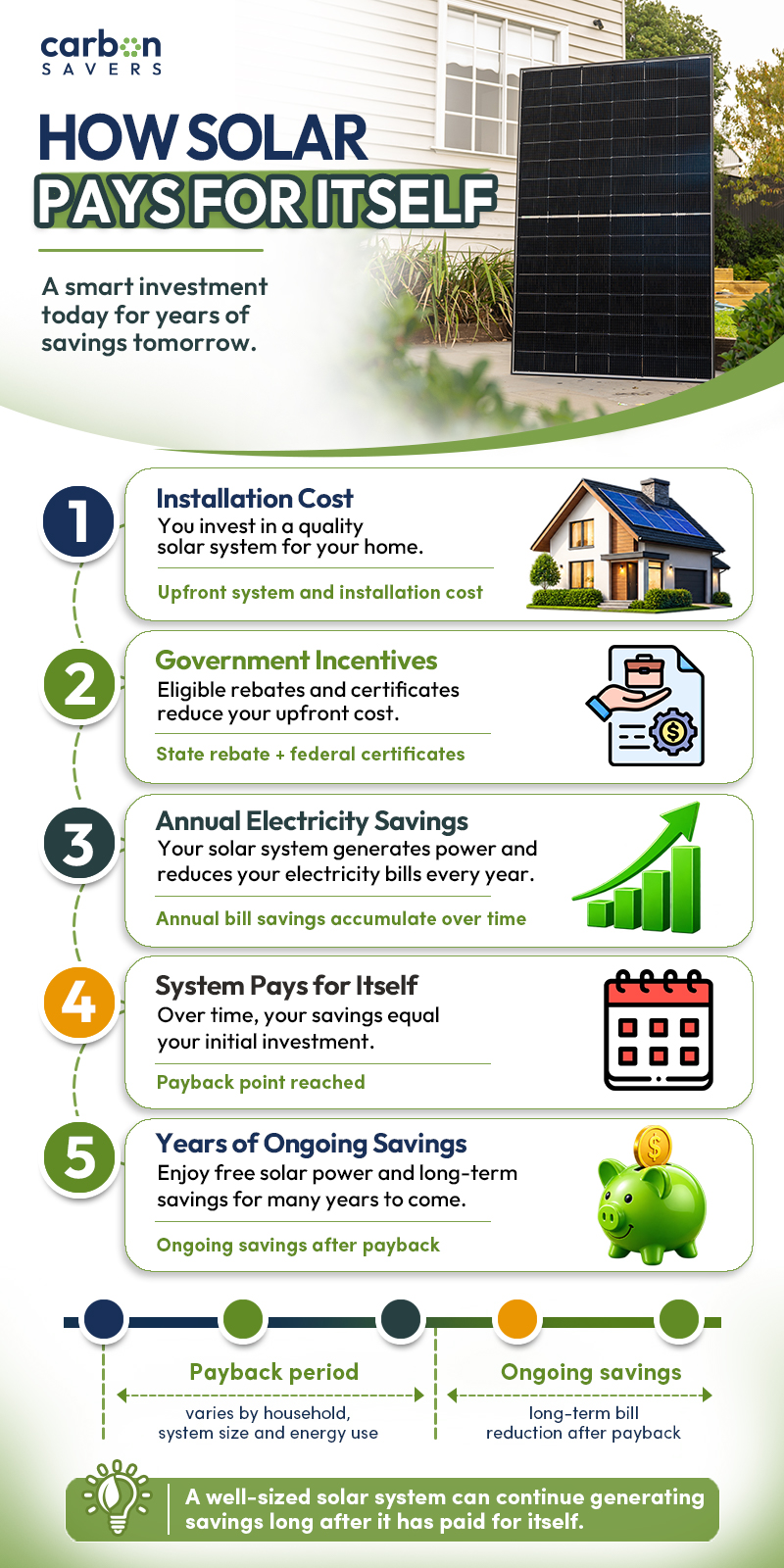
One of the biggest questions homeowners ask is how long it takes for a solar system to recover its installation cost.
The estimated solar payback period in Victoria is approximately 4 to 7 years,3 depending on household electricity consumption and system size. Higher electricity use generally produces a faster payback because more solar energy is used within the home.
Eligible Victorian households may access a Solar Victoria rebate of up to $1,400, subject to eligibility and program availability.4 The rebate may cover up to 50 per cent of the system’s purchase cost, capped at $1,400.
Several factors influence how quickly you reach that point.
| Factor | Impact on Payback |
| Upfront installation cost | Lower installation costs generally reduce the time needed to recover your investment. |
| Government incentives | The Solar Victoria rebate and Small-scale Technology Certificates may help reduce the upfront installation cost for eligible households |
| Daytime electricity use | Using more of your own solar power usually improves your savings. |
| Electricity prices | Higher retail electricity prices can increase the value of the electricity your panels generate. |
| System quality | Well-designed systems often deliver more reliable performance over the long term. |
Rather than focusing only on the purchase price, think about the total value the system provides over its lifetime. A quality system that performs reliably for decades is often a better investment than a cheaper system that produces less energy or requires repairs sooner.
Imagine two homeowners purchasing solar systems.
Homeowner A
Homeowner B
Although both install solar, Homeowner A is far more likely to achieve stronger long-term value because the system matches how the household actually uses electricity.
The lesson is simple.
Solar isn’t just about buying panels. It’s about buying the right system for your home.
Solar panels are designed to be a long-term investment.
Most quality solar panels are built to continue producing electricity for 25 years or more. They don’t suddenly stop working after this time. Instead, they gradually produce slightly less electricity as they age, a process known as degradation.
Manufacturers usually provide two different warranties.
Warranty | What It Covers |
Product Warranty | Covers manufacturing defects and equipment faults. |
Performance Warranty | Guarantees that the panels will continue to produce a certain percentage of their original output over time. |
Many premium manufacturers now offer product warranties of 25 years or longer, although warranty terms vary between brands.
It’s also important to remember that solar panels are only one part of the system.
The inverter, which converts the electricity generated by the panels into usable power for your home, generally has a shorter lifespan than the panels themselves.
Depending on the type and manufacturer, an inverter may need replacing at some point during the life of your solar system.
That doesn’t mean solar becomes poor value. It simply highlights why choosing quality equipment and a reputable installer matters.
Solar panels require very little maintenance.
For most Victorian homes, rainfall removes much of the dust and debris that collects on the panels. However, occasional inspections are still worthwhile to ensure leaves, bird droppings or heavy dirt build-up are not reducing performance.
You should also monitor your system regularly through its monitoring app or inverter display. If electricity generation suddenly drops without an obvious reason, it may indicate a fault that should be investigated.
Many homeowners assume their house is too old for solar.
In reality, the age of your home is often less important than its condition.
Thousands of older Victorian homes have successfully installed rooftop solar systems. Before installation, your installer will usually assess several parts of your property to ensure it is suitable.
If your roof is structurally sound and receives reasonable sunlight, there’s a good chance solar can be installed successfully.
Some older homes require additional electrical work before installation.
Common upgrades include:
Although these upgrades add to the initial project cost, they also improve the safety and reliability of your home’s electrical system.
A reputable installer should explain any required upgrades clearly before work begins.
Older Home Feature | Does It Prevent Solar? |
Older brick home | Usually no |
Tile roof | Usually suitable |
Metal roof | Usually suitable |
Older switchboard | May require upgrading |
Some roof shading | Depends on the amount of shade |
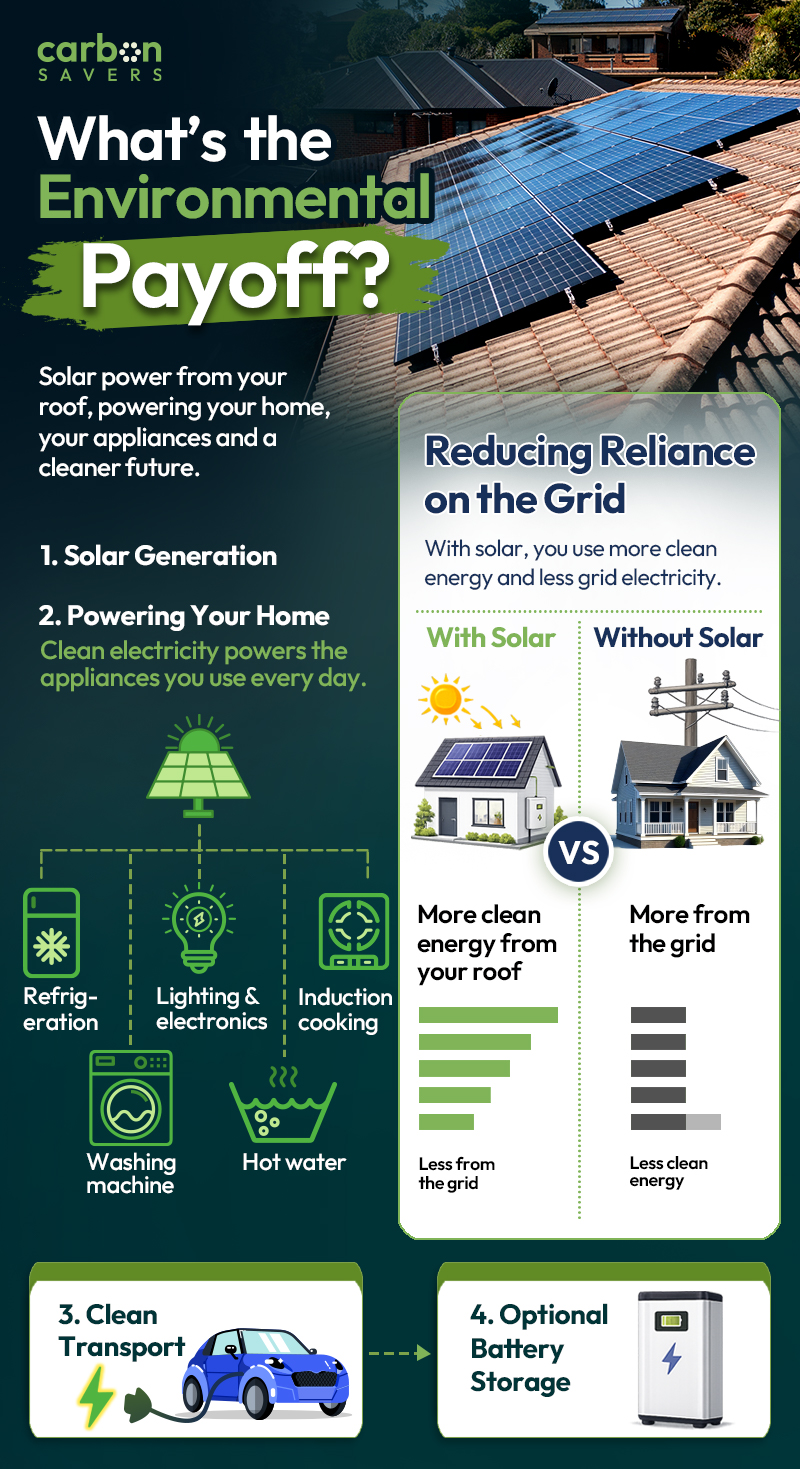
Saving money is often the main reason people install solar, but it isn’t the only benefit.
Every unit of electricity your solar system generates is electricity that doesn’t need to be produced elsewhere.
Australia’s electricity network continues to include energy generated from fossil fuels alongside growing amounts of renewable energy. By producing clean electricity on your own roof, you help reduce demand for electricity generated from higher-emission sources.
For many homeowners, this is an opportunity to reduce their household’s environmental impact without changing their everyday lifestyle.
Solar can also support the broader transition towards cleaner transport and home electrification.
If you later install:
your solar system can help offset the electricity used by those appliances, reducing reliance on grid electricity.
The result is a home that is not only cheaper to run but also more energy efficient over the long term.
For many Victorian homeowners, solar remains a worthwhile long-term investment.
Today, the greatest savings generally come from using the electricity your system generates rather than exporting excess energy to the grid.
A well-designed solar system can reduce your electricity bills, improve your home’s energy efficiency and lower your reliance on grid electricity over time.
Before making a decision, compare detailed proposals and ask questions about expected system performance, equipment quality, warranties and any electrical upgrades your home may require.
Taking a little extra time at the beginning to understand your options, including which of our solar solutions in Victoria best suits your property and electricity use, can help you achieve reliable savings and cleaner energy for many years.