- $0 upfront with our repayment plan
- No call-out fees
- 24-hour response
Blog › Which upgrade comes first
Energy Tips

By Alex Howard
Divisional Head ·
26 Nov 2026 ·
On this page
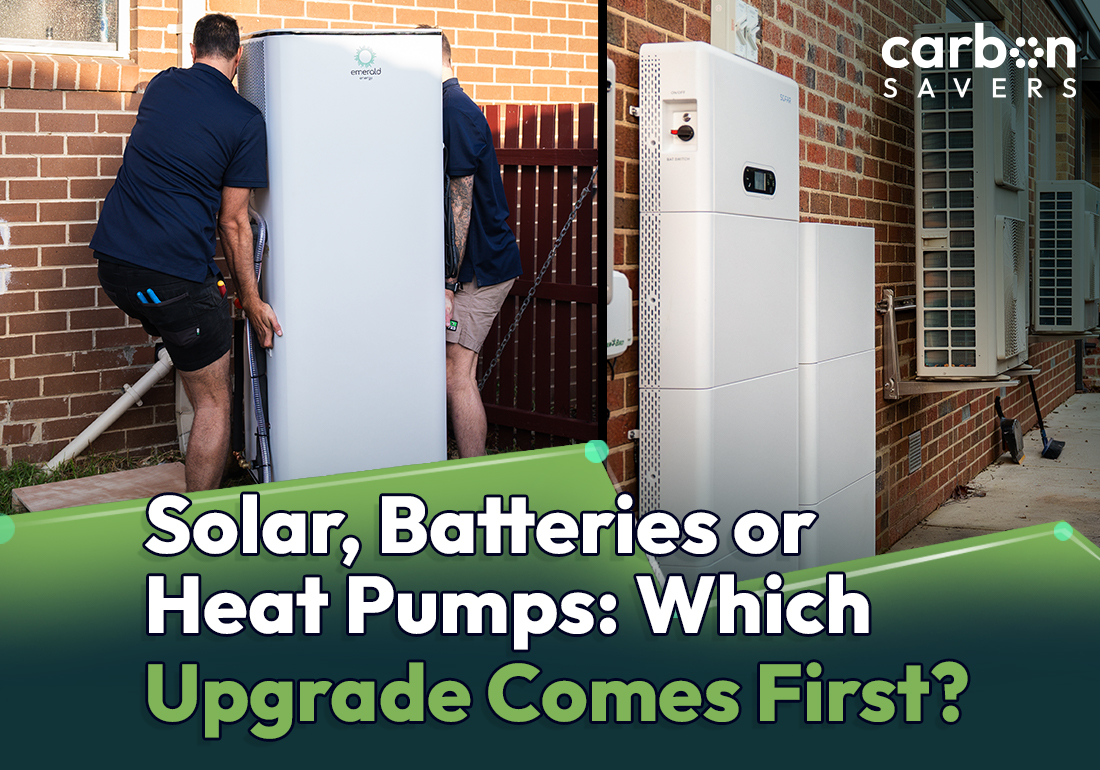
If you’re choosing between solar panels, a home battery or a heat pump hot water system, the best first upgrade depends on what your household already has, how it uses energy and which appliances need replacing.
Solar can be a practical starting point for many Victorian households, but an ageing hot water system or existing rooftop solar could change that decision.
You don’t need to install everything at once.
So, let’s explore which upgrade makes sense first, what can wait and how to plan your investment around your household’s needs.
Energy efficiency is becoming an increasingly important consideration in the property market.
Buyers are looking beyond a home’s appearance and considering features that could improve comfort and reduce ongoing energy costs.
Domain’s Sustainability in Property Report 2025 also highlights this shift:1
These findings suggest that energy efficiency is becoming a more mainstream part of property decisions.
For Victorian homeowners, planning upgrades such as solar panels, home batteries and heat pump hot water can be a way to improve their home’s overall energy performance.
One important thing to note is that the upgrade order varies from home to home.
For instance,
A home without solar panels has different priorities from a home already exporting electricity to the grid.
Similarly, replacing an unreliable hot water system might be more urgent than installing a new battery.
So, the best starting point is your household’s current situation.
| Your household situation | Upgrade to consider first | Reasons |
|---|---|---|
| No solar panels and suitable roof space | Solar panels | Generate electricity to reduce grid purchases |
| Old or unreliable hot water system | Heat pump hot water | Address an essential appliance while improving efficiency |
| Existing solar with regular surplus generation and high evening usage | Solar battery | Store more electricity for use after sunset |
| Existing solar with high daytime exports and ageing hot water | Heat pump hot water | Use available solar electricity for water heating |
| Limited budget and several working appliances | Assess bills and appliance condition first | Avoid investing before identifying the most useful upgrade |
These are starting points, not fixed recommendations. Your roof suitability, existing equipment and installation requirements still need assessment.
Before spending money, look at how your home currently consumes energy and where a new system would make the biggest practical difference.
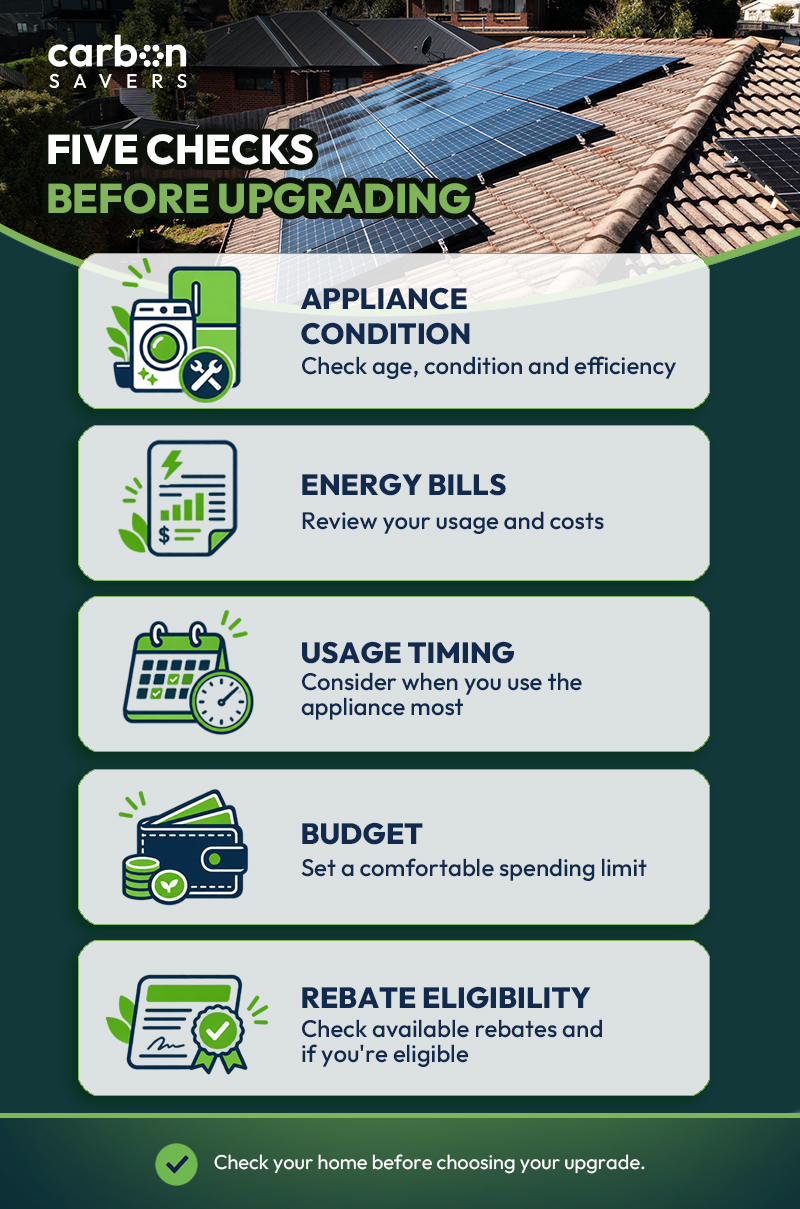
Here are the 5 questions you should ask
Start with equipment that’s ageing, unreliable or becoming expensive to operate.
For example, if your hot water system regularly needs repairs, upgrading it may be more sensible than waiting until it fails completely.
Solar Victoria notes that a heat pump hot water system uses 60 to 75% less electricity and commonly lasts around 8-10 years, although actual service life varies.2
Check the age, reliability and recent repair history of your major appliances.
A fully functioning system doesn’t necessarily need immediate replacement simply because a more efficient alternative exists.
Your electricity and gas bills can help identify which services are contributing to your household expenses.
Look at:
Don’t assume your largest bill automatically identifies the best upgrade.
If your electricity use is relatively low but you have an inefficient gas hot water system, replacing that appliance may be worth considering before investing in additional solar equipment.
Timing is especially important when comparing solar panels with batteries.
Victoria’s smart meters record electricity use at 30-minute intervals. This information can help you understand when your household draws power from the grid.3
If you’re regularly home during daylight hours, solar-generated electricity may be useful immediately.
If your household consumes more electricity after sunset, battery storage could become relevant once you have sufficient solar generation.
Your existing retailer or electricity distributor may provide access to your usage data.
A new energy system should suit your household budget without creating unnecessary financial pressure.
Consider how much you’re comfortable spending upfront, whether an appliance needs immediate replacement and whether you can make further improvements later.
For detailed installation prices, estimated savings and payback comparisons, see our latest guide, Which Home Energy Upgrades Pay Off Most in Victoria?
Victoria offers assistance for eligible solar installations and energy-efficient hot water upgrades.
Qualified households can access a Solar Victoria solar panel rebate of up to $1,400, with an optional interest-free loan.4
Eligible heat pump hot water installations may receive Solar Victoria rebates and Victorian Energy Upgrades discounts, while approved battery installations may qualify under the federal Cheaper Home Batteries Program.
Check eligibility before purchasing equipment. An available discount shouldn’t be the only reason to replace a system that’s otherwise performing well.
Imagine you’ve been saving for solar panels, but your existing electric hot water system starts leaking.
Suddenly, reducing your electricity bill isn’t the only concern. You need reliable hot water.
In this situation, replacing the failing system may be a more practical immediate priority.
A heat pump hot water system uses electricity to transfer heat from the surrounding air into water, rather than relying primarily on direct electric resistance heating.
An efficient heat pump system can use much less electricity than conventional electric hot water systems.
That makes them an option worth considering when an older electric storage system needs replacing.
No. A heat pump hot water system can operate using grid electricity, so solar panels aren’t a requirement.
However, the two technologies can complement each other.
If you install solar later, a suitably configured heat pump may be able to heat water during solar generation hours, helping you use more of your own electricity.
This gives Victorian homeowners some flexibility. You can deal with an ageing hot water system now and consider rooftop solar as a separate investment.
Before making the switch, check your household’s tank capacity needs, installation space, outdoor noise considerations, and the product’s suitability for your local climate.
For available systems and installation options, see Carbon Savers’ heat pump hot water solutions.
A solar battery serves a different purpose from solar panels or a heat pump.
It doesn’t generate electricity or directly make an ageing appliance more efficient. Instead, it stores electricity for later use.
That distinction matters when deciding whether your household needs one.
Consider a family that already has rooftop solar. Their panels generate plenty of electricity during the day, but most family activities happen after sunset.
They export electricity during daylight hours and purchase grid electricity again in the evening.
A battery could help bridge that gap by storing some of their surplus solar generation.
But there’s an important question to answer first.
Before investing in storage, look at whether you can shift some electricity consumption into daylight hours.
For example, you might:
These changes can increase solar self-consumption without purchasing additional storage equipment.
Solar Victoria recommends considering opportunities to use solar electricity directly when assessing whether a battery is worthwhile.5
If your household still has substantial solar exports and significant evening electricity demand, battery storage may deserve closer investigation.
You’ll need to compare your generation, exports, electricity tariffs, battery compatibility and expected usage to determine whether an installation is suitable.
If blackout protection is also important, discuss backup capabilities and the circuits you want supported with your installer. Not every battery installation automatically provides backup power.
Government incentives can reduce the initial cost of eligible systems, but they shouldn’t be the only reason to choose an upgrade.
Here are several programs that are relevant to Victorian households.
| Upgrade | Available assistance |
|---|---|
| Solar panels | Solar Victoria rebate of up to $1,400 and an optional matching interest-free loan for eligible applicants |
| Heat pump hot water | Solar Victoria hot water rebate and potential Victorian Energy Upgrades discounts |
| Solar batteries | Federal Cheaper Home Batteries Program discount for eligible installations |
Under Solar Victoria’s current arrangements, eligible hot water products can attract rebates of up to $1,000, or up to $1,400 for qualifying locally made products.6
Eligibility depends on program rules, household and property circumstances, approved equipment and installation requirements.
For solar panel and hot water rebates, the combined household income eligibility cap changed to $150,000 per year from 1 July 2026.7
The federal Cheaper Home Batteries Program also has specific requirements for battery capacity, product approval and accredited installation.
There’s an important distinction between which system you need first and which rebate application should come first.
Solar Victoria recommends applying for the solar panel rebate first when a household plans to claim both solar panel and hot water rebates.8
If you’re considering both upgrades, check the application process and eligibility requirements before committing.
A good upgrade strategy isn’t only about selecting suitable equipment. It’s also about avoiding decisions that create unnecessary costs later.
1. Buying a battery based only on solar exports
High exports don’t automatically mean a battery is worthwhile. Consider your evening electricity demand.
2. Ignoring future electricity needs
Plan for future electric heating, hot water and EV charging before sizing your solar system.
3. Replacing perfectly functional equipment just to claim a rebate
An incentive reduces an eligible purchase cost, but it doesn’t automatically make an unnecessary replacement worthwhile.
4. Overlooking installation requirements
Roof repairs, electrical upgrades, space and compatibility can add to installation costs.
Assessing these factors before accepting a quote can help you avoid unexpected expenses.
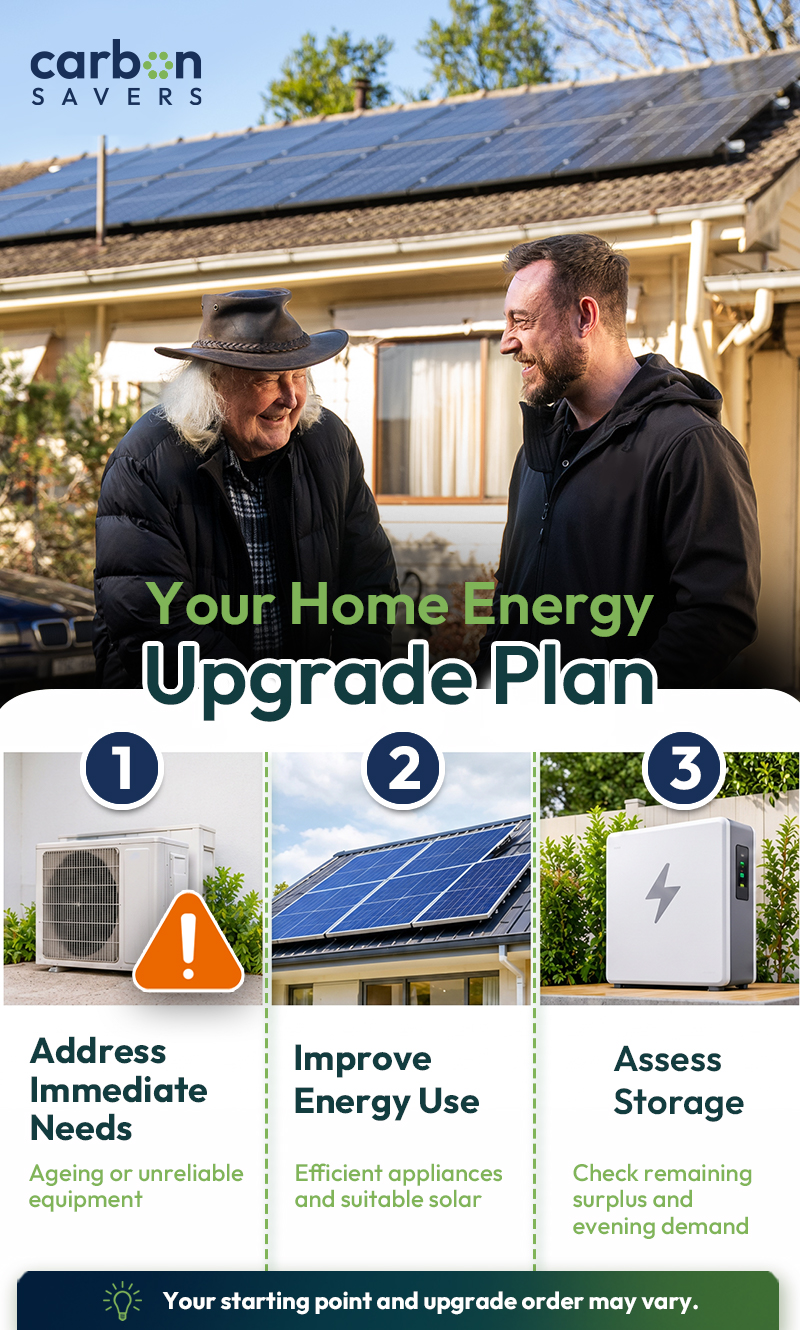
You don’t have to complete your entire home electrification journey in one project.
A staged approach can help you manage spending while making sure each installation supports the next.
Identify any appliances that are unreliable, nearing replacement or creating immediate problems.
If nothing urgently needs attention, use this stage to review your electricity bills and establish your household’s priorities.
Consider how efficient appliances and rooftop solar could fit together.
For some households, this may involve installing solar first. Others may replace hot water before adding panels.
Think about when appliances operate and whether their electricity use can be shifted into suitable daytime periods.
Once your initial upgrades are operating, look at the results.
Are you exporting substantial solar electricity? Are evening grid purchases still significant? Has your household’s energy usage changed?
Those answers can help determine whether battery storage or another improvement should be your next step.
If your longer-term goal is to move away from gas entirely, our guide Is Going All-Electric Worth It? Costs, Savings and Benefits explains the broader transition.
There’s no need to rush into a complete home energy overhaul.
Start by understanding your electricity use, checking the condition of your appliances and deciding what your household needs most.
The aim is to choose an upgrade that makes sense today without limiting your options tomorrow.
At Carbon Savers, we help Victorian homeowners explore solar panels, solar batteries and heat pump hot water systems based on their household needs.
Our team can assess suitable options, help identify applicable government incentives and arrange professional installation.
Not sure which upgrade to tackle first? Speak with us about your home energy goals and find a practical place to start.
Alex oversees the operational execution of localised energy solutions like solar & storage to drive business growth and sustainability.
Talk to an expert
Tell us a little about your home and what you’re keen on. We’ll come back with your options, and the rebates you could get. No sales pressure, no cookie-cutter systems, no jargon.
We’ll look at your home, your bills and the rebates you could get, then recommend what to do first.
$0 upfront with our repayment plan. No call-out fees. No obligation.
More answers in the FAQ hub →
If your hot water system is ageing or unreliable, replacing it may deserve priority. If your appliances work well and your roof is suitable, solar could be a sensible first upgrade.
It depends on the condition of your gas water heater, your budget and available incentives. If the system needs replacing soon, investigating an efficient electric alternative may be worthwhile.
Possibly. Compare your solar exports with evening electricity consumption and consider whether using more electricity during daylight hours could meet your needs first.
Start with essential equipment that needs replacing, then assess your bills and available rebates. Avoid purchasing additional technology without understanding how your household will use it.
Some households can access incentives for multiple eligible upgrades, including solar panels and hot water systems.
No. Solar panels, heat pump hot water and battery storage can often be installed separately. Professional advice can help ensure your first upgrade remains compatible with future improvements.
Alex Howard
Divisional Head
26 Nov 2026
Alex Howard
Divisional Head
26 Nov 2026

David Bonaddio
25 Nov 2026