- $0 upfront with our repayment plan
- No call-out fees
- 24-hour response
Blog › Who qualifies and how to claim
Batteries
Rebates
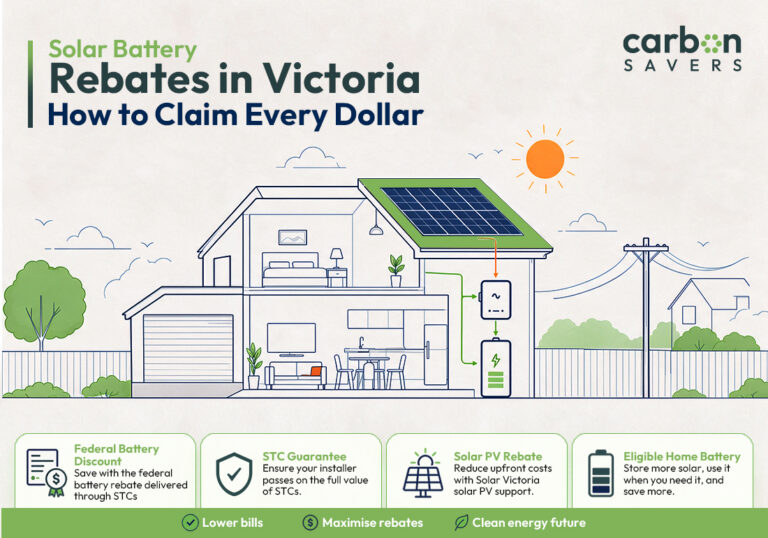
Victorian households looking to install a home battery may be eligible for the Australian Government’s Cheaper Home Batteries Program.

By Reno Damianou
Operations Manager ·
25 Nov 2026 ·
On this page
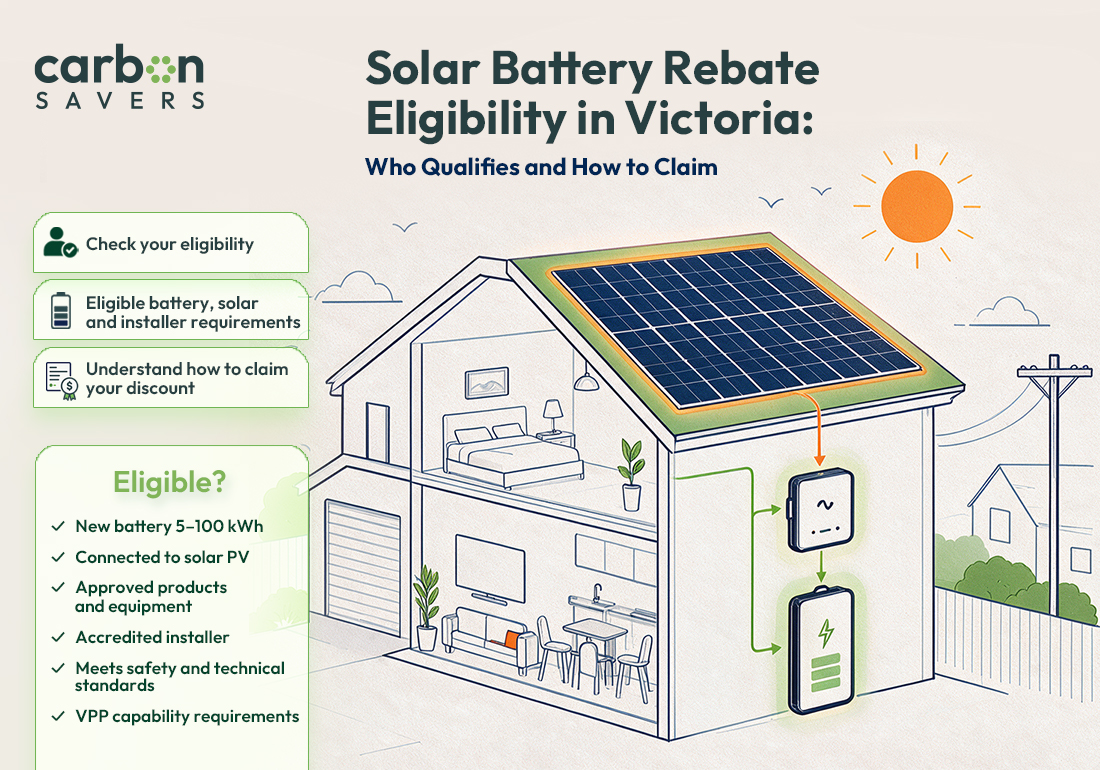
Although it is often called a “solar battery rebate”, the federal incentive is technically a discount delivered through small-scale technology certificates (STCs) under the Small-scale Renewable Energy Scheme (SRES).
The government says the program currently provides a discount of around 30% on the upfront cost of eligible battery systems, although the actual value depends on the battery’s usable capacity, the applicable STC factor and other program rules.1
You do not have to install a completely new solar system to qualify. An eligible battery can be connected to an existing solar PV system, provided the battery, inverter arrangement, installer and installation satisfy the relevant requirements.
Quick Eligibility Check
You may qualify if:
Under the rules applying from 1 May 2026, eligible systems can still have up to 100 kWh of nominal capacity, but STCs are available only for the first 50 kWh of usable battery capacity, with the level of support tapering for larger systems.2
The battery incentive available to Victorian households is part of the Australian Government’s Cheaper Home Batteries Program, administered through the Small-scale Renewable Energy Scheme.
The Clean Energy Regulator administers the program, while the Australian Government funds the discount.
For a typical grid-connected Victorian home, eligibility depends on several things: the battery itself, the solar PV system it connects to, the inverter arrangement, the installer and compliance with electrical safety requirements.
An eligible battery system must generally have a nominal capacity of at least 5 kWh and no more than 100 kWh.3
Nominal capacity is the battery’s rated storage capacity, while usable capacity is the portion available for normal charging and discharging.
From 1 May 2026, STCs can only be created for the first 50 kWh of usable capacity, even where the total eligible battery system is larger.
Yes. The battery must be installed with eligible solar PV.
The Clean Energy Regulator says an eligible battery can be installed with either a new or existing solar PV system of up to 100 kW.
A battery that is installed without the required solar PV connection and is used only to store electricity from the grid does not qualify under the standard Cheaper Home Batteries Program rules.
The good news is that there is normally no separate homeowner application to DCCEEW or the Clean Energy Regulator before accessing the standard discount. In most cases, the discount is organised through an accredited installer, retailer or registered STC agent.
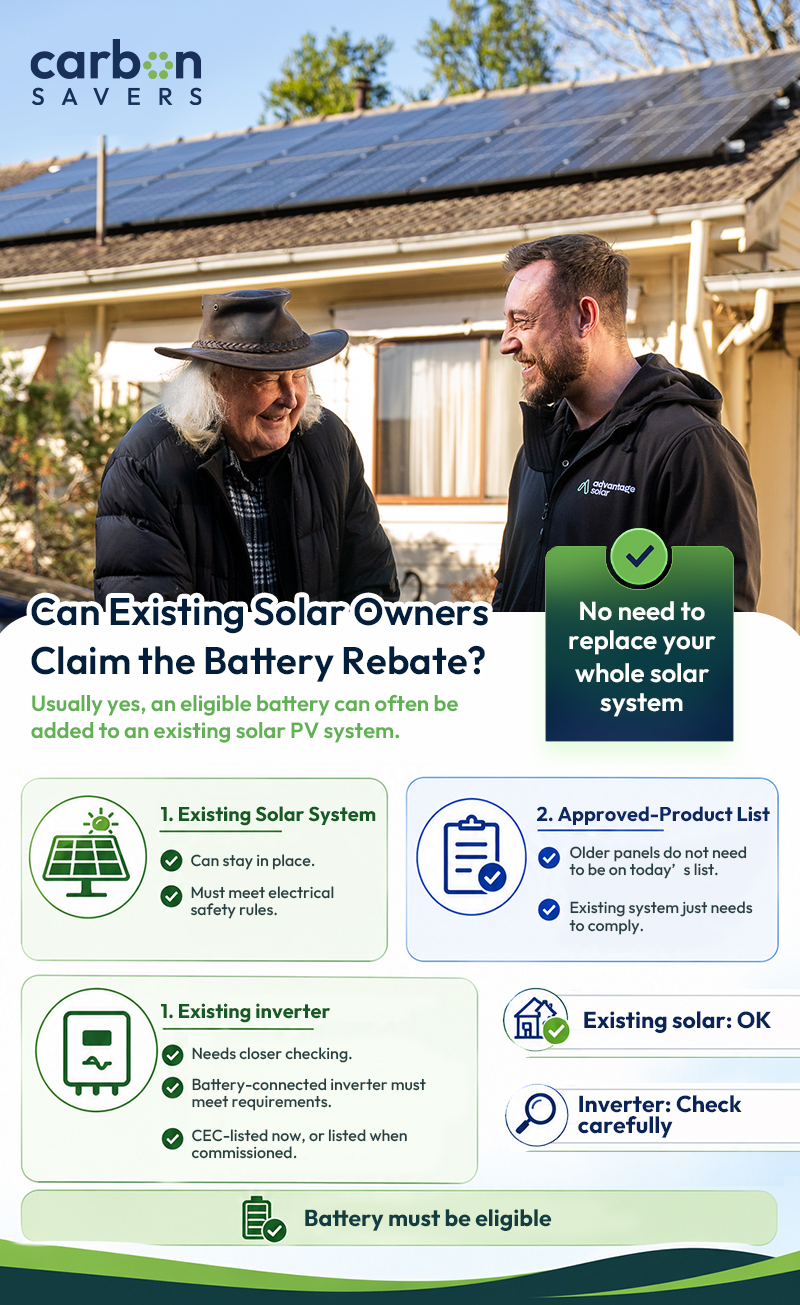
You do not need to replace your entire solar system simply because it was installed several years ago.
The federal program allows an eligible battery to be connected to an existing solar PV system, provided the installation satisfies the program and electrical safety requirements.
This is particularly useful for Victorian homeowners who already generate solar electricity but want to store more of that energy for use later in the day.
No. The Clean Energy Regulator specifically states that when a battery is added to an existing solar PV system, the existing solar PV system must comply with relevant state or territory electrical safety requirements.
However, the existing solar PV system itself does not have to appear on the current Clean Energy Council approved-product list.
That distinction can be important for older systems whose panels may no longer appear on current product lists.
The inverter needs closer attention.
The inverter that the battery connects to must meet the applicable requirements, including VPP capability where required.4
If the battery connects to an existing VPP-capable hybrid inverter, the Clean Energy Regulator says that inverter must either:
If it is no longer on the current list, it must not have been removed because it was declared ineligible or delisted for safety reasons.
Other existing solar PV inverters at the property do not automatically have to be VPP-capable simply because a battery is being added.
Yes. To qualify under the federal program, the battery installation must be undertaken by, or with the required on-site supervision of, a battery installer accredited by Solar Accreditation Australia (SAA) with the appropriate battery accreditation.
The Clean Energy Regulator also requires the installation to comply with SAA technical requirements.
For Victorian households, federal accreditation is only part of the picture. Victorian electrical safety laws also apply.
Energy Safe Victoria states that electrical work must be performed by appropriately licensed electrical workers. In Victoria, electricians performing work for customers must work for a Registered Electrical Contractor.
Battery energy storage systems are treated as prescribed electrical installation work in Victoria.
A Certificate of Electrical Safety (COES) is required, and prescribed electrical work must be inspected by an independent Licensed Electrical Inspector before it can be left energised.5
Before installation, it is sensible to ask the retailer:
No. Joining a Virtual Power Plant is not compulsory simply to receive the federal battery discount.
However, there is an important difference between VPP capability and VPP participation.
For an eligible grid-connected battery system, the battery and inverter must generally have the technical capability to participate in a Virtual Power Plant.
A VPP allows distributed batteries and other energy resources to communicate and respond to external signals so that their charging or discharging can be coordinated.
But the Australian Government explicitly states that actual participation in a VPP is not required under the program.
So:
VPP capable = generally required for eligible grid-connected systems.
Joining a VPP = your choice.
If a retailer tells you that you must join its particular VPP to receive a battery deal, ask whether that condition comes from the federal program itself or from the retailer’s own product, electricity plan, finance arrangement or promotional offer.
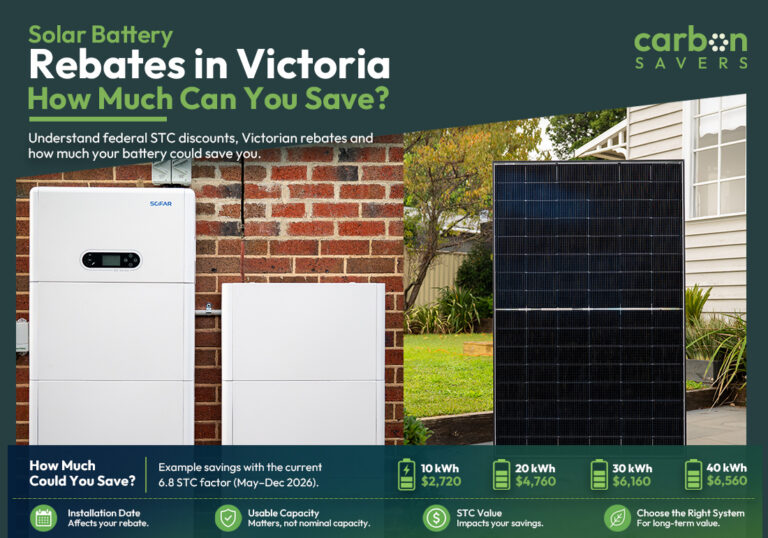
Depending on the battery system, usable capacity and applicable certificate value, the federal incentive can reduce eligible battery costs by around 30%.
Under the federal Cheaper Home Batteries Program, eligible Victorian households could receive an upfront battery discount of approximately $3,000-$6,500 for certain battery sizes, based on indicative 2026 STC calculations. Actual discounts may fall outside this range depending on battery capacity, installation date and certificate value.
The rebate is generally provided through Small-scale Technology Certificates (STCs) rather than as a cash payment from the government. In most cases, the installer or retailer calculates the eligible STC value and applies it as an upfront discount on your battery quote.
This means you normally do not have to submit a separate government rebate application yourself.
Your rebate amount may depend on factors such as:
Because rebate amounts can vary between households and battery systems, it is worth checking your eligibility and estimated discount before choosing a system.
For most homeowners, there is no complicated government rebate application to complete yourself.
The Australian Government says consumers do not need to apply directly to DCCEEW or the Clean Energy Regulator to receive the standard discount.
There are two main routes.
This is the most common approach.
You assign your right to create the STCs to a registered agent, retailer or installer. In exchange, they may provide the benefit as an upfront reduction in the purchase price or a rebate after installation.
A typical process is:
You can choose not to assign your STC rights to the retailer or installer.
Instead, an eligible system owner can create and trade STCs through the REC Registry.
However, the process involves registration, evidence and compliance requirements. The Clean Energy Regulator notes that most people assign their STC rights to a registered agent because it makes the process simpler and allows the value to be reflected in the purchase price.
STCs must be created within 12 months of the installation date.
STC claims are supported by installation, system and compliance information.
Registered agents and installers have responsibilities for collecting and submitting the required evidence.
For battery installations, the Clean Energy Regulator also requires photographic evidence.
Installers must take geotagged and time-stamped photographs at key stages of the installation, including job setup, mid-installation and testing and commissioning. There are also photo requirements covering battery and inverter serial numbers.
From 1 March 2026, additional geotagged and time-stamped photographs of critical battery labelling and signage are required.
Failure to provide the required evidence can cause an STC claim to fail.
For a Victorian installation, you should also retain your contract, invoice, warranty documents, system information and Certificate of Electrical Safety.
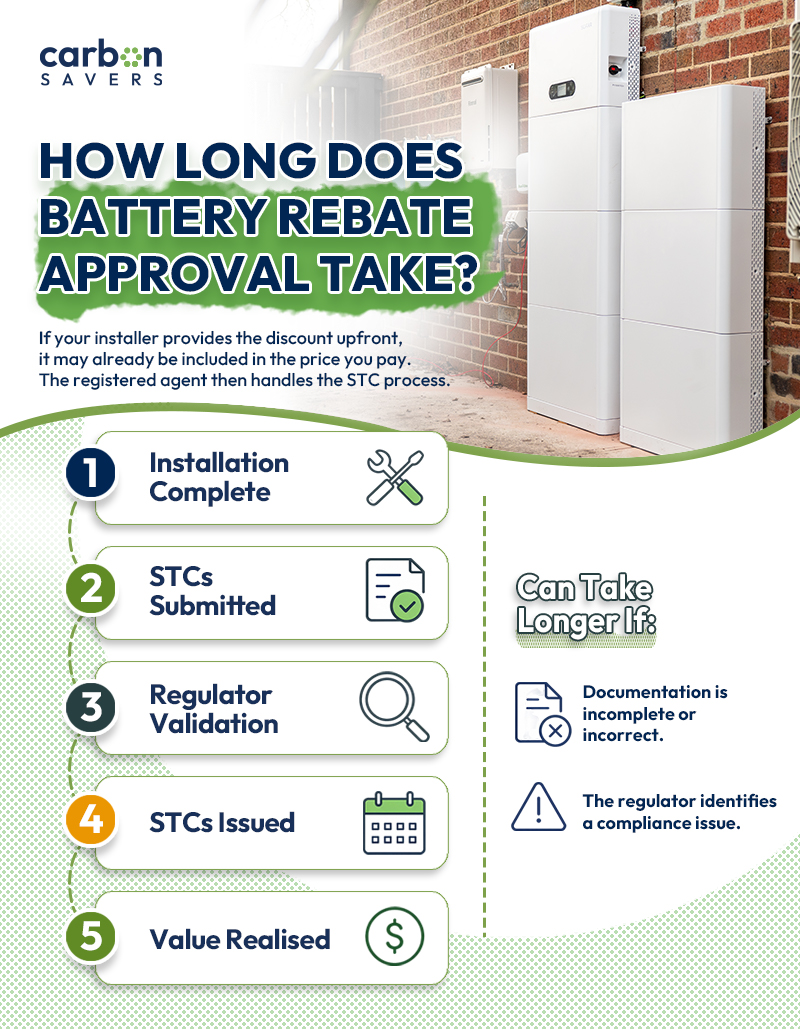
There is no single government “battery rebate approval” timeframe for an ordinary homeowner because, in the usual process, the homeowner does not submit a separate rebate application before installation.
If your installer or retailer provides the discount upfront, the financial benefit may already be included in the price you pay. The registered agent then handles the STC process.
Once STCs are submitted, the Clean Energy Regulator says validation will usually take 4 to 6 weeks.6
It can take longer when:
If you choose to create the STCs yourself, there is another timing consideration. A system owner needs an appropriate REC Registry account, and the Clean Energy Regulator says its verification checks can take six weeks or longer.7
This is separate from installation scheduling, Victorian electrical inspection requirements or electricity-distributor requirements that may apply to your particular system.
Many problems can be avoided by checking eligibility before installation.
The Clean Energy Regulator says an STC claim may fail where information is incorrect, invalid or duplicated, required documents are incomplete, the system is not eligible or the installation does not meet applicable installer requirements.
Common problems can therefore include:
There is another particularly important rule for homeowners considering future battery expansion.
The Clean Energy Regulator states that only one solar battery system is eligible for STCs per premises after an eligible claim has been made. For grid-connected installations, this generally means one eligible battery system per NMI or commercial sub-meter.
There are specific rules for batteries that existed before the program commenced, but you should not assume you will be able to claim another round of STCs simply by adding another battery later.
That makes choosing the right battery size at the beginning especially important.
Not sure which battery suits your home? We’ll compare them for you.
If you already have solar or are planning a new system, you may be eligible for valuable battery savings as long as your battery, installer and installation meet the program requirements.
Checking eligibility before you commit can help you avoid delays and unexpected costs. Check your eligibility for solar batteries in Victoria and see what options are available for your home.
Talk to an expert
Tell us a little about your home and what you’re keen on. We’ll come back with your options, and the rebates you could get. No sales pressure, no cookie-cutter systems, no jargon.
We’ll match a battery to your home, your solar and your energy use, and check the rebates you could get.
$0 upfront with our repayment plan. No call-out fees. No obligation.

David Bonaddio
25 Nov 2026
Reno Damianou
Operations Manager
25 Nov 2026
Reno Damianou
Operations Manager
25 Nov 2026