- $0 upfront with our repayment plan
- No call-out fees
- 24-hour response
Blog › How to claim every dollar
Batteries
Rebates
Victorian homeowners can currently access the Australian Government’s Cheaper Home Batteries Program, which reduces the cost of eligible solar-connected batteries through Small-scale Technology Certificates (STCs).1

By Reno Damianou
Operations Manager ·
25 Nov 2026 ·
On this page
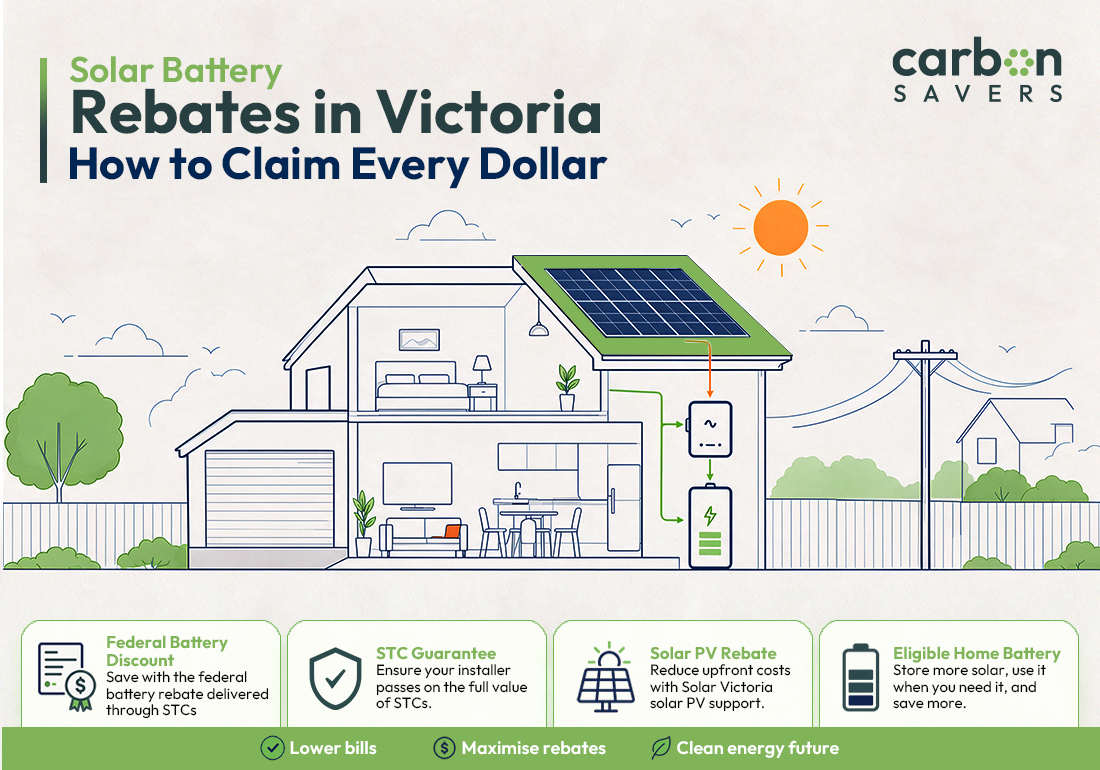
Solar Victoria’s dedicated battery loan is closed, but eligible households may still qualify for a solar panel rebate of up to $1,400 and a matching interest-free solar PV loan.2
The key is understanding which incentives apply to your project, how much they may reduce the installed cost and whether solar plus battery makes financial sense for your home.
2026 rebate snapshot
Victorian homeowners need to distinguish between federal battery support and Victorian solar support. They are separate programs with different eligibility rules.
| Incentive | Status | Applies to | Key point |
|---|---|---|---|
| Cheaper Home Batteries Program | Active | Eligible batteries | Delivered through STCs and worth around 30% |
| Solar Victoria solar panel rebate | Active | Solar PV | Up to $1,400 |
| Solar Victoria interest-free PV loan | Active | Solar PV | Up to approved rebate value |
| Solar Victoria battery loan | Closed | Batteries | No new applications |
The federal program operates through the Small-scale Renewable Energy Scheme. Eligible batteries generate STCs, which are usually assigned to the retailer in exchange for an upfront discount.
The Australian Government says the program is designed to reduce the upfront cost of eligible batteries by around 30% across a range of common battery sizes, although the actual dollar discount varies with battery capacity, STC value and the way the retailer structures the transaction.
Eligible Victorian households can receive a rebate of up to $1,400 towards an eligible solar PV installation. The rebate can cover up to 50% of the purchase price, subject to the program maximum and eligibility rules.3
Solar Victoria also offers an interest-free solar PV loan of up to the value of the approved rebate.
Solar Victoria is no longer accepting new applications for its interest-free battery loan.4
That means homeowners researching a battery in 2026 should generally look to the federal Cheaper Home Batteries Program, not older articles referring to a current Victorian battery rebate or battery loan.
The federal incentive is not a fixed cash rebate paid directly into your bank account.
Instead, an eligible battery creates Small-scale Technology Certificates. Most homeowners assign those STCs to their installer, retailer or registered agent, which then applies their value as a discount to the system price.
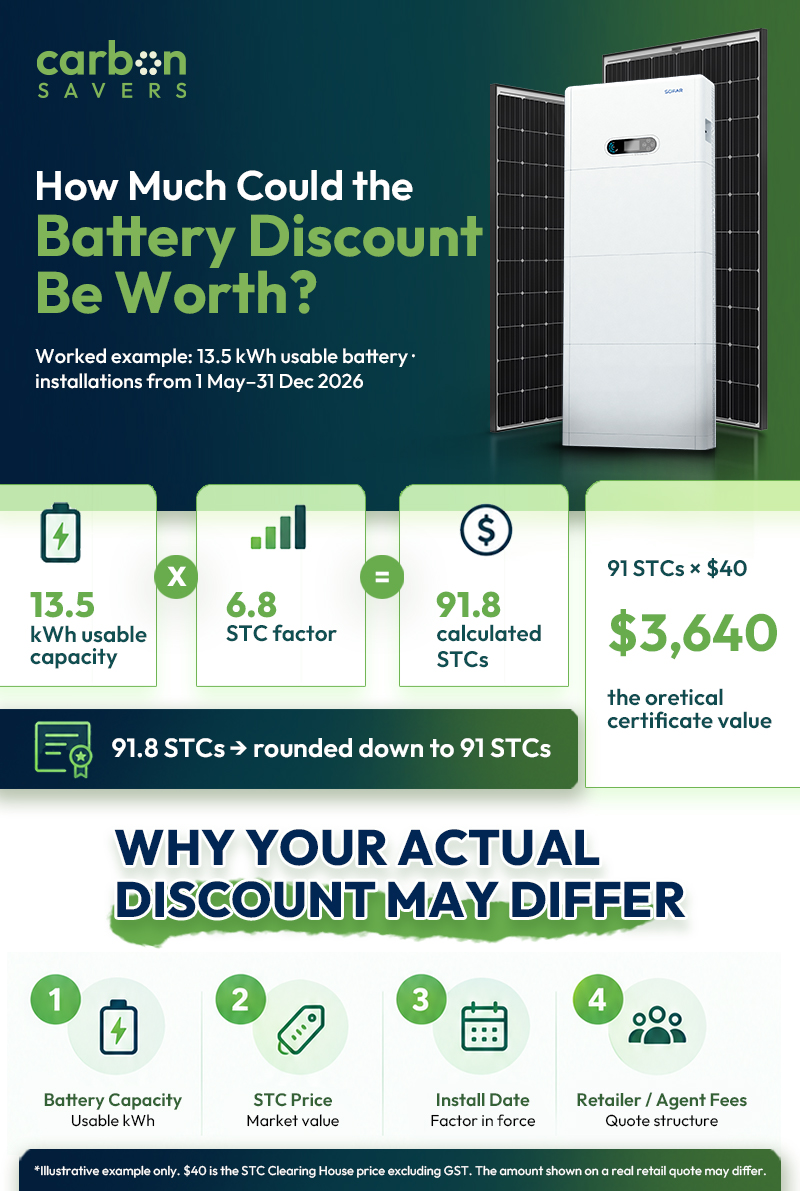
For installations from 1 May to 31 December 2026, the base STC factor is 6.8.5
The STC factor is determined by when the battery is installed, so the final discount may change if installation takes place after a scheduled program adjustment.
Support then tapers as battery size increases:
| Usable battery capacity | Support level |
|---|---|
| First 14 kWh | 100% |
| Above 14-28 kWh | 60% |
| Above 28-50 kWh | 15% |
| Above 50 kWh | No additional battery STCs |
This means a larger battery can receive a larger total discount, but the incentive does not keep increasing at the same rate.
These terms are often confused when comparing battery quotes.
The federal program generally covers batteries between 5 and 100 kWh nominal capacity, but STCs apply only to the first 50 kWh of eligible usable capacity.6
There is no single fixed dollar rebate for Victorian batteries.
The value depends on:
The STC Clearing House price is $40 per certificate, excluding GST, although STCs can also trade at different prices on the open market.7
For a 13.5 kWh usable battery installed while the factor is 6.8:
13.5 × 6.8 = 91.8 STCs
The result is rounded down to 91 STCs.
At $40 per STC, that represents a theoretical Clearing House certificate value of:
91 × $40 = $3,640
That is useful for understanding the scale of the incentive, but it should not be treated as a guaranteed retail discount. The amount appearing on a real quote may differ.
Potentially, yes. A homeowner installing a new solar and battery system may access:
Each program has its own eligibility and calculation rules.
| Project | Solar STCs | Battery STCs | Solar Victoria PV rebate | Solar Victoria interest-free PV loan |
|---|---|---|---|---|
| New solar only | Potentially | No | Potentially | Potentially |
| Battery added to existing solar | Already applied previously | Potentially | Generally not relevant | Not for a battery-only installation |
| New solar + battery | Potentially | Potentially | Potentially | Potentially |
The Solar Victoria rebate is calculated after other relevant solar PV discounts, including STCs.
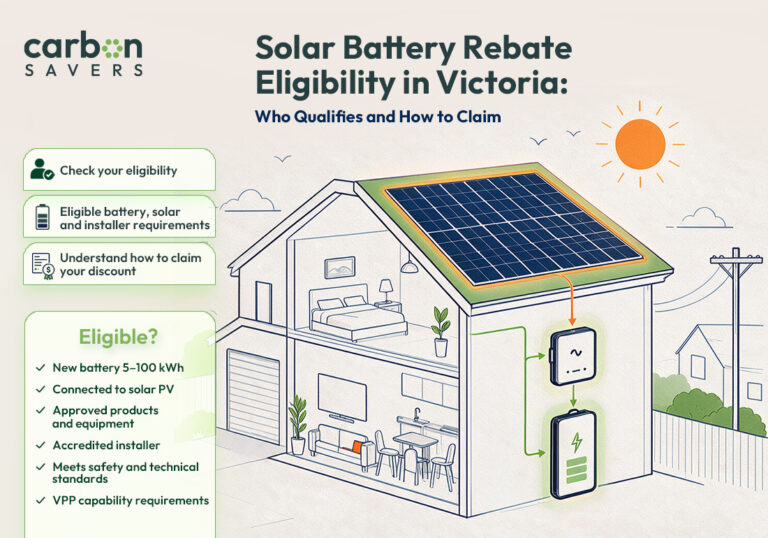
At a high level, an eligible battery generally needs to be:8
You do not generally have to join a Virtual Power Plant simply because the battery is technically capable of participating in one.
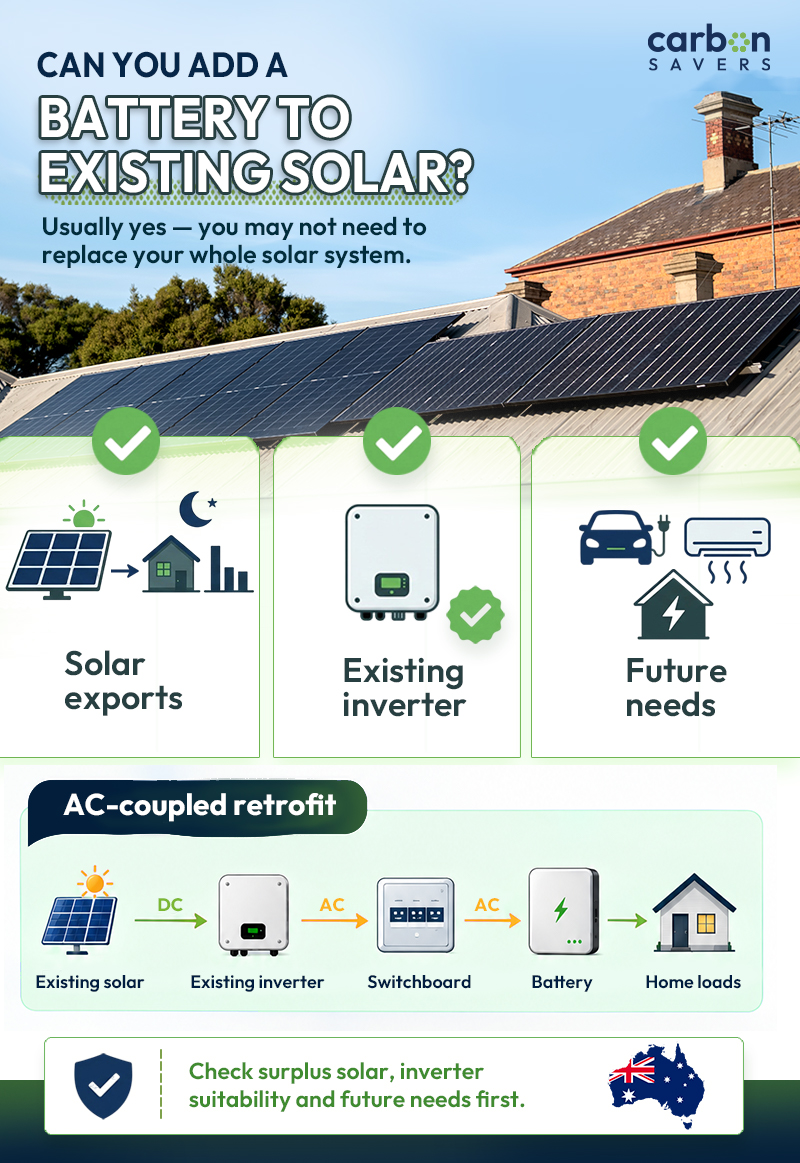
Yes. You do not need to replace your entire solar system simply to qualify for the federal battery incentive.
Eligible batteries can be connected to new or existing solar PV systems.
The bigger question is whether your existing solar system is well suited to a battery.
A battery works best when there is enough surplus solar available to charge it.
If your household already consumes most of its solar generation during the day, a very large battery may remain partly empty for much of the year.
Useful information to review includes:
Battery compatibility depends partly on the existing inverter and system design.
An older inverter may still work in some configurations, while other homes may require inverter upgrades or a different battery design.
The Australian Government notes that AC-coupled batteries are commonly used when adding storage to an existing solar installation.9
Practical rule: Do not replace an existing solar system automatically. First assess whether it produces enough surplus energy, whether the inverter is suitable and whether the system can support your future electricity needs.
For many Victorian households, rooftop solar is the first investment worth considering. Adding a battery can increase savings by allowing you to store excess solar electricity for use later, but it doesn’t automatically deliver better financial returns.
The federal battery discount helps reduce the upfront cost, although whether a battery pays for itself depends on your household’s electricity use, tariffs and system size.
Without a battery, surplus solar electricity is usually exported to the grid. With a battery, some of that energy can be stored and used later, reducing the electricity you need to buy during the evening or other high-use periods.
The financial benefit depends largely on the difference between your electricity import rate and the feed-in tariff you receive for exported solar.
For example, if you pay 30 cents per kWh for grid electricity but receive only 5 cents per kWh for exported solar, storing that electricity for later use could provide an additional benefit of around 25 cents per kWh, before accounting for battery energy losses.
Since 1 July 2025, Victoria has no longer had a regulated minimum solar feed-in tariff. Retailers set their own rates, so battery savings should be calculated using your actual electricity plan.
For households on time-of-use tariffs, batteries may offer additional value by reducing grid purchases during expensive peak periods.
According to Australian Government estimates, households installing a new solar and battery system could save up to $2,300 a year, equivalent to as much as 90% of a typical family electricity bill.10
However, actual savings depend on electricity use, system size, tariffs and installation costs.
| Consideration | Solar Only | Solar + Battery |
|---|---|---|
| Upfront cost | Lower | Higher |
| Daytime bill reduction | Strong | Strong |
| Evening solar use | Limited | Higher |
| Federal battery incentive | No | Potentially |
| Blackout backup | Usually no | Possible if designed |
| System complexity | Lower | Higher |
| Typical payback | Faster | Often longer |
Solar alone may make more sense if:
Solar plus a battery may make more sense if:
A simple way to estimate payback is:
Net installed cost ÷ estimated annual savings = simple payback period
However, annual savings should account for electricity tariffs, solar generation, household consumption, battery efficiency and expected usage patterns.
The Australian Government’s SunSPOT calculator can help estimate system costs, potential savings and payback.11
Ultimately, the best choice isn’t necessarily the system offering the largest rebate. It’s the one that provides the right balance of upfront cost, long-term savings and practical benefits for your household.
Two battery quotes can have similar final prices while offering very different systems.
Check:
The Australian Government recommends comparing system quality and projected benefits rather than focusing only on upfront price.
Installation quality also matters. The Clean Energy Regulator has increased inspections of battery installations as program uptake has grown.12
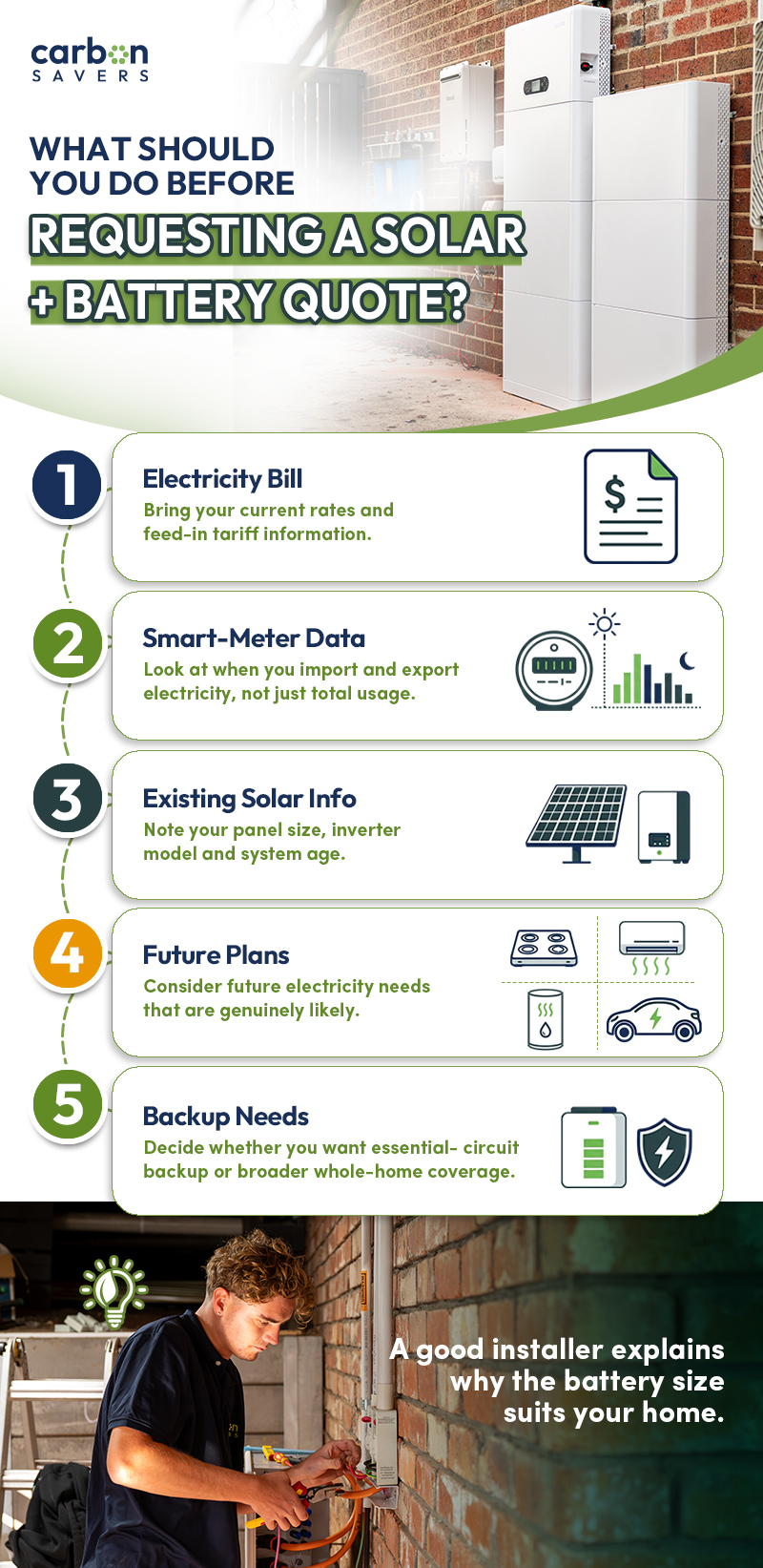
Before asking an installer to size a system, gather:
1. A recent electricity bill
Check your import rate and feed-in tariff.
2. Smart-meter or interval data
This shows when you import and export electricity.
3. Existing solar information
Note your panel capacity, inverter model and system age.
4. Future electricity plans
EV charging, heat-pump hot water, induction cooking and electric heating can all change the right system size.
5. Backup requirements
Decide whether you want selected essential circuits or broader blackout coverage.
A good installer should be able to explain why a particular battery size suits your household, not simply tell you which product receives the biggest discount.
Not sure which battery suits your home? We’ll compare them for you.
Victoria’s solar and battery incentives can make the upfront cost of going solar or adding storage significantly more manageable. But the size of the rebate should not be the only factor driving your decision.
The best solar and battery setup is one that matches how your household actually uses electricity.
For some Victorian households, solar panels alone may offer the better starting point.
For others, particularly homes that export significant surplus solar during the day and buy electricity back from the grid at night, adding a battery may help increase solar self-consumption and reduce reliance on grid electricity.
If you are considering solar, upgrading an existing system or adding a home battery, check your eligibility and explore your solar and battery options.
Talk to an expert
Tell us a little about your home and what you’re keen on. We’ll come back with your options, and the rebates you could get. No sales pressure, no cookie-cutter systems, no jargon.
We’ll match a battery to your home, your solar and your energy use, and check the rebates you could get.
$0 upfront with our repayment plan. No call-out fees. No obligation.
More answers in the FAQ hub →
Yes. Eligible Victorian households can access the federal Cheaper Home Batteries Program, delivered through STCs.
No. Solar Victoria’s dedicated battery support is no longer open to new applicants.
For eligible systems installed from 1 May to 31 December 2026, the published base factor is 6.8.
Yes. Eligible batteries can be added to existing solar PV systems.
Yes. An eligible battery needs to be connected to qualifying new or existing solar PV.
Yes. A battery can be installed with new solar or added to an existing eligible solar system.
Eligible systems generally need a nominal capacity between 5 and 100 kWh, with STCs applying to the first 50 kWh of eligible usable capacity.
kWh measures stored energy. kW measures how much power the battery can deliver at one time.
No. A battery may need to be technically capable of VPP participation, but actual participation is not generally compulsory.
Only if the system is specifically designed for backup operation. Some batteries back up selected circuits rather than the whole property.
It can be, but the result depends on your installed cost, solar exports, evening electricity use, electricity tariffs and battery utilisation.
Not necessarily. Oversizing can reduce the financial benefit if your solar system cannot regularly charge the battery or your household cannot make effective use of the stored energy.

David Bonaddio
25 Nov 2026
Reno Damianou
Operations Manager
25 Nov 2026
Reno Damianou
Operations Manager
25 Nov 2026