
by
The right solar battery size is based on how much electricity you need to store and use later, not simply the size of your house or the number of people living in it.
You also need enough battery power measured in kW to run the loads you expect it to handle.
For Victorian homes, that means looking at your solar surplus, evening and overnight consumption, future electrical loads and whether backup power matters.
Solar Victoria specifically recommends considering your solar system size, typical overnight energy use and backup requirements when sizing a battery.1
This guide explains those decisions without burying you in datasheet jargon: how to estimate useful capacity, what kW and kWh really mean, when AC or DC coupling makes sense, what LFP and NMC chemistry changes, and which specifications deserve your attention.
Let’s dive in!
Australian Government guidance says household batteries commonly have capacities of roughly 4 kWh to 14 kWh.2
That range is useful context, but it is not a sizing recommendation that fits every home for your home. A salesperson cannot determine your ideal battery from “three-bedroom house” or “family of four” alone.
For many solar homes, the important number is not total daily energy consumption. It is how much electricity you need after solar production falls away, particularly through the evening and overnight period.
If your household regularly uses 8 kWh after solar generation has finished, that tells us much more about useful battery capacity than knowing the home consumes 20 kWh across the entire day.
Solar Victoria similarly recommends looking at typical overnight consumption when choosing battery size.3
Solar batteries can typically hold the charge for hours to several days. A larger battery can even last for 7 days depending on your household’s energy consumption.
A large battery is of limited use if your solar system rarely produces enough excess electricity to charge it.
The Australian Government notes that a battery stores electricity left over after household consumption, so without enough excess generation, there may be little energy available to store.4
Moreover, look at actual solar exports across different seasons rather than assuming every sunny-day kilowatt-hour will be available.
Your last electricity bill describes the past. Your battery may be operating for years.
Consider major changes such as adding an EV, switching from gas to a heat-pump hot-water system, increasing your solar array or electrifying more of the home.
Solar Victoria specifically recommends allowing for future changes in electricity use and solar capacity when planning storage.
Well, there is no trustworthy “one-size-fits-most” answer.
However, the Australian government currently states that typical household batteries are around 4-14 kWh.5
It also notes that usable capacity is slightly lower (5% to 10%) than the battery’s rated capacity because lithium-ion batteries generally shouldn’t be completely discharged.
So, a useful starting point is to compare the energy you want to shift into the evening with the solar energy available to refill the battery.
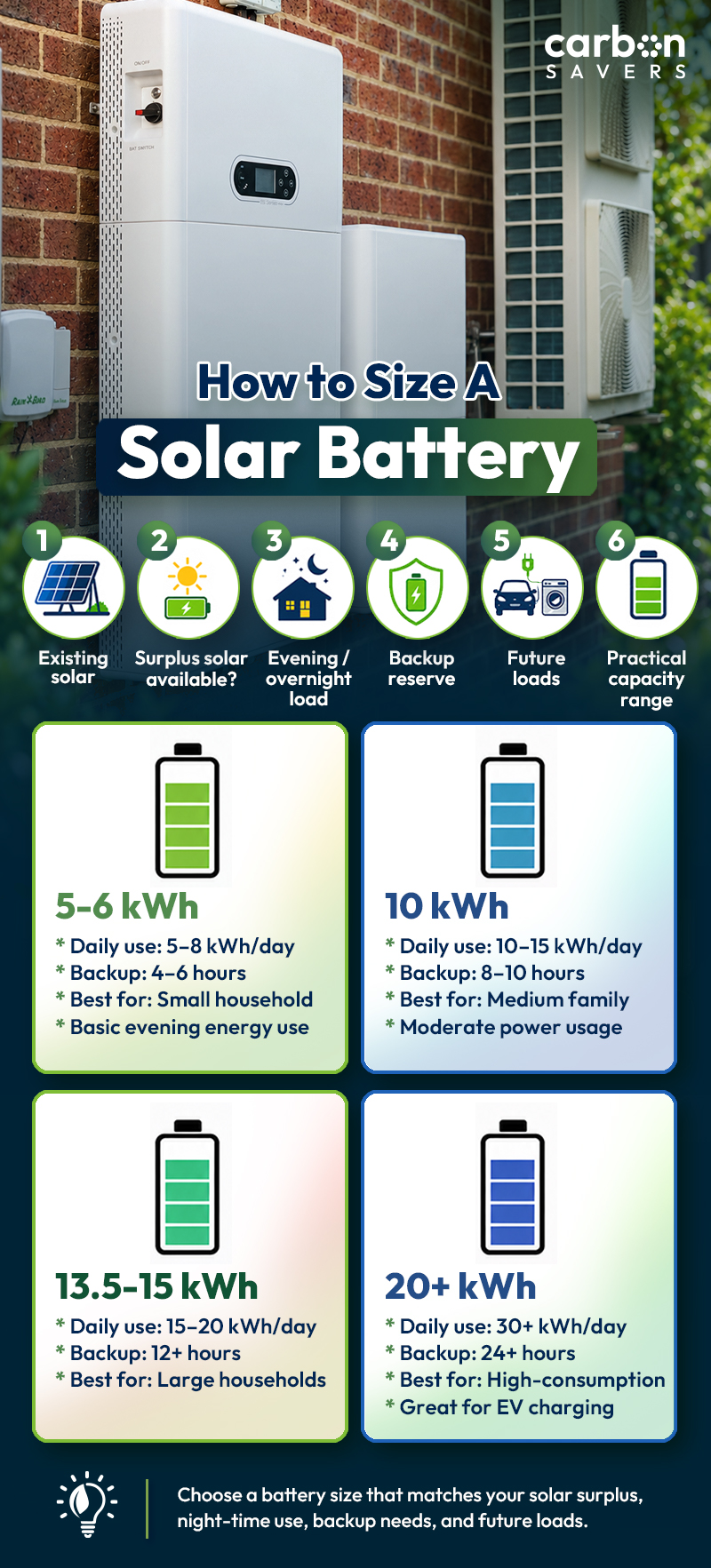
| Battery Capacity | Daily Energy Usage | Backup Time | Household Types |
|---|---|---|---|
|
5 to 6 kWh |
5-8 kWh/day |
4-6 hours |
Small household with Basic evening energy use |
|
10kWh |
10-15 kWh/day |
8-10 hours |
Medium family with moderate power usage |
|
13.5 to 15 kWh |
15-20 kWh/day |
12+ hours |
Large households |
|
20kWh or more |
30+ kWh/day |
24+ hours |
High-consumption homes and EV charging |
Why total daily electricity use can mislead you
Imagine a home uses 22 kWh a day, but 14 kWh is consumed while the panels are producing.
Sizing the battery around the full 22 kWh ignores the fact that much of that electricity can come directly from solar without ever entering the battery.
The battery mainly needs to cover evening and overnight usage, plus any backup reserve you want.
Usable capacity vs nominal capacity
Battery datasheets can show both nominal capacity and usable capacity.
Nominal capacity is the battery’s total energy-storage capacity when fully charged. Usable capacity is the portion available for normal discharge.
As mentioned earlier, it’s worth noting that for lithium-ion household batteries, usable capacity is typically around 5-10% below total capacity.
The fact is, when you are comparing what a battery can actually do in your house, usable kWh is usually the more useful number.
Consider this deliberately simplified example for better understanding:
| Household energy profile | Illustrative amount |
|---|---|
|
Daily electricity use |
20 kWh |
|
Electricity used while solar is producing |
11 kWh |
|
Evening/overnight use |
9 kWh |
|
Typical surplus solar available |
10 kWh |
|
Energy targeted for battery supply |
About 9 kWh |
So, a battery with roughly 9 kWh of usable capacity is therefore a much more logical starting point than automatically buying 20 kWh because the home consumes 20 kWh per day.
That is not a recommendation that a 9 kWh battery suits every household with the same daily consumption. Wondering why?
Because seasonal solar generation, tariffs, backup reserves, charge and discharge limits and future loads still matter.
Why bigger isn’t automatically better?
Solar Victoria advises choosing battery capacity that can be regularly charged and meaningfully used, rather than simply maximising battery size.
Also, consider whether the extra storage will actually save you enough money to justify its higher cost.
For pricing, incentives and payback details, check out How to Choose the Right Solar Battery Without the Sales Spin
The easiest way to understand battery specifications is:
A 10 kWh usable battery contains 10 kWh of usable stored energy when full.
In a simplified example, a constant 2 kW load would mathematically consume 10 kWh in five hours.
Real systems will differ because appliances cycle on and off, battery reserves may be maintained, and conversion losses occur.
Some batteries typically lose around 10% of stored energy through charging and discharging.
Suppose a battery stores plenty of energy but has a rated power output of 5 kW.
If your home suddenly requires 7 kW while the grid is available, the battery cannot meet the whole load by itself; the balance may need to come from the grid.
Government guidance confirms that battery power output limits the number and size of appliances it can supply simultaneously.
That makes kW particularly important for homes with large simultaneous loads.
Instead of comparing every line on two datasheets, here are some solar battery specifications and what they change for you :
Note: Specifications can vary significantly between models and brands, so use these figures as benchmarks rather than fixed requirements.
Most current household batteries are lithium-ion.
Within that category, Solar Victoria identifies lithium iron phosphate (LFP or LiFePO₄) and lithium nickel manganese cobalt oxide (NMC) as two important types for residential battery chemistries.
| Lithium iron phosphate (LFP) | Nickel manganese cobalt (NMC) |
|---|---|
|
Slightly larger: Takes up more physical space for the same storage capacity. |
Higher energy density: Stores more energy in a smaller physical footprint.
|
|
Safer thermally: Generally considered to have better thermal stability than NMC. |
Thermal management matters: Proper thermal management is important when using NMC batteries. |
|
Installation matters: Consider battery chemistry alongside the overall system and installation location. |
Space-efficient: Useful where installation space is limited. |
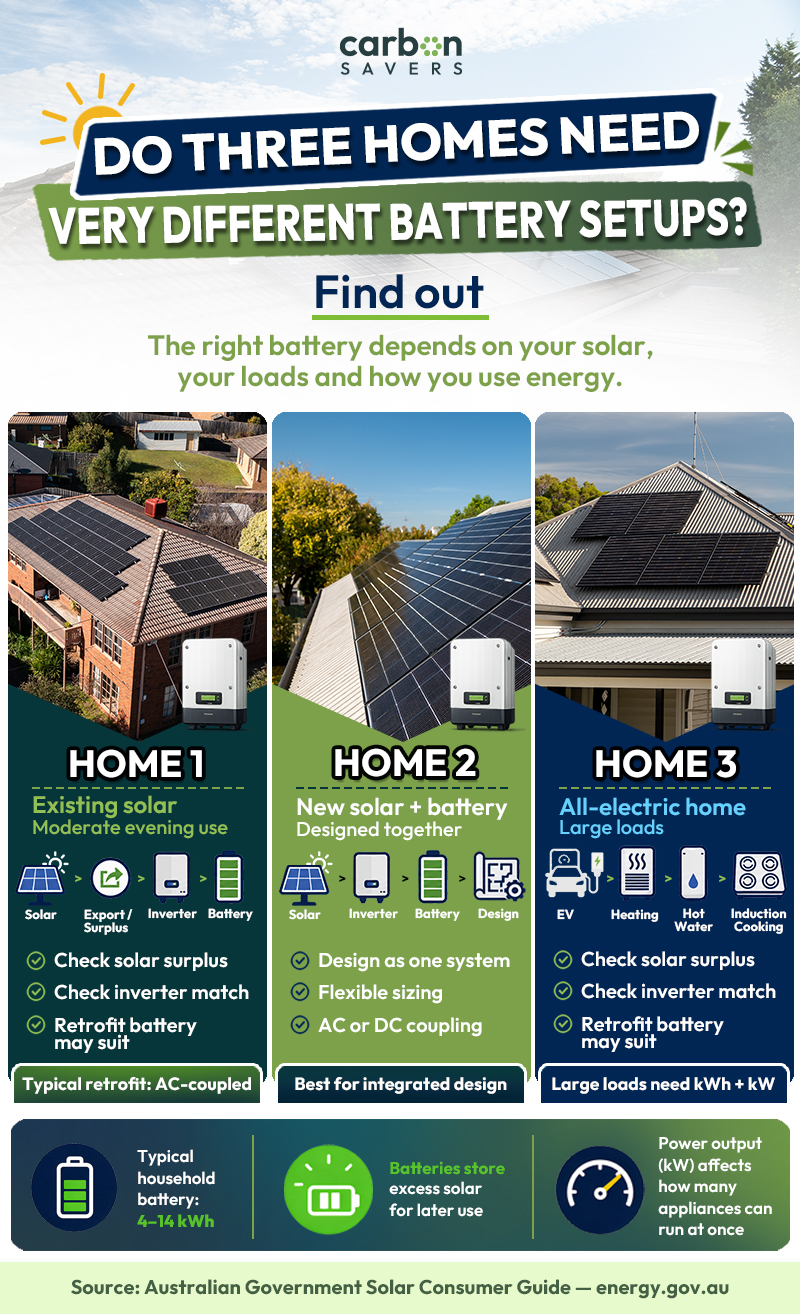
If your current panels regularly export enough solar to cover a substantial evening load, a retrofit battery may be relatively straightforward.
The solar installer still needs to check your existing inverter and usable solar surplus before deciding capacity or coupling.
Starting from scratch gives the designer more freedom and flexibility to coordinate the solar array, inverter and battery. Either AC or DC coupling may be appropriate.
A home with EV charging, electric cooking, hot water and heating can have very different load patterns from a lightly electrified home.
In this case, focusing only on battery kWh risks missing the importance of kW output and simultaneous loads.
Battery shopping becomes much easier when you stop asking “Which battery is best?” and first answer three questions:
How many usable kWh do I need? How many kW do I need at once? How should the battery connect to my existing or planned solar system?
Once those are clear, chemistry and the remaining specifications become filters rather than distractions.
For a Victorian household, the strongest solar battery recommendation should therefore start with actual consumption and solar data, then check the home’s existing electrical equipment and future needs.
Only after that does it make sense to compare products.
Need help with your eligibility? Get in touch with a trusted installer to explore your options and make the most of the rebate while it’s available.
Australian Government guidance says household batteries commonly fall around 4-14 kWh, but the right size depends on solar surplus, evening use, backup needs, and future loads.
It can be, but “10 kWh” by itself tells you very little about suitability. Compare the usable capacity with how much electricity you actually want to shift into evenings or outages.
Not directly. Solar Victoria recommends considering solar-system capacity alongside overnight consumption and backup needs, rather than using a fixed solar-to-battery ratio.
10 kWh describes stored energy; 10 kW describes power output. One affects how much energy is available, while the other affects how much load can be supplied at once.
Neither is automatically better. AC coupling is common for existing-system retrofits, while both AC and DC coupling are options when solar and storage are designed together.
Yes. Solar Victoria explains that a microinverter solar system can use a battery with a dedicated inverter, creating an AC-coupled arrangement.
Not in every respect. Solar Victoria describes LFP as somewhat larger but safer thermally, while NMC provides greater energy density; the best system still depends on the complete design rather than chemistry alone.
Not necessarily. Capacity determines stored energy, while power output limits how much equipment can run simultaneously; the battery and system must also be configured for backup operation.
Some modular systems allow expansion, but Solar Victoria warns that upgrade options depend on the particular system and can be more difficult in some cases. So confirm expandability before buying.
1.https://www.solar.vic.gov.au/solar-battery-buyers-guide/section-6-planning-your-solar-battery-system
2.https://www.energy.gov.au/solar/get-know-solar-technology/batteries
3.https://www.solar.vic.gov.au/solar-battery-buyers-guide/section-6-planning-your-solar-battery-system
4.https://www.energy.gov.au/solar/get-know-solar-technology/batteries
5.https://www.energy.gov.au/solar/get-know-solar-technology/batteries