
by
The best solar battery brand isn’t automatically the most expensive or the cheapest.
For a Victorian homeowner, the better choice is the battery that combines reliable performance, a meaningful warranty, compatible equipment and support you can actually access if something goes wrong.
That matters because two batteries with similar storage capacity can offer very different long-term value.
A 10-year warranty may include a capacity guarantee, usage limit or throughput condition
In contrast, another may offer different conditions entirely. Software, backup capability, expandability and Australian support can also vary.
So instead of asking, “Which brand is right or cheapest?”, this guide shows you how to compare battery brands on the things that matter after installation.
Let’s get started!
Think of a solar battery as more than a big box for storing electricity.
The best one is the battery that fits how your household generates, uses, and stores energy. Before comparing brands and prices, pay attention to:
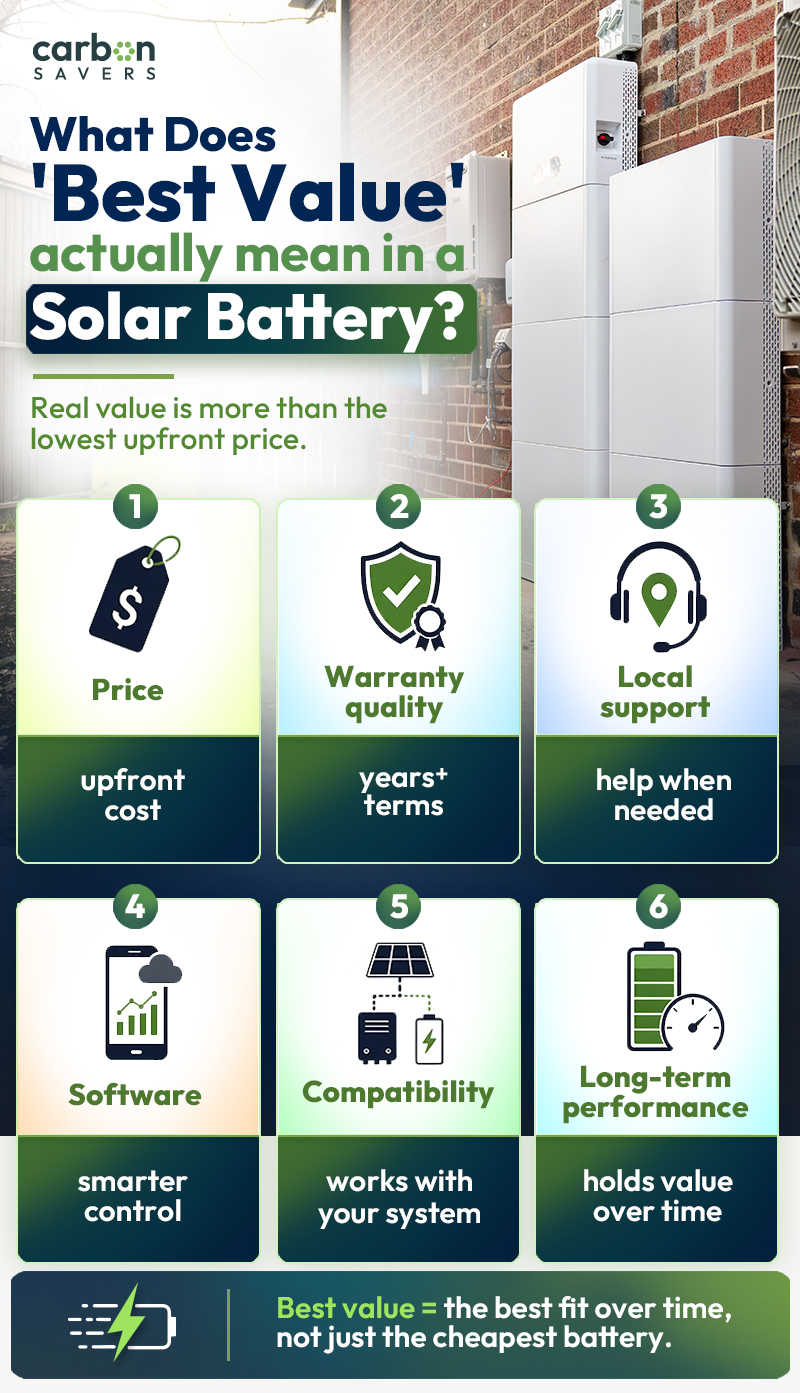
A solar battery can look impressive on paper, but the real test is how well it fits your home, your energy habits and your solar system.
With plenty of brands competing for attention in 2026, comparing what each one offers can help you separate genuine value from clever marketing.
Well, there is no fixed winner.
The important point is to compare these features against your home’s actual requirements.
Honestly, this is where brand comparisons become much more revealing.
All the products can advertise a 10-year solar battery warranty while promising different things.
Look for the capacity guarantee
Lithium batteries gradually lose storage capacity.
A useful warranty therefore tells you not just how long the warranty lasts, but what capacity should remain.
Tesla currently states at least 70% capacity retention at 10 years for Powerwall under its stated warranty conditions.1
BYD’s Australian Battery-Box warranty similarly specifies 70%, but also incorporates minimum energy-throughput limits.
Look for throughput or cycling limits
Throughput measures the total amount of energy that has passed through a battery.
This matters because a heavily cycled battery may reach a warranty limit sooner than a lightly used one. BYD, for example, publishes minimum throughput figures for each HVS/HVM configuration.2
Do not assume “10 years” always means ten years under every usage pattern.
Ask who actually handles the claim
A strong written warranty is more valuable when there is a clear pathway to use it.
| Ask: |
|---|
|
Do I contact the installer or manufacturer? |
|
Is there Australian technical support? |
|
Who diagnoses the fault? |
|
Is labour covered? |
|
Who removes and reinstalls replacement equipment? |
|
What documentation will I need? |
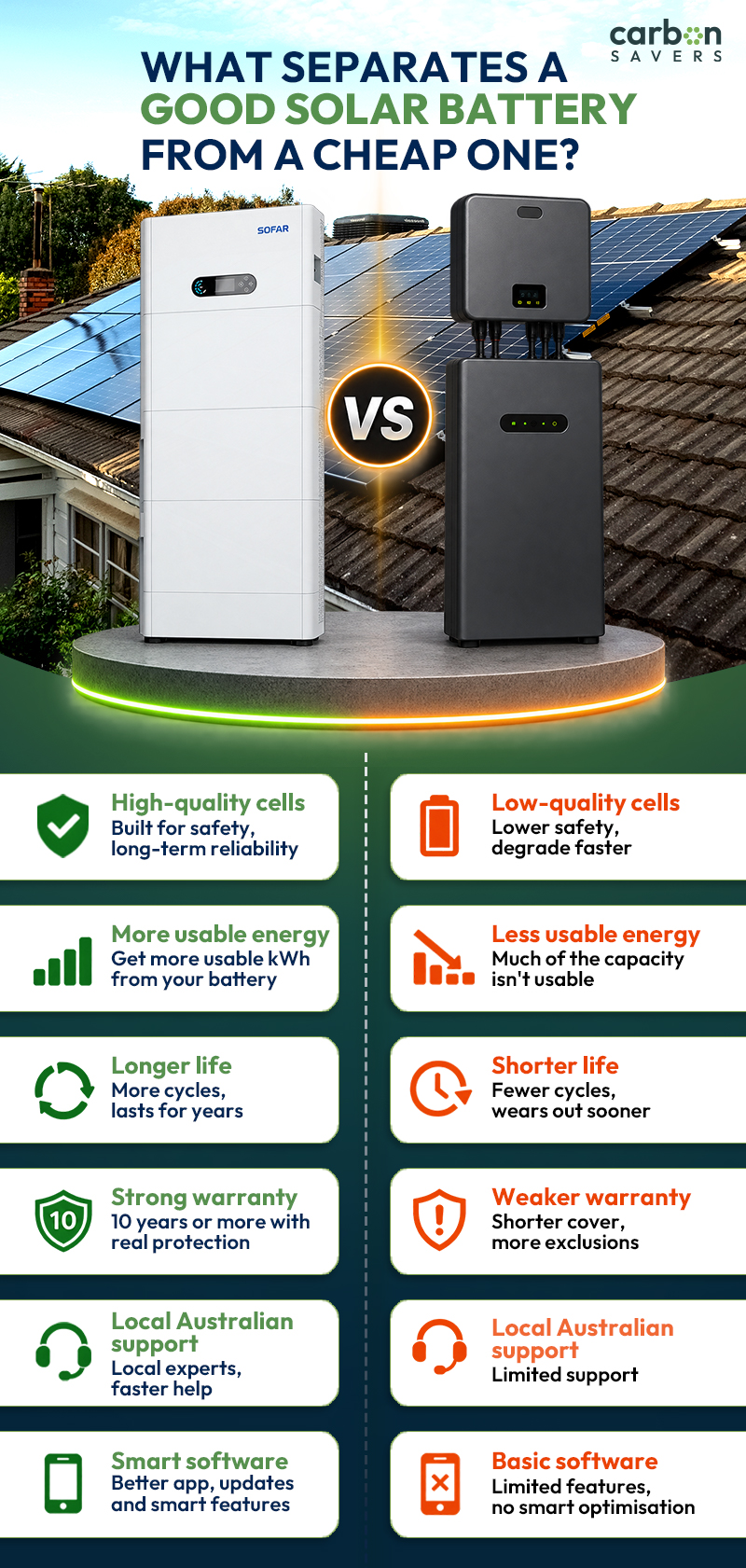
Price matters. But a suspiciously cheap battery deserves more questions, not immediate rejection or immediate excitement.
The Clean Energy Council maintains Australia’s Approved Batteries list.
It currently contains more than 1,000 lithium-based battery products that have met applicable requirements for the list.3
Always check the exact model number, not simply the manufacturer’s brand.
A good brand should make it reasonably easy to establish what is covered.
If the warranty headline says “10 years” but nobody can clearly explain the capacity guarantee, throughput restrictions or claim process, keep asking.
A battery is connected equipment expected to operate every day for years. At some point, software, communications, an inverter or another component may need attention.
That makes local technical support and an experienced installer valuable even when two products look similar on paper.
Most homeowners will interact with the battery through an app.
Useful software should make it straightforward to understand:
Sophisticated automation may be valuable for some households. For others, reliable monitoring and easy controls matter more.
An excellent battery can still be the wrong battery for your house.
If you are unsure what capacity, power output or coupling arrangement your home needs, read Battery Basics That Actually Matter: Size, Chemistry and What They Mean for You before choosing a brand.
A homeowner wanting a highly integrated battery, inverter, backup and app ecosystem may put Tesla high on the shortlist.
Someone who values modular storage, scalable options, and compatible-inverter flexibility may find SOFAR and BYD more attractive
However, none of those statements means one is universally “best”.
The better question is:
Which battery gives my home the best combination of suitable performance, warranty protection, support and installed value?
Carbon Savers’ current battery installation process starts with assessing energy requirements and the existing solar installation before selecting a battery solution, followed by installation, system setup and ongoing support.
Its broader landing pages also position tailored recommendations and accredited installation as core parts of the offer.4
So the wise step is to choose the system your home needs first, then choose the brand that delivers it well.
Yes, particularly if you value an integrated inverter, backup capability and Tesla’s software ecosystem. Powerwall 3 provides 13.5 kWh of storage and carries a 10-year warranty.
No. Read what is actually covered, including remaining capacity, throughput limits, exclusions and whether an advertised longer term requires additional conditions.
Not on price alone. The government recommends comparing like-for-like systems and considering warranty and post-purchase support alongside upfront cost.
Yes. The battery and installation are part of one working system, which distinguishes responsibilities for product faults and installation-related problems.
Search the exact model on the Clean Energy Council Approved Batteries list rather than relying only on a brand name or salesperson’s claim.
It can be one useful measure, but it misses warranty quality, power capability, included equipment, support and installation differences. Use it as one comparison point, not the decision.
1.https://www.tesla.com/en_au/learn/backup-power-and-energy-savings-for-your-family
2.https://bydbatterybox.com/uploads/downloads/BCU2.0_Warranty%20T%26CS%20BYD%20Battery-Box%20Premium%20HV%20Australia-EN%20V1.0%20-%2020250328-67ee33dc46f4e.pdf
3.https://cleanenergycouncil.org.au/industry-programs/products-program/batteries?
4.https://carbonsavers.com.au/services/solar-battery-installation/